Guidance
Wash Water Isn't Stormwater: The Two Lines Missing From Most Pressure-Washing Contracts
Florida's stormwater rules treat the storm drain in your parking lot as a regulated outfall, and wash water is not on the short list of things allowed into it. What that means for Florida commercial owners and managers, where the liability actually lands, and the two contract lines that close the gap before fall washing season.
Beachfront Commercial Services ·
This article is general information for property owners and managers, not engineering, insurance, or legal advice.
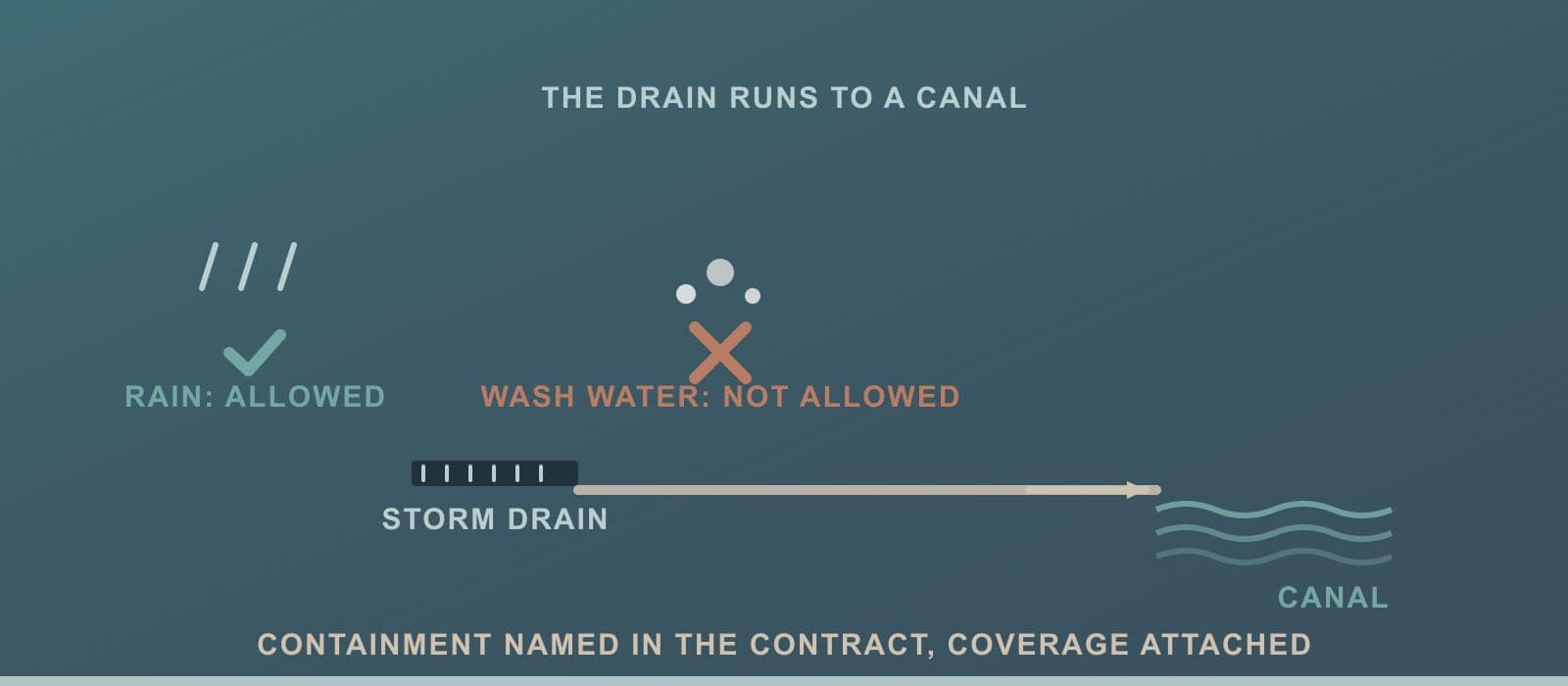
The storm drain in your parking lot is not a sewer. It is plumbing that runs, untreated, to a canal, a lake, or the Intracoastal. Florida's stormwater rules treat it accordingly: rain is allowed in, and almost nothing else is. The water that comes off your building during a pressure wash, carrying detergent, algae, paint chalk, and whatever was on the pavement, is on the wrong side of that line. When it goes down the drain anyway, the enforcement file gets opened where the drain is: your property.
Most wash contracts never mention any of this. The fix costs two lines of text and a certificate of insurance, and fall washing season is the right time to add them.
The drain in the parking lot is plumbing to a canal
Every South Florida municipality of any size operates what the regulators call an MS4, a municipal separate storm sewer system. "Separate" is the operative word: it is a network of inlets, pipes, and swales built to move rainwater away from streets and slabs, and it discharges to surface water without passing through a treatment plant.
That is why stormwater programs across the state run under the same slogan: only rain down the drain. A sanitary sewer forgives what goes into it, because a treatment plant stands at the end. A storm drain forgives nothing. Whatever enters the inlet in front of your building arrives in the receiving water in roughly the condition it left your site.
What the rules say, and what they mean for a building
The state's permit for those municipal systems is specific. Florida DEP's generic permit for Phase II MS4s authorizes the discharge of stormwater, and it lists the handful of non-stormwater flows a storm sewer may lawfully carry: water line flushing, air-conditioning condensate, landscape irrigation runoff, dechlorinated swimming pool water, water from individual residential car washing, and a few others.
Read that list twice, because the detail matters: an individual resident washing a car is on it. Commercial building washing, flatwork cleaning, and roof washing are not. In the rule's terms, wash water from your property is an illicit discharge, and the same permit obligates every covered city and county to run a program that detects and eliminates exactly those discharges. Municipal stormwater staff are not being zealous when they trace a soap line back from an inlet. They are doing what their own permit requires.
Local codes go further. Insurance and licensing guides for wash contractors report that Miami-Dade requires wash water to be collected and disposed of at approved locations, and Miami-Dade County code language has made it unlawful not just to discharge into a storm sewer, but to "cause, permit, allow or suffer" the discharge. That phrasing deserves a slow read. It reaches the party who hired the truck, not only the operator holding the wand.
Where the liability lands
Start with the fines. Brokers who insure Florida pressure-washing companies put it plainly: the EPA and Florida DEP can fine businesses tens of thousands of dollars per day for illegal discharges, even accidental ones. The same brokers cite a Florida contractor fined $20,000 for a discharge, plus $12,000 in cleanup costs. Against a wash invoice that might run a few thousand dollars for a mid-size commercial property, the penalty math is not close.
Now the part that concerns your building rather than the contractor's truck. If the discharge traces to your storm drain, your property is in the file, and your recourse against the contractor is only as good as the contractor's insurance. Here the coverage detail matters: most commercial general liability policies carry a pollution exclusion. A wash contractor holding a standard GL certificate may be uninsured for the single most likely regulatory loss in their line of work. The coverage that answers it, contractors pollution liability, exists, is commonly written at $1 million per occurrence, and costs a wash contractor roughly $300 to $2,500 per year, per the brokers and trade guides that price it.
That number is worth keeping in mind when bids arrive. A vendor who has not spent $2,000 a year to insure the water leaving your site has made a decision about who carries that risk. It is you.
What compliant washing looks like on site
None of this makes washing a problem. It makes washing a scope item, and professional crews handle it the way they handle any other one. Government best-management-practice guidance for pressure washing, and the bid sheets of contractors who do this correctly, converge on the same five mechanics:
- Dry cleanup first. Sweep or blow off loose debris, dirt, and paint chips before water touches the surface, so the wash water starts cleaner.
- Control the inlets. Storm drain covers, berms, or filter socks on every inlet in the work zone before the first trigger pull.
- Send the water somewhere legal. Directing rinse water to landscaping or another pervious area where it soaks in on site is the standard first option in BMP guidance. What no option allows is the inlet.
- Recover where it can't soak in. On large flatwork (garages, plazas, drive lanes), vacuum-recovery and reclaim rigs collect the water for filtration or approved disposal. Contractor bidding guides list water reclamation as a normal cost line, right beside chemicals and labor. It is not exotic equipment; it is what the professional end of the market carries.
- Document it. Photos of the covered inlets and the recovery setup, dated, in the job file. If a question ever comes, the answer is already written.
One nuance worth knowing: "biodegradable" on the detergent jug does not make discharge legal. The rule regulates the water, not the soap, and by the time rinse water leaves a wall it carries the algae, chalking, and grime that was the point of the wash. Biodegradable products matter for the landscaping option; they are not a license to use the drain.
Four questions that sort wash bids, and the two lines to add
You do not need to become a stormwater regulator to buy washing well. You need four questions at the walk-through and two lines in the contract.
The four questions:
- "Where does the water go on this site?" A professional answers with specifics: which inlets get covered, which landscaped areas take the rinse water, where the reclaim rig stages. Vague reassurance is a finding.
- "What's on the truck for containment?" Drain covers, berms, and recovery equipment are physical objects. Ask to see them listed in the bid.
- "Show me the insurance certificate, and does the GL policy exclude pollution?" Ask for pollution liability coverage by name.
- "Who signs the runoff plan, and where does the documentation live?" The answer should be a person and a file, not a shrug.
The two contract lines, IN WRITING, on every wash agreement:
No wash water will enter any storm drain or surface water. Containment method for this site: ______.
Contractor carries pollution liability coverage; certificate attached.
That is the whole fix. It also does for wash bids what a written scope does for repaint bids: it makes them comparable. A quote that is 30 percent cheaper and silent on containment is not a better price. It is a different job, with the difference parked on your side of the ledger. The same logic drives the pre-bid walk we laid out for comparing commercial repaint bids.
The money math
Washing is one of the cheapest things you can do to a building. Current cost guides put commercial building-exterior washing at roughly $0.15 to $0.50 per square foot, with garages and flatwork lower. Exterior repaint on the same wall runs $2.50 to $8.00 per square foot per current estimating guides. The wash protects a coating asset worth 10 to 20 times its own price, both by keeping mildew and contamination from shortening the coating's life and by being the required first step of any recoat that will hold, as we covered in the surface prep and mil-build guide.
Set the compliance numbers beside that. Proper containment might add a modest line to a wash bid. The discharge it prevents draws fines quoted in tens of thousands of dollars per day. There is no version of this decision where the cheap, uncontained wash is the economical one; the low bid simply moves the largest cost off the page.
Method matters to the same asset, by the way. Which surfaces take pressure and which need low-pressure soft washing is its own decision rule, and the wrong choice damages the coating you were protecting. The breakdown is in our soft wash versus pressure washing guide.
The calendar: wash season meets the dry-season window
Regional climate researchers put South Florida's dry season at November through April. That timing drives two things at once. First, the rainy season ending now is what loaded your walls: months of daily moisture are why algae and mildew coverage peaks in early fall. Second, the dry-season window is when coating, sealing, and repaint work books, and washing is the first operation in nearly all of it, whether that is a recoat, a paver and flatwork sealing program, or an envelope repair scope.
A building washed and documented in October enters the dry season with a clean substrate, a current photo record, and its pick of the calendar. The same building in January is negotiating for crew time with everyone else who waited. Booking the wash now, with the runoff plan in the contract, is the head start.
What a fall envelope assessment gets you
We self-perform pressure cleaning (building soft wash and flatwork) with W-2 crews, containment equipment on the truck, and the runoff plan written into every scope. The fall envelope assessment is where that starts. You walk away holding three things:
- A timestamped photo documentation file of the envelope's current condition: walls, sealant joints, flatwork, and the drainage the wash plan has to respect.
- A prioritized punch list separating what needs washing, what needs repair before any coating, and what can wait.
- A priced dry-season plan with the wash scope, containment method, and insurance documentation already in it, bid-comparable from day one.
Call 561-557-8534 or reach us through beachfrontcs.com. Assessment slots are scheduling now, ahead of the dry-season calendar.
FAQ
Is it legal to pressure wash a commercial building in Florida? Yes. Washing is legal and, for coating life and lease appeal, advisable. The regulated part is where the water goes afterward. Contained, recovered, or infiltrated on site: fine. Down a storm drain: an illicit discharge under the state's stormwater rules.
Can wash water go into landscaping? Usually yes, and government BMP guidance lists directing wash water to landscaped or pervious ground as the standard practice, provided it soaks in on site, detergents are appropriate, and it does not run off to an inlet from there. Your contractor's runoff plan should name the specific areas.
Does biodegradable soap make it legal to discharge to the drain? No. The prohibition covers the wash water itself, which carries contaminants off the surface regardless of the detergent. Biodegradable products support the landscaping option; they do not open the storm drain.
Who gets fined if a contractor discharges illegally, the contractor or the property? Enforcement can reach both. Code language in Miami-Dade County makes it unlawful to "cause, permit, allow or suffer" a prohibited discharge, and the investigation starts at the drain, which is on your property. The contractor's pollution liability coverage, or the lack of it, decides how much of that lands on you. Hence the certificate.
Does washing require a permit? Routine exterior cleaning does not generally require a permit of its own. What the rules regulate is the discharge. A contractor who manages the water correctly (containment, recovery, or on-site infiltration) is operating inside the standing rules without pulling a separate permit for a standard wash.
Ready to Protect Your Property?
Tell us about your building and a Beachfront estimator will follow up with a clear scope and fair pricing.