Pressure Cleaning
Soft Wash vs. Pressure Washing for Coastal Florida Condos: Which Protects Your Stucco, Paint, and Roof
A board-and-CAM guide to soft washing vs. high-pressure washing for Florida coastal buildings: the right PSI for stucco, painted facades, and tile/shingle roofs, the ARMA-recommended chemistry, why the wrong wash voids your paint and roof warranties, and how often to clean by coastal exposure tier.
Beachfront Commercial Services ·
Short answer: For a Florida condominium's stucco walls, painted facades, and tile or shingle roofs, the correct method is soft washing: low pressure (generally under 500 PSI, and as low as 50–150 PSI on a roof) combined with a sodium-hypochlorite biocide that kills algae and mildew at the root. High-pressure washing (roughly 2,000–4,000 PSI) belongs on hard, durable horizontal surfaces such as driveways, sidewalks, and pool decks, not on your building envelope. Using high pressure on stucco, paint, or roofing doesn't just risk cosmetic damage; it can drive water behind the wall, strip the coating your board already paid to install, and void the manufacturer warranties on your paint and your roof.
That distinction matters more on the coast than almost anywhere else in the country. The same salt air, humidity, and shade that make coastal Florida buildings stain so quickly also make them more fragile when cleaned the wrong way. This guide explains exactly what each method does, which method belongs on which surface, the chemistry and standards behind the recommendation, how often coastal buildings should be cleaned, and how a properly specified wash protects the rest of your envelope program instead of undermining it.
A note on scope: This article is general maintenance guidance for boards, CAMs, and building owners, not engineering, coatings-warranty, or environmental-compliance advice for your specific building. Always confirm cleaning methods against your paint and roofing manufacturers' written warranty terms and your association's governing documents.
What "Soft Washing" and "Pressure Washing" Actually Mean
The two terms get used interchangeably in marketing, but they are fundamentally different processes that solve the staining problem in opposite ways.
Pressure washing removes grime by mechanical force. A pump drives water through a tip at high velocity (commonly 2,000 to 4,000 PSI on commercial equipment), and that force physically blasts dirt, loose paint, and surface buildup off the substrate. It is fast and effective on hard, non-porous, horizontal surfaces. It does almost nothing to the cause of organic staining, so the green and black streaks come back quickly.
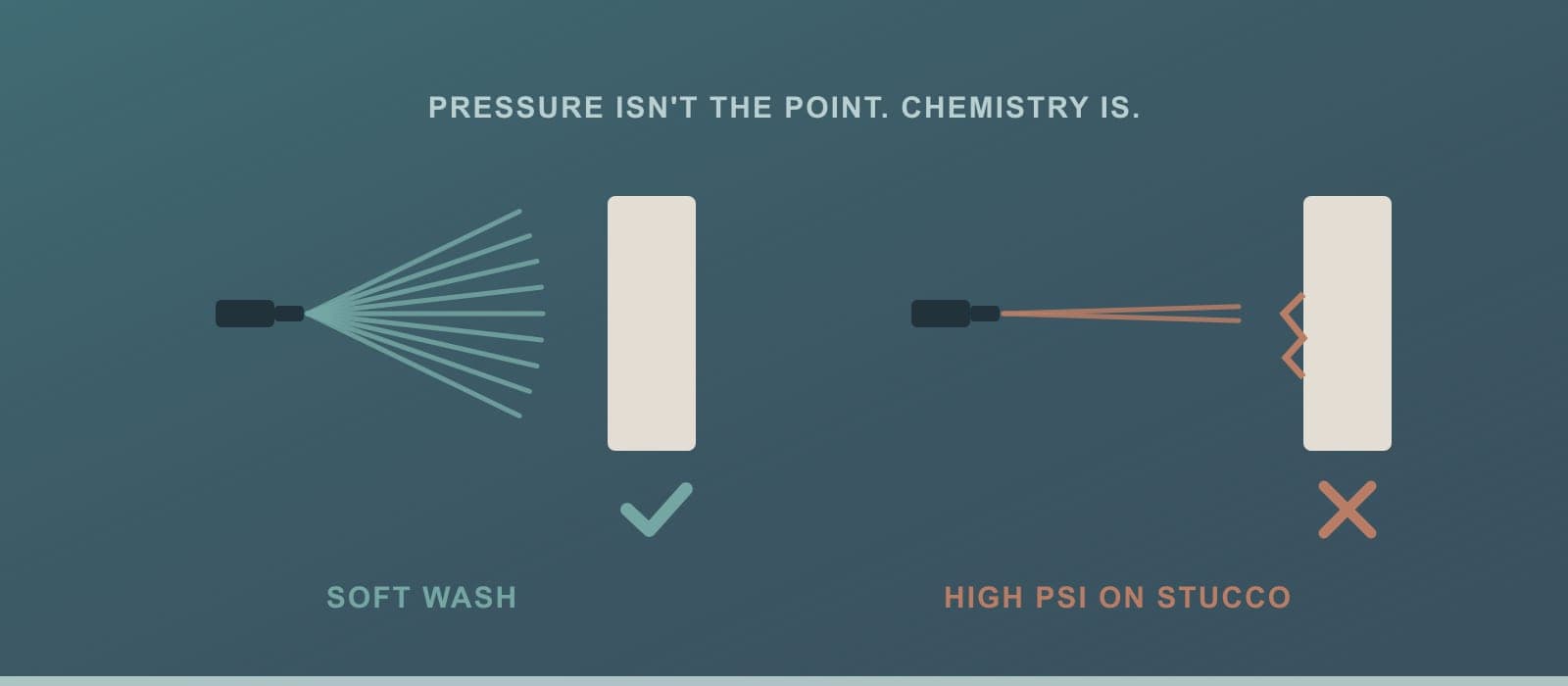
Soft washing does the opposite. It relies on chemistry, not force. A diluted biocide, most commonly sodium hypochlorite (the active ingredient in bleach) at a working strength of roughly 0.5–3%, paired with a surfactant that helps it cling and dwell, is applied at low pressure, typically under 500 PSI at the surface and often 50–150 PSI on a roof. The solution kills the algae, mildew, mold, and lichen at the root, dwells for a set period, and is then rinsed away gently. Because the organism is killed rather than merely knocked off, the surface stays clean several times longer between cleanings.
The simplest way to think about it: pressure washing treats the symptom (the stain you can see); soft washing treats the disease (the living biofilm producing the stain).
The Coastal Problem: Gloeocapsa magma, Salt, and Shade
Those black streaks crawling down a Singer Island tower or a Fort Lauderdale mid-rise are usually Gloeocapsa magma, a hardy cyanobacterium that feeds on moisture and the mineral fillers in roofing and masonry. South Florida is close to an ideal habitat for it: year-round warmth, summer humidity, afternoon downpours, and salt-laden air that holds moisture against north- and east-facing elevations long after the sun comes out. Shaded courtyards, breezeways, and the canopy-covered sides of inland Broward and Palm Beach properties stay damp the longest and stain the fastest.
Salt does two things that make method selection critical. First, it accelerates the biological growth and the corrosion of embedded metals. Second (and this is the part most homeowner-focused articles miss), when high-pressure water hits porous stucco, it can drive salty moisture behind the wall and under roof tiles, trapping it in the very cavity where it does the most damage. On a coastal condo, that trapped moisture feeds the rebar corrosion and concrete spalling that your structural reserve and milestone inspection are designed to catch. A wash that's supposed to protect the building can quietly work against it.
Why High Pressure Is the Wrong Tool for Your Envelope
Stucco
Stucco is a porous, cementitious finish. High pressure can etch it, pit the texture, blow out hairline cracks, and force water into the wall assembly. As a rule of thumb, stucco should not be cleaned above roughly 500 PSI, and many stucco and coating manufacturers explicitly prohibit high-pressure washing in their warranty terms. Once water is behind the stucco, you've created an interior moisture problem that no amount of exterior cleaning will fix.
Painted and Coated Facades
This is the most expensive mistake a board can make. A high-pressure wand doesn't distinguish between dirt and the elastomeric or acrylic coating your association spent six figures to install. It can gouge the film, erode it unevenly, and tear chalking off in patches. Because most paint warranties require correct surface preparation and prohibit damaging cleaning methods, an aggressive wash can void the warranty on a coating that should have lasted years longer. You can pay to "clean" the building and shorten the life of its single most valuable finish in the same afternoon.
Tile and Shingle Roofs
For roofs, the industry guidance is unambiguous. The Asphalt Roofing Manufacturers Association (ARMA) recommends removing algae with a low-pressure application of a diluted bleach solution (commonly cited as roughly a 50/50 mix of household sodium hypochlorite and water), allowed to dwell about 15–20 minutes and then rinsed at low pressure. High pressure on shingles dislodges the protective granules, shortens roof life, and can void the roof's warranty. On tile, high pressure cracks edges, lifts caps, and forces water under the overlaps and into attic spaces. Any cleaning method that risks water intrusion is, by definition, the wrong method for a roof.
Method-by-Surface Quick Reference
| Surface | Correct method | Approx. pressure ceiling | What does the work |
|---|---|---|---|
| Stucco (painted or unpainted) | Soft wash | ≤ ~500 PSI | Sodium-hypochlorite solution + surfactant |
| Elastomeric / acrylic coated facade | Soft wash | Low pressure / detergent | Chemistry; gentle rinse to protect the film |
| Tile roof | Soft wash | 50–150 PSI rinse | Biocide dwell, then low-pressure rinse |
| Asphalt-shingle roof | Soft wash (ARMA method) | 50–150 PSI rinse | ~50/50 bleach solution, 15–20 min dwell |
| Concrete flatwork / sidewalks | Pressure wash OK | 2,000–3,500 PSI | Mechanical force (+ detergent for organics) |
| Pavers / soft stone | Controlled pressure | Lower PSI, wide tip | Force tuned to avoid joint-sand loss |
| Wood (decks, fences) | Low pressure / soft wash | Gentle | Chemistry; avoid splintering the grain |
| Metal railings / structural steel | Soft wash or low pressure | Gentle | Avoid driving water into connections |
Pressure ranges are general planning figures; the correct setting depends on substrate condition, coating type, and manufacturer instructions for your building.
How Often Should a Coastal Florida Building Be Cleaned?
"Once a year" is the answer you'll see most often, and for many inland properties it's reasonable. But on the coast, exposure varies enough that a single number is misleading. A smarter approach is to set cadence by exposure tier, because the rate of regrowth is driven by salt, moisture retention, and shade, not the calendar.
| Exposure tier | Typical examples | Suggested soft-wash cadence |
|---|---|---|
| Oceanfront / Intracoastal, salt spray direct | Singer Island, Fort Lauderdale beach, Miami Beach towers | Roof & facade every ~6–12 months; shaded elevations more often |
| Mid-island / near-water, moderate salt | Jupiter, Boca, coastal Broward | Facade ~12 months; roof ~12–18 months |
| Inland, heavy tree canopy / shade | Western Palm Beach & Broward communities | ~12 months, with spot treatment of north faces |
| Inland, open and sunny | Suburban low-rise | ~12–18 months |
North- and east-facing walls, breezeways, and anything under a tree canopy will always stain first; many boards budget a lighter "touch-up" soft wash of the shaded elevations between full-building cleanings rather than letting the streaks build to the point of a deed-restriction notice. Cleaning on a schedule also keeps each visit gentle: the heavier the buildup, the more aggressive (and risky) the cleaning has to be.
The Differentiator Boards Miss: A Wash Is Prep and Protection, Not Just Curb Appeal
Most articles frame this as an aesthetics question. For a board managing a capital budget, the more important framing is that exterior cleaning is part of your coatings and waterproofing program, for better or worse.
Done right, soft washing extends the life of everything your association has already funded. It removes the biofilm that holds moisture against the paint and accelerates coating breakdown, and it's the mandatory first step before any repaint or recoat: a coating bonds to a clean, sound surface, and a proper wash is what makes the difference between a paint job that lasts its full rated life and one that fails early. The wash is also where surface problems first become visible: chalking, hairline cracks, failed sealant joints, and early spalling all show up clearly on a freshly cleaned wall, which is useful intelligence heading into a milestone inspection or a Structural Integrity Reserve Study (SIRS).
Done wrong, the same activity destroys value: high pressure strips the elastomeric, voids the warranty, and drives moisture into the assembly. That's why we treat pressure cleaning as connected to, not separate from, painting, waterproofing, and concrete restoration. If your building is due for a repaint or recoat in the next year or two, the wash should be specified and sequenced as part of that program, not bought as a one-off from whoever shows up with the cheapest truck.
What a Professional, Board-Grade Soft Wash Should Include
A wash protocol that protects a multi-building coastal property is more than a crew with a hose. When you bid the work, expect a contractor to address:
A documented method and chemistry appropriate to each substrate: the working concentration of sodium hypochlorite, the surfactant, dwell times, and the PSI ceiling for stucco, coated facades, and each roof type. Plant, hardscape, and runoff protection: pre-wetting landscaping, covering sensitive plantings, and managing rinse water responsibly (sodium-hypochlorite runoff is regulated in many jurisdictions, and a professional crew plans for it). Occupied-building logistics: resident notifications, balcony and window-closure notices, parking and access coordination, and scheduling around amenities. Roof-access safety: proper footwear and walking patterns on tile, fall protection, and avoidance of unnecessary weight on fragile materials. And, fundamentally, licensing and insurance. A coastal condo is a high-value asset; the contractor on it should carry the proper Florida licensure and liability coverage to stand behind the work.
Why Beachfront
Beachfront Commercial Services is a licensed and insured Florida contractor (DBPR licenses CGC #1537131, CCC #1333921, and CCC #1333373), with coastal properties as our specialty. Pressure cleaning sits inside a full building-envelope practice that also includes commercial and residential painting (including electrostatic), roofing, waterproofing and sealants, and concrete restoration. That matters for a wash because we don't view it as a standalone service: we soft-wash in a way that protects the coatings and waterproofing systems rather than strips them, we sequence cleaning correctly as prep when a repaint or recoat is on the horizon, and we flag the envelope issues a clean wall reveals (useful when your board is heading into milestone-inspection or SIRS readiness). For mixed-substrate properties, that one-source approach keeps the building consistent and the warranties intact.
Frequently Asked Questions
Is soft washing or pressure washing better for stucco condo buildings in Florida?
Soft washing is the correct method for stucco. Stucco is porous and cementitious, so high pressure can etch the texture, open hairline cracks, and force water behind the wall, and many stucco and coating warranties prohibit high-pressure washing. Soft washing uses low pressure (generally under 500 PSI) plus a sodium-hypochlorite solution that kills algae and mildew at the root, cleaning thoroughly without damaging the finish.
Will pressure washing ruin my building's paint?
It can. A high-pressure wand doesn't distinguish between dirt and your coating. It can gouge the film, erode it unevenly, and strip chalking in patches. Because most paint warranties require proper surface preparation and prohibit damaging cleaning methods, an aggressive wash can void the warranty on a coating you paid to install. Use a low-pressure soft wash on painted and coated facades.
How often should a coastal Florida condo or HOA be soft washed?
It depends on exposure. Oceanfront and Intracoastal buildings facing direct salt spray often need roof and facade cleaning every 6–12 months, while inland or sunnier properties may go 12–18 months. North- and east-facing walls, breezeways, and shaded elevations stain fastest and frequently need more frequent spot treatment. Setting cadence by exposure tier, and cleaning before buildup gets heavy, keeps each wash gentle and avoids deed-restriction notices.
What chemicals are used in soft washing, and are they safe for landscaping?
The primary biocide is sodium hypochlorite (the active ingredient in bleach), diluted to a low working strength and paired with a surfactant so it clings and dwells. Applied and rinsed correctly with proper plant pre-wetting, covering, and runoff management, it cleans effectively while protecting landscaping. A professional crew plans for responsible runoff because sodium-hypochlorite discharge is regulated in many areas.
Can a roof be cleaned without damaging it or voiding the warranty?
Yes, with the right method. The Asphalt Roofing Manufacturers Association (ARMA) recommends a low-pressure application of a diluted bleach solution (commonly a roughly 50/50 mix with water), allowed to dwell about 15–20 minutes, then rinsed at low pressure. High pressure on shingles dislodges the protective granules and can void the warranty; on tile it cracks edges and forces water under the overlaps. Soft washing is the manufacturer-recommended, warranty-safe approach.
Ready to Protect Your Property?
Tell us about your building and a Beachfront estimator will follow up with a clear scope and fair pricing.