Pressure Cleaning
Should You Seal Pavers and Concrete After Cleaning? A Coastal Florida Condo Board's Guide
After a Florida condo's pavers or concrete are cleaned, should you seal them, and with what? A board/CAM guide to penetrating vs. film-forming sealers, the coastal 18–24-month reseal cadence, efflorescence, slip safety, and who pays.
Beachfront Commercial Services ·
Direct answer: Yes. Sealing pavers and exposed concrete after a professional cleaning is worth doing, but only once the surface is fully dry and any efflorescence (white salt haze) has cleared, and only with the right kind of sealer for the surface and its exposure. On the Florida coast, plan to reseal roughly every 18–24 months if you use a film-forming (acrylic/urethane) sealer, or every 3–5 years if you use a penetrating (silane/siloxane) sealer, because salt air and relentless UV shorten every sealer's life. The most reliable schedule isn't a fixed calendar date; it's the water-bead test: when water stops beading and starts soaking in, the surface is due.
That's the short version. The reason sealing trips up so many Florida condo and HOA boards is that the decision has three moving parts (which sealer, when to apply it, and how often to redo it), and the coast changes all three. This guide is written for boards, community association managers (CAMs), and facility managers responsible for common-area hardscape: entry drives, amenity pool decks, community walkways, courtyards, and plaza or podium decks over occupied space. Get it right and you protect an expensive surface for a small annual cost. Get it wrong and you get a cloudy, slippery, peeling mess that has to be stripped and redone.
Why sealing is a real maintenance decision on the coast, not a cosmetic upgrade
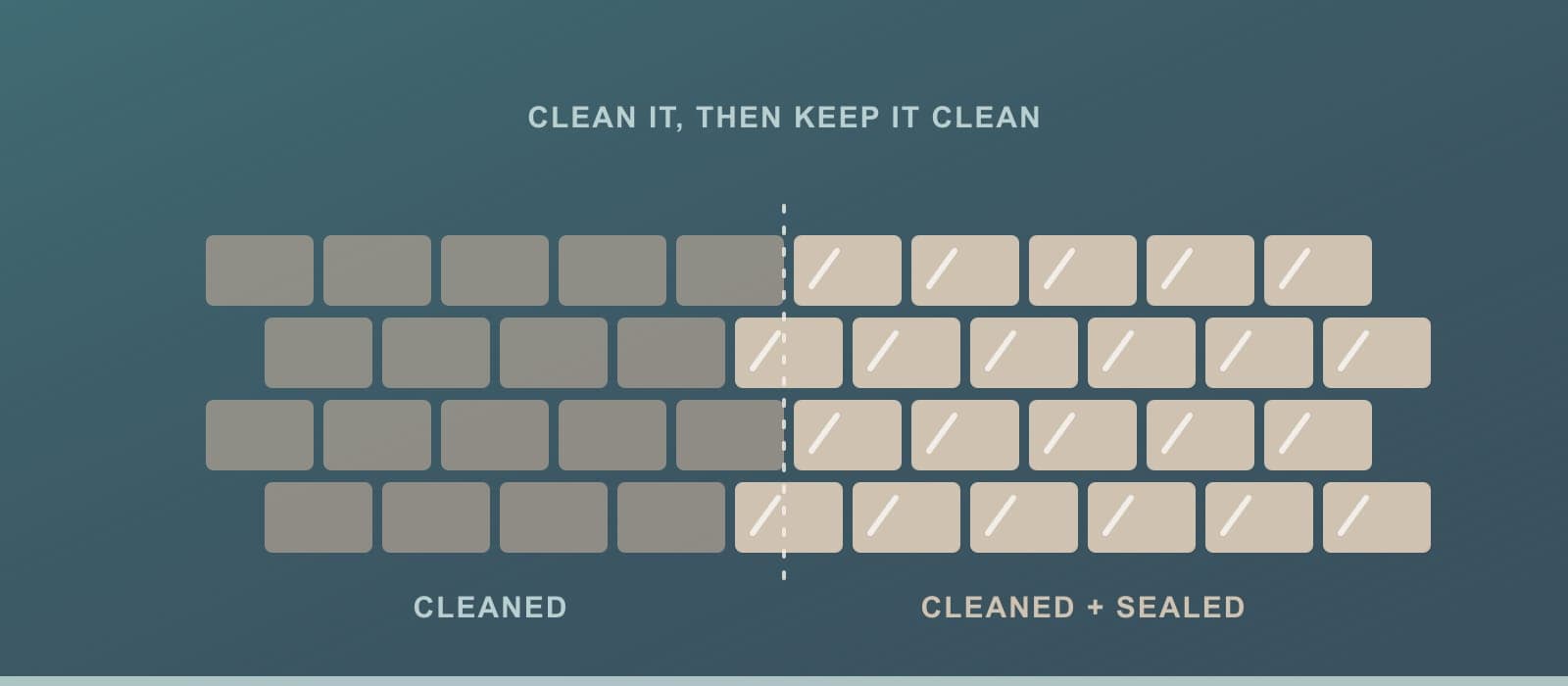
Most homeowner-facing articles frame sealer as a way to make a driveway look wet and rich. That's part of it, but for a condo association the case is more practical. A good sealer does five things: it slows UV color fade, resists oil and rust and organic staining, helps lock joint sand so pavers don't shift and sprout weeds, reduces moisture absorption that feeds mold and mildew, and makes routine soft-washing easier because grime sits on top instead of soaking in.
Coastal Florida stacks the odds against unsealed hardscape. Intense year-round UV bleaches pigment. A roughly six-month wet season with near-daily afternoon downpours keeps surfaces damp and washes joint sand out at the edges. Salt-laden air within a few miles of the ocean and Intracoastal drives chloride and mineral film onto surfaces. Irrigation overspray leaves hard-water and iron deposits. On amenity pool decks, chlorinated splash and sunscreen add their own residue. All of that is exactly why a sealing schedule copied from a northern climate, or from a big-box product label, doesn't fit here.
The first decision: penetrating vs. film-forming sealer
Nearly every sealer falls into one of two families, and choosing the wrong family is the single most common cause of a failed job on the coast.
Penetrating sealers (silane / siloxane)
Penetrating sealers soak into the pore structure of the paver or concrete rather than sitting on top. Silane/siloxane blends are the workhorse of this category. Because they work below the surface, they are breathable: they repel liquid water while still letting water vapor escape from inside the substrate. They typically don't change color or add gloss (the surface looks essentially untouched), they keep the natural slip texture of the material, and they generally last about 3–5 years before they need renewal. Their breathability makes them the safer choice anywhere moisture can drive up from below: travertine and natural stone, pool decks, shaded walkways, and any surface prone to efflorescence.
The trade-off: penetrating sealers give little to no color enhancement and don't lock joint sand as aggressively as a film-forming product. If the board's goal is a rich, wet-look finish, a penetrating sealer alone won't deliver it.
Film-forming sealers (acrylic, urethane, epoxy)
Film-forming (also called topical) sealers dry as a thin film on the surface. Acrylics are the most common for pavers; they deliver the color pop and matte-to-wet-look sheen people associate with "sealed" pavers, and they help bind joint sand into a stable, weed-resistant surface. They typically last about 18–24 months in Florida conditions before recoating.
The catch, and it's a big one on the coast, is that a film-forming sealer can trap moisture and salt beneath it. Applied over a damp or still-efflorescing surface, or applied too heavily, an acrylic can blush white, turn cloudy, get sticky, become slippery when wet, and eventually peel. Acrylic films also wear faster under vehicle tires (so they're a weaker choice for a heavily trafficked entry drive) and can be slick on a pool deck unless a traction additive is broadcast into the coat.
A quick decision-by-surface guide for common-area hardscape
| Common-area surface | Typical best fit | Why |
|---|---|---|
| Entry / access drive (vehicle traffic) | Penetrating silane/siloxane | Won't wear off under tires; keeps traction; no film to peel |
| Amenity pool deck | Penetrating, or film-forming with traction additive | Breathability + slip safety around water are the priority |
| Community walkways / entries (shaded, damp) | Penetrating | Breathable; resists the algae/moisture that films trap |
| Courtyards / patios (foot traffic, look matters) | Film-forming acrylic | Color enhancement + joint-sand lock where appearance counts |
| Travertine / natural stone | Penetrating | Preserves natural look; avoids trapping vapor in porous stone |
| Plaza / podium deck over occupied space | Consult first; the waterproofing membrane below governs | A decorative topping sealer must not compromise the deck's waterproofing system |
The last row matters more than it looks. On a plaza or podium deck sitting over parking or living space, the real protection is the waterproofing membrane assembly beneath the finish, not the surface sealer. Sealing that kind of deck is a coordination question, not a paver question, and it should be handled by a contractor who understands both the finish and the membrane below (see our balcony and podium waterproofing coverage).
The second decision: efflorescence and the "don't seal too soon" rule
Efflorescence is the white, chalky haze that shows up on pavers and concrete. It happens when water-soluble salts inside the material migrate to the surface with moisture and react with carbon dioxide in the air to form calcium-carbonate crystals. New concrete pavers go through an efflorescence "bloom" for roughly the first two to three months (sometimes up to six) after installation.
This creates a firm rule that most homeowner articles skip: don't seal brand-new pavers for about 6–12 months. Sealing too soon, especially with a film-forming product, can trap the salts and moisture under the film, locking in a permanent white haze that's far harder to remove than surface efflorescence would have been. The same logic applies to any cleaning-and-sealing job: efflorescence on the surface must be removed and the substrate allowed to dry before sealer goes down. Seal the surface, not the moisture.
Where efflorescence or vapor drive is a recurring problem, a breathable penetrating sealer is the safer specification because it lets the substrate keep releasing vapor instead of blistering the film.
The third decision: how often to reseal on the coast
Here is where the coast rewrites the calendar. Across Florida generally, the common reseal interval is every 2–3 years. But salt air alone shaves an estimated 6–12 months off sealer life, which is why coastal condo hardscape realistically lands at 18–24 months for film-forming sealers, with penetrating sealers stretching toward the longer 3–5 year end. Exposure modifies that further:
- Vehicle drives and community entrances near irrigation or the waterline wear fastest. Plan on the shorter end (roughly 18–24 months).
- Sunny amenity pool decks need attention around every two years, mostly to keep traction and color consistent.
- Shaded, low-traffic walkways and screened courtyards can sometimes stretch toward 36 months, but confirm by condition, not hope.
Rather than reseal on a rigid date, verify with the water-bead test: sprinkle water on the surface. If it beads and sits, the sealer is still working. If it soaks in and darkens the paver, it's time. Other tells that a seal is failing: color that looks chalky or washed-out (compare an exposed area to the richer color hiding under furniture), joint sand sitting low with weeds or ant trails moving in, and, importantly, whitish or hazy patches after rainy stretches, which can mean moisture is trapped under a failing film.
Why sealer jobs fail in Florida, and how to prevent it
Almost every "why do my pavers look cloudy?" problem traces to one of three preventable mistakes:
- Sealing over trapped moisture. Florida's short dry windows tempt crews to wash and seal the same day. A surface that looks dry can still hold moisture in its pores; a topical sealer applied over it hazes, blushes, or turns slippery. The fix is a genuine dry-out period after cleaning, verified before sealing, not a same-day rush.
- Over-application. More sealer is not more protection. Too much product, especially acrylic, leaves a sticky, cloudy, slick surface that has to be stripped.
- Incompatible re-coats. Layering a new sealer over an old, failing, or chemically different one causes peeling. Before recoating, a professional evaluates whether the existing finish is sound enough to accept a new coat or whether it needs to be stripped first.
When a sealer has already failed, the honest answer is usually strip and reseal, not "put another coat on." Another coat over a hazed or peeling film just buries the problem.
Timing is the quiet controller behind all of this. Seal only on a clean, fully dry surface, ideally in the dry season (roughly November–April), with a 24–48 hour rain-free window before and after so the sealer can cure. Florida's summer humidity and 4 p.m. storms routinely ruin an uncured application. (For the full seasonal logic behind coating and sealing weather windows, see our exterior-coating timing guide.)
The part homeowner guides skip: slip safety and common-area liability
For a condo association, a pool deck or walkway isn't just an aesthetic surface. It's a slip-and-fall exposure. This is a real reason the sealer family matters. A glossy film-forming acrylic can be genuinely slippery when wet, which is the last thing you want around a pool or on a shaded walkway that stays damp. Two ways to manage it: specify a penetrating sealer that leaves the natural surface texture intact, or, if a topical finish is chosen for appearance, broadcast a fine traction additive (polymer or aluminum-oxide grit) into the coat to restore grip. Either way, slip resistance on amenity surfaces should be written into the scope, not left to chance.
The board / CAM playbook
Sealing sits in the "small, cheap, easy-to-defer" category of building maintenance, which is exactly why it gets skipped until a surface looks bad enough to need full replacement. A better approach treats clean-and-seal as scheduled preventive maintenance:
- Put it on the calendar as a cadence, not an emergency. Budget a coastal reseal interval per surface (roughly 18–24 months film-forming; 3–5 years penetrating) and tie the next date to the water-bead test, not just the clock.
- Fund it from the right bucket. Routine clean-and-seal is a recurring maintenance expense (operating budget), distinct from the reserve-funded replacement of the hardscape itself. On a plaza or podium deck, remember the surface finish protects a reserve-relevant waterproofing membrane below, which raises the stakes on getting the sealing done correctly and on schedule.
- Document it. A dated photo-and-scope record of each clean-and-seal supports your maintenance file and shows a reserve professional that the surface is being maintained, which supports its remaining useful life.
- Handle wash-water responsibly. Cleaning before sealing generates runoff. For HOA and commercial work, wash-water and any sealer-stripping discharge should follow NPDES and local containment/runoff rules. A legitimate contractor plans for this rather than letting it run to the storm drain.
- Schedule around the season. Book the dry-season window early; the same November–April period everyone wants for painting and coating fills up fast.
Where Beachfront fits
Beachfront Commercial Services is a licensed, insured Florida contractor (DBPR CGC #1537131, CCC #1333921, CCC #1333373), with coastal properties as our specialty. Two things set our approach to clean-and-seal apart. First, we self-perform both the cleaning and the sealing with our own W-2 crews, so there's no wash-then-seal handoff where one contractor blames the other for a hazed surface. One team controls the dry-out and the application. Second, because we also self-perform concrete restoration and waterproofing, we can tell you when a surface actually needs repair (spalling, joint sand loss, a failing podium-deck membrane) before it's worth sealing, instead of sealing over a problem and hiding it. We spec the sealer family to the surface and its exposure, protect slip resistance on amenity decks, and time the work to the coastal dry-season window.
This article is general information for Florida condominium and commercial property decision-makers and is not engineering, legal, or product-specific application advice. Sealer selection and application should follow the manufacturer's data sheet and, where a plaza/podium deck or waterproofing membrane is involved, the guidance of a qualified contractor or engineer for your specific building.
Frequently Asked Questions
Should I seal pavers right after they're pressure washed? Not the same day. Clean first (sealer bonds poorly over dirt, grease, mold, or efflorescence), but then let the surface dry completely before sealing. In Florida's humidity a "looks dry" surface can still hold moisture in its pores, and sealing over that trapped moisture is the leading cause of a cloudy, hazy, or peeling result. A proper job is clean, verify dry, then seal within a dry-weather window.
How often should a coastal Florida condo reseal its pavers or concrete? Roughly every 18–24 months for a film-forming (acrylic) sealer and every 3–5 years for a penetrating (silane/siloxane) sealer, shorter than inland Florida because coastal salt air and UV cut sealer life by an estimated 6–12 months. Confirm timing with the water-bead test: when water soaks in instead of beading, it's due.
What's the difference between penetrating and film-forming sealers, and which is better? Penetrating (silane/siloxane) sealers soak in, stay breathable, don't change color, keep natural slip texture, and last about 3–5 years, the safer pick for pool decks, natural stone, and anywhere moisture or efflorescence is a concern. Film-forming (acrylic/urethane) sealers sit on top, enhance color and lock joint sand, and last about 18–24 months, but can trap moisture and haze or peel if misapplied. Neither is universally "better"; the right choice depends on the surface and its exposure.
Why did our sealed pavers turn white, cloudy, or hazy? Almost always one of three things: the sealer was applied over trapped moisture or active efflorescence, it was over-applied, or a new coat was layered over an incompatible or failing old sealer. The salts and moisture get locked under the film and blush white. The remedy is usually to strip and reseal correctly, not add another coat.
Can we seal brand-new pavers, or do we have to wait? Wait about 6–12 months. New concrete pavers release efflorescence (a natural salt bloom) for the first several months after installation. Sealing too early, especially with a film-forming product, can trap that haze permanently. Let the pavers weather and clear first, then clean and seal.
Is a sealed pool deck slippery, and is that a liability concern for the association? It can be if you use a glossy film-forming sealer, which is a real slip-and-fall consideration on amenity surfaces. Manage it by choosing a penetrating sealer that preserves the natural surface texture, or by broadcasting a fine traction additive into a topical coat. Slip resistance on common-area decks and walkways should be specified in the scope, not left to chance.
Ready to Protect Your Property?
Tell us about your building and a Beachfront estimator will follow up with a clear scope and fair pricing.