Guidance
Three Repaint Bids, Three Different Jobs: The Pre-Bid Walk That Makes Them Comparable
Commercial repaint quotes routinely land 20 to 40 percent apart because each contractor is pricing different assumptions, not different margins. How Florida owners and managers run a pre-bid walk and write a scope that makes three bids match, in time for the dry-season calendar.
Beachfront Commercial Services ·
Get three bids on the same commercial repaint and the numbers will routinely land 20 to 40 percent apart. National cost guides report that spread as normal, and estimators explain it the same way: each contractor priced different assumptions, not different profit margins. One bid assumes a light wash and one coat over sound paint. Another assumes failed areas get scraped, primed, and built to a specified film thickness. The third quietly excludes the sealant joints. Three numbers, three different jobs, one building.
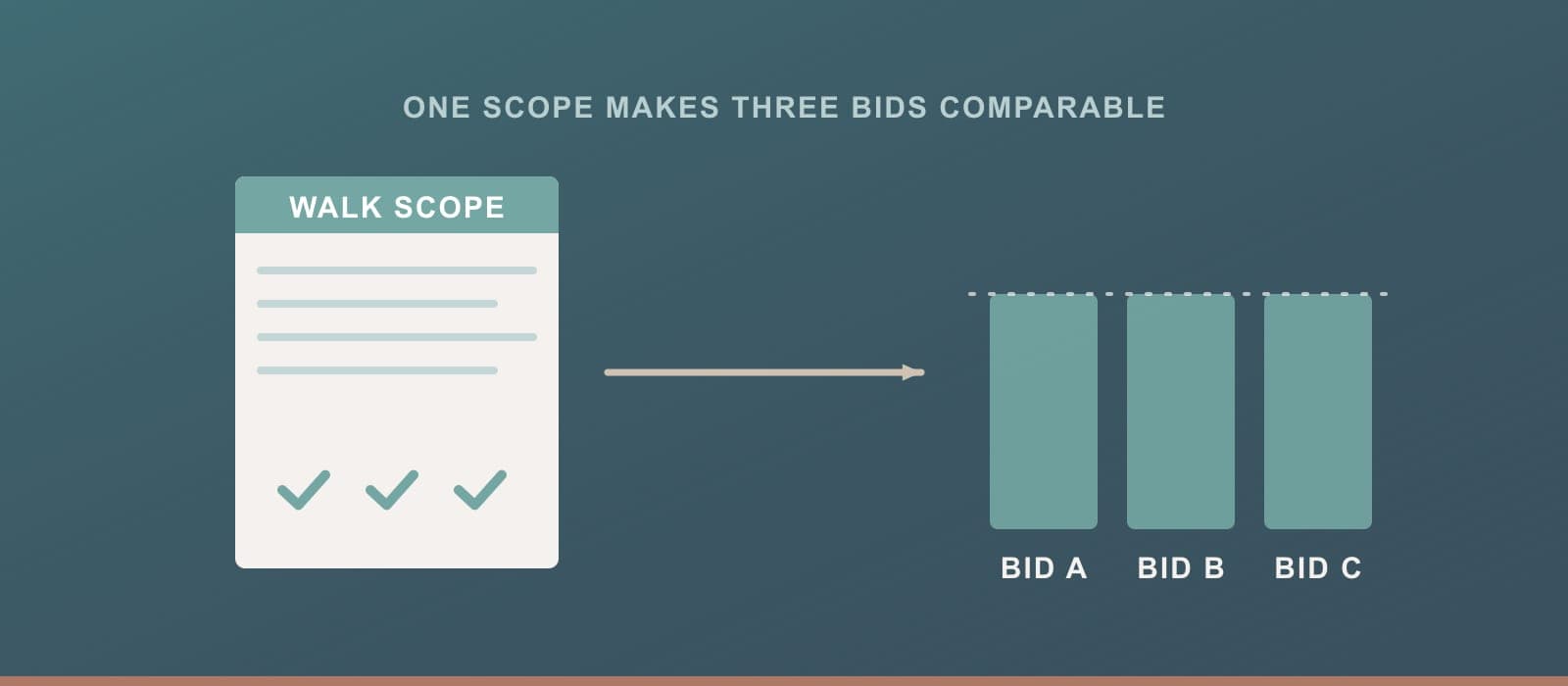
That spread is not noise. It is a measurement of how much of the job you left undefined. Close the gap yourself, before bids go out, and the numbers converge until the lowest one means something. This article is the how: the pre-bid walk, the scope-versus-allowance split, and the four verification clauses that make bids comparable. Run it in September and October, and the work lands inside the dry-season window when coatings cure on spec.
This article is general information for property owners and managers, not engineering, insurance, or legal advice.
Why the numbers spread: five assumptions nobody prices the same
Cost guides put exterior commercial painting at roughly $2.50 to $8.00 per square foot in 2026. That range is wide enough to hide almost anything, and what hides inside it is assumptions. Labor is most of a paint bid, typically 60 to 70 percent by industry estimates, so every assumption about how much work the crew does gets multiplied before it reaches your total.
Five assumptions do most of the spreading:
1. Prep level. Estimating guides consistently call surface preparation the largest cost variable in a repaint. "Pressure wash and paint" and "wash, verify moisture and pH, spot-prime bare stucco, then build film to spec" are different jobs that differ by thousands of dollars on the same wall, and both fit under the word "prep" in a one-page proposal.
2. Film build. Paint fails by the mil. A mil is a thousandth of an inch of coating, and the difference between 2 dry mils and 4 is the difference between a coating that bridges hairline cracks and one that fails early on a salt-loaded coastal wall. A bid that never states target dry mils has not committed to either.
3. Product line. "Premium acrylic" is not a specification. A manufacturer and product name is, because it fixes the volume solids, the coverage rate, and the warranty terms the bid must honor.
4. Access. Lifts, swing stages, and multi-story staging change labor hours. If one bidder assumed ground-and-ladder access and another priced a lift for the west elevation, their numbers cannot match.
5. Allowances and exclusions. Crack repair, stucco patching, and sealant replacement are where the honest money hides. A bid that includes 500 linear feet of joint replacement and one that says "caulk as needed" are not comparable, and the second one usually gets reconciled later as change orders.
None of this makes the low bidder a bad actor. It makes the bid documents the problem. The fix is owner-side and costs a morning.
The pre-bid walk: 90 minutes that define the job
Before any bid request goes out, walk the building and document what the crews will actually meet. Bring a camera, a screwdriver, and a rag. The findings become the shared facts every bidder prices against.
Rub a wall in a few places, especially sun-loaded elevations. A chalky film on the rag is oxidized coating that has to be washed to a sound surface before anything sticks. Note where chalk is heavy; that is prep scope, and every bidder should see the same photos.
Tap the stucco where it looks tired. A hollow, drummy sound means the stucco has debonded. Hollow areas are repair scope, not paint scope, and they need a square-foot count so bidders price the same quantity.
Walk the sealant joints. Control joints, window perimeters, and penetrations. Split, hardened, or peeling joints are a separate waterproofing scope with its own linear-foot count. The chemistry and the joint-geometry rules are in the sealant joints guide; what matters at bid time is that the quantity is counted, not guessed. Left out of the scope, an open joint keeps feeding water and chlorides to the structure behind it: sealant replacement runs about $5 to $18 per linear foot, while the concrete spall repair that follows a neglected joint runs $50 to $150 or more per square foot.
Identify what is on the wall now. Elastomeric over stucco behaves differently from thin-film acrylic, and recoat compatibility decides the primer system. A paint chip and a close-up photo settle arguments later.
Photograph everything with timestamps. Sound areas included. The photo file is the baseline every bidder prices from, and it doubles as the before-record your insurance file wants anyway.
The full building-science version of this inspection, with the failure mechanisms behind each check, is in the surface prep and mil build guide. The pre-bid walk is its procurement application: same facts, pointed at the bid table.
Write the scope: what gets specified, what gets an allowance
A scope of work that produces comparable bids has two layers.
Specified work is everything measurable today, written so no bidder has to assume: elevations and square footage included, wash method, the acceptance tests below, primer system by condition, product line by manufacturer and name, number of coats, and target dry film thickness in mils. If it is in this layer, every bid prices identical work.
Unit-priced allowances cover what cannot be fully counted from the ground: crack repair by the linear foot, stucco patching by the square foot, sealant replacement by the linear foot per joint type. Set the estimated quantity from your walk, and require a unit price for overage. Now a bid with a bigger allowance number is not "more expensive," it is more honest, and overruns get priced at bid-time rates instead of change-order rates.
The single most useful line in the specified layer is a set of acceptance tests. These are pass-fail conditions the wall must meet before coating goes on, and they convert "proper preparation" from a promise into a checklist:
- Surface pH inside the coating's data-sheet limit, commonly 10 or below for standard acrylics, checked per ASTM D4262. Fresh stucco and concrete patches need their cure time, roughly 28 days, before they can pass.
- No trapped moisture, verified per the ASTM D4263 plastic-sheet check or a moisture meter reading below the coating manufacturer's limit. Washing and coating the same wall the same day fails this test almost by definition on the coast.
- Chalk removed to spec, evaluated per ASTM D4214 after washing.
- Surface temperature at least 5 degrees above the dew point at application, per the ASTM D3276 inspection rule, logged by elevation as work proceeds.
Any bidder who balks at those four lines has told you something valuable before you signed anything.
The four verification clauses
Specification without verification is decoration. Four clauses keep the delivered job connected to the priced one:
1. The gallons audit. Theoretical coverage is 1,604 square feet per gallon at 1 mil of thickness, multiplied by the product's percent volume solids from its data sheet. Divide by the specified dry mils, subtract a stated loss factor for texture and spray, and the scope's square footage converts into a gallon count. Require the bid to state gallons, and reconcile delivery tickets at closeout. Thin film cannot hide from arithmetic.
2. Wet-film readings during application (ASTM D4414) and dry-film spot checks (ASTM D6132) at an agreed frequency. A wet-film comb, used daily, is the cheapest quality program in construction.
3. A mock-up as the standard of workmanship. One or two hundred square feet on the worst elevation, full prep and full film build, approved in writing before production painting starts. Adhesion can be spot-verified on the mock-up per ASTM D3359. Every later dispute gets settled by pointing at the wall.
4. Closeout documentation. Dew-point and application logs, DFT readings, gallon reconciliation, and the manufacturer's warranty registration, delivered as a package. That file supports the coating's stated service life in your capital plan and your insurance record.
The money math: price per year, not price per bid
Once bids are comparable, compare them the way the asset sees them. Estimating guides frame it as cost per year of service: a $40,000 system that lasts 12 years costs about $3,300 a year; a $28,000 bid that fails in 5 costs $5,600 a year. The "cheaper" job costs roughly 70 percent more per year of paint on the wall, and that is before mobilizing a second repaint's worth of lifts and disruption years early.
On a Florida coastal wall the stakes are wider than the national examples, because the failure modes are faster. A repaint built on verified prep and full film is an 8-to-12-year asset here. The same product applied over chalk, trapped moisture, or half the specified mils can be failing in 3 to 5. Same invoice line, twice the frequency, which means the same work funded twice in one ownership cycle. The scope and verification clauses above are what buy the longer number.
The calendar: why this is a September project
South Florida's dry season, November through April by the regional climate definition, is when exterior coatings go on inside their temperature, humidity, and dew-point specs without weather-day roulette. The full go/no-go math is in the best-time-of-year guide.
Work backward from that window and September is not early, it is on time. Pre-bid walk and scope in September. Bids back and leveled in October. Contract signed, mock-up approved, and a mobilization date reserved before the calendar opens. Dry-season slots on good crews' schedules are finite, and a quiet storm season has already given owners a head start on exactly this sequence. The owner who shows up in January with an unwritten scope takes whatever dates and crews are left.
What a fall envelope assessment gets you
The pre-bid walk described above is work we do every week, and the fall envelope assessment is that walk, productized. A Beachfront assessment covers the walls, sealant joints, balconies and decks, and drainage, and you walk away holding three things:
- A timestamped photo documentation file of current condition, elevation by elevation, organized for your bid package and your insurance file.
- A prioritized punch list with the quantities that make allowances real: stucco repair square footage, crack and joint linear footage, prep condition by elevation.
- A scoped, priced plan for the repaint and any repair work, sequenced against the dry-season calendar, written against the acceptance tests in this article.
We self-perform painting, pressure cleaning, waterproofing, concrete restoration, and roofing with W-2 crews, under CGC #1537131, CCC #1333921, and CCC #1333373, with certified-applicator standing on the major coating systems. Use the assessment to level our bid against anyone else's. That is what it is for.
Call 561-557-8534 or reach us through beachfrontcs.com. Assessment slots are scheduling now, ahead of the dry-season calendar.
FAQ
Isn't the spread just contractors padding numbers? The cost guides that report 20-to-40-percent spreads attribute them to assumption differences: prep level, coats, product, access, and exclusions. Padding exists, but you cannot see it until the assumptions match. Level the scope first; then an outlier means something.
Can we just take the middle bid and move on? The middle of three prices for three different jobs is not a market price, it is an average of guesses. A leveled scope usually costs less than the middle bid delivered more predictably, because allowances price overruns at bid rates instead of change-order rates.
Our building needs repairs before paint. Does that change the sequence? It strengthens it. Stucco, crack, and joint repairs discovered mid-repaint are the most expensive version of themselves. The pre-bid walk finds them in September, the allowances price them competitively, and one mobilization handles repair and repaint in sequence.
Who should run the pre-bid walk? Anyone diligent can run the rag test and the photo file. The quantities and the coating identification are where a contractor's eye pays for itself. Have a contractor you trust run the documented version, and make its findings the shared basis for every bid, including that contractor's own.
Ready to Protect Your Property?
Tell us about your building and a Beachfront estimator will follow up with a clear scope and fair pricing.