Painting
Why Exterior Paint Fails Early on Florida Buildings: The Surface-Prep and Mil-Build Spec Boards Should Be Writing
Coastal condo repaints fail at year three because of prep and film build, not paint brand. The acceptance numbers (28-day cure, pH ≤10, <12% moisture, dew point, dry mils) and the gallons audit that proves the coating you paid for was actually applied.
Beachfront Commercial Services ·
Short answer: an exterior coating on a coastal Florida building almost never fails because the wrong brand of paint was bought. It fails because the substrate was not clean, dry, and chemically ready when the coating went on, or because less coating was applied than the manufacturer requires. Both of those failures are invisible on the wall the day the scaffolding comes down. A board that only compares price per square foot is comparing the one number that cannot tell it which bid will still be intact in year eight.
This is the difference between a repaint that lasts 8 to 12 years on the Intracoastal and one that starts blistering on the west elevation in year three. Two crews can apply the same premium acrylic from the same manufacturer to the same building and produce those two different outcomes. What separates them is prep and film build: the two line items easiest to shave out of a bid, and the two hardest for a board to see.
Below is how coastal coatings actually fail, the acceptance numbers a board should be writing into its scope, and a simple gallons-versus-square-feet audit any board member can run without a coatings background.
This article is general information for building owners and boards, not engineering advice. Specific coating systems, substrate conditions, and repair scopes should be confirmed by your licensed contractor, coating manufacturer's technical representative, or engineer of record.
The four ways a coastal repaint actually fails
Peeling paint is a symptom. There are four distinct mechanisms behind it, and they call for four different corrections.
1. Adhesion loss (peeling, flaking, sheeting). The coating never bonded, usually because it went over chalk, mildew, salt residue, dust, or a previous coating that was itself letting go. On the coast, airborne salt deposits on a wall between rains and forms a soluble film. A coating applied over that film is bonded to salt, not to stucco, and the first driving rain that redissolves the salt lifts the paint off in sheets.
2. Blistering (bubbles that appear weeks or months later). Moisture inside the wall tries to leave, hits a coating with too little vapor permeability, and pushes the film off the substrate. This is the classic result of washing a building and coating it the same day, or of putting a low-perm elastomeric over a wall that is still taking on water through open cracks, failed sealant joints, or a leaking balcony above.
3. Saponification (soft, gummy, soapy-feeling film). A specifically cementitious failure. Fresh or wet stucco is highly alkaline. A new stucco surface can start out near pH 13. When high alkalinity meets water underneath an acrylic film, the alkali chemically attacks the coating's binder from behind. The paint goes soft, slick, and mushy, and it comes off with a fingernail. This is why the 28-day cure and the pH check exist.
4. Premature weathering (chalking, fade, loss of crack-bridging). The coating bonded fine and was never wet. There just was not enough of it. Ultraviolet exposure in Florida erodes the binder from the outside in, and a film applied at half the specified dry mils has half the sacrificial thickness to give up. It looks perfect at closeout and dead at year four.
Only the first three are prep failures. The fourth is a film-build failure, and it is the one boards almost never catch.
Prep is not "pressure washing." It's five acceptance tests.
Every competing article on the internet will tell you to "wash the building and let it dry longer than you think." That is true and completely unusable. A board cannot inspect "longer than you think." Here is the same advice converted into numbers a board can write into a scope of work and a superintendent can verify with a $200 meter.
| Condition | Acceptance criterion | How it is verified | Reference method |
|---|---|---|---|
| Cure of new/patched stucco | 28 days minimum before coating (longer in humid, shaded conditions) | Calendar + moisture and pH checks below | Manufacturer convention |
| Surface alkalinity | pH ≤ 10 for a standard acrylic; higher values require an alkali-resistant primer | pH pencil, paper, or meter on a dampened surface | ASTM D4262 |
| Substrate moisture | < 12% moisture content (confirm your manufacturer's number) | Pin or pinless masonry moisture meter; taped clear-plastic sheet left 16+ hours shows condensation if the wall is still releasing water | ASTM D4263 |
| Cleanliness / chalk | No chalk, mildew, salt film, or loose coating; chalk rating acceptable to the manufacturer | Rub test (black glove/cloth), plus a documented wash | ASTM D4258 (cleaning), ASTM D4214 (chalking) |
| Ambient + surface conditions at application | Surface ≥ 5°F above the dew point, air and surface within the product's range (commonly 50–90°F), relative humidity below the product's ceiling (commonly 70–85%) | Sling psychrometer or digital dew-point meter + infrared surface thermometer, logged per elevation | ASTM D3276 |
Two of those rows deserve emphasis in a coastal context.
The wash-and-coat-the-same-day trap. Stucco is a sponge. A building that is soaking wet from a soft wash at 9 a.m. is dry to the touch by 1 p.m. and still well above 12% moisture content inside the render. Coat it, and you have sealed a wet wall. In Florida's coastal humidity, a proper exterior wash typically needs a full 24 to 72 hours of drying before coating, and shaded north elevations and courtyards need the long end of that. If a bid schedules the wash and the first coat on the same calendar day across a whole elevation, that is not efficiency. It is a defect being scheduled.
The dew-point rule is a coastal Florida rule. A sun-loaded west wall can be 20°F warmer than the air. At sunrise, that same wall can be colder than the air and running with condensation you cannot see. Coating within 5°F of the dew point traps a microscopic layer of moisture at the bond line. This is why a serious contractor logs surface temperature and dew point by elevation, by hour, not once for the whole building at 8 a.m.
The primer decision boards never see in a bid
"Includes primer" means almost nothing. There are three functionally different primers, and choosing the wrong one is a failure waiting to happen.
- Alkali-resistant masonry primer. For new stucco, fresh patches, and any surface where pH is above about 10. It is formulated to survive the alkali attack that would saponify a standard acrylic.
- Bonding / conditioning primer. For chalky-but-sound existing coatings that cannot be fully removed. It penetrates and locks down residual chalk so the topcoat has something solid to grab.
- Block filler or bridging primer. For raw CMU, or where an acrylic is going over an existing elastomeric and you need to prevent pinholing and telegraphing.
A bid that says "prime as needed" is transferring the judgment call (and the risk) to the crew on the wall. A bid that says "alkali-resistant masonry primer on all new stucco and patches; bonding primer on all chalk-rated areas; two-coat finish over 100% of primed area" is telling you the contractor has actually walked the building.
Mil build: where the low bid hides
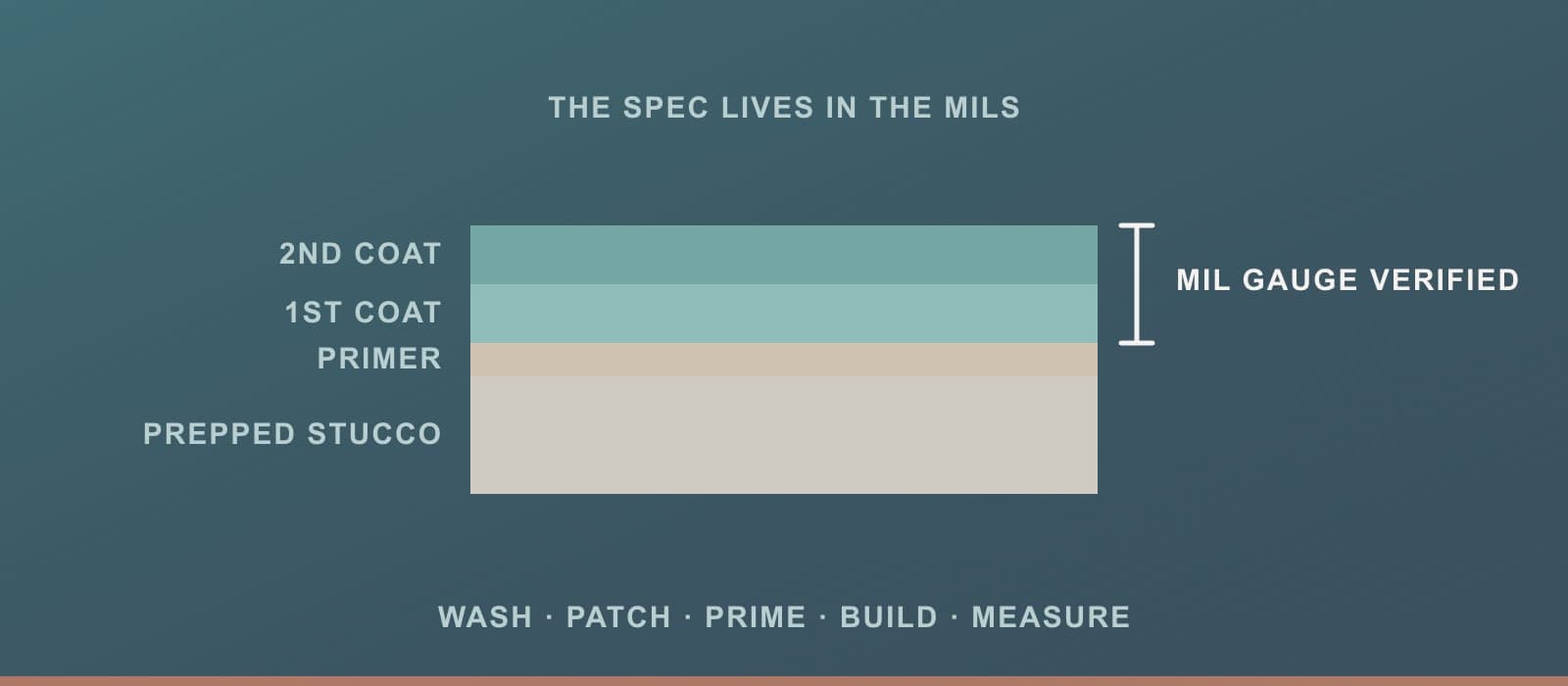
A "mil" is one one-thousandth of an inch. Coating manufacturers do not warrant a look. They warrant a dry film thickness (DFT), and every performance claim on the data sheet (UV life, crack-bridging, water resistance, perm rating) assumes that thickness was achieved.
Rough, typical numbers for a coastal exterior wall system:
- A conventional 100% acrylic: roughly 4 mils wet per coat, drying to about 1.5–1.7 mils per coat. Two coats → roughly 3–4 mils total DFT.
- A wall-grade elastomeric: manufacturers commonly require a total dry build in the neighborhood of 10 mils, roughly three times an acrylic, because the crack-bridging and waterproofing performance is the thickness. Applied at acrylic thickness, an elastomeric is simply an expensive acrylic that fails at cracks anyway.
Always confirm the actual numbers on the product's technical data sheet. They vary by product and by substrate. The point is the ratio: you cannot spray an elastomeric "thin to save money" and still get an elastomeric.
The gallons audit: how a non-technical board member verifies film build
Here is the piece almost nobody publishes, and it is the single most useful thing a board can learn.
A gallon of liquid, spread perfectly, covers 1,604 square feet at 1 mil thick. That is fixed geometry, not marketing. But paint is mostly solvent and water that evaporates. Only the percent volume solids stays on the wall. So:
Theoretical coverage (ft² per gallon at 1 mil DFT) = 1,604 × % volume solids
Every technical data sheet lists percent volume solids. Work an example:
- An exterior acrylic at 38% volume solids → 1,604 × 0.38 = ~610 ft²/gal at 1 mil.
- Target 1.6 mils DFT per coat → 610 ÷ 1.6 = ~380 ft²/gal per coat, theoretically.
- Stucco texture, spray loss, and waste realistically consume another 20–40% → call it ~270–305 ft²/gal actually delivered per coat.
- On 100,000 ft² of wall, two coats → roughly 650–740 gallons of finish coat, before primer.
Now compare that against the bid. If a contractor is proposing two coats on 100,000 square feet and the material line (or the submitted product order) shows 350 gallons, the arithmetic is telling you the truth: the building is going to get roughly one thin coat's worth of solids spread over two passes. It will look flawless at final walkthrough. It will chalk through on the south and west elevations years early.
Ask every bidder for three things: the product technical data sheet, the specified dry mils and coats, and the estimated gallons of each product. Then check the arithmetic. You do not need to be a coatings inspector to divide.
And verify on the wall, not just on paper
- Wet-film comb gauge (ASTM D4414): a few dollars, pressed into the wet coating, reads the wet mils on the spot. Wet mils ÷ volume solids ≈ the dry mils you will get. A superintendent should be pulling wet-film readings on every elevation, every day, and logging them.
- Ultrasonic dry-film gauge (ASTM D6132): non-destructive DFT readings on non-metal substrates, for spot verification after cure.
- Tape adhesion test (ASTM D3359): a cross-hatch pull on an inconspicuous area confirms the new system is actually bonded to the old one.
- Gallon reconciliation at closeout: require the contractor to submit material invoices against the square footage painted. This costs nothing and is the most powerful clause a board can add.
Compatibility: what you can safely coat over
Coastal repaints are almost never over bare substrate. They are over 15 to 40 years of accumulated coating history, often including at least one elastomeric campaign.
- Never put a rigid coating over a moving one. A conventional acrylic applied over an existing elastomeric will pinhole and telegraph every crack the elastomeric was bridging.
- A sound elastomeric can usually be recoated with an elastomeric after cleaning and priming. A failing elastomeric (one that is blistered, drummy, or coming off in sheets) must be removed, and that is a demolition line item, not a prep line item.
- Chalk is not dirt. A heavily chalked surface can be washed, look clean, and still be releasing binder dust. That is what bonding primer is for, and it is why a chalk rub test belongs in the pre-bid walk.
- If the substrate itself is moving, no coating fixes it. Structural cracks, spalling stucco over corroding rebar, and delaminated render are concrete-restoration scope. Paint applied over them is money spent to hide a milestone-inspection finding for one season. (See our posts on stucco cracks: cosmetic vs. structural and concrete spalling in coastal condos.)
Why this is a reserve issue, not a paint issue
Under Florida's structural integrity reserve study requirements (§718.112(2)(g), Fla. Stat.), exterior painting and waterproofing sit on the component list, and the reserve contribution is driven by each component's remaining useful life. Since HB 913, reserves for these components generally cannot be waived or reduced by a simple owner vote the way they once could.
That changes the math on a repaint bid. A coating system that delivers its rated life gives the association a defensible 8-to-12-year cycle on the coast. A prep-and-film-build failure delivers 3 to 5. Over a 30-year horizon that is roughly three repaint cycles versus six or seven: the same work, funded twice. That gap does not show up as "we picked a bad painter." It shows up as a special assessment.
A repaint is one of the few envelope components where the association can buy remaining useful life with documentation: a photographed prep log, dew-point and moisture readings by elevation, wet-film gauge readings, and a gallon reconciliation is exactly the evidence a reserve professional can use to credit the full service life of the coating rather than a conservative default.
What Beachfront does differently
We are a licensed Florida contractor (CGC #1537131, CCC #1333921, CCC #1333373) and a certified applicator for the coating and waterproofing systems we install. That matters here for a specific reason: a manufacturer's warranty on a coastal wall system is conditioned on prep and film build being performed to their specification, and a certified applicator is the party the manufacturer will actually stand behind.
Because we self-perform pressure cleaning, concrete restoration, waterproofing, and painting, we do not have to hand a wall between three trades and hope the sequence holds. The crew that washes the building is accountable to the crew that coats it. When the wash exposes spalling, a drummy patch, or a failed sealant joint, the repair and the recoat are the same contract, not a change order and a three-week gap while a wall sits open through a hurricane-season afternoon storm.
And we document. Prep logs, dew-point and substrate-moisture readings by elevation, wet-film gauge readings, and material reconciliation at closeout, because on a coastal condo, that file is worth as much to the board as the paint is.
Serving condo and HOA boards, property managers, and commercial building owners across Florida, with coastal properties as our specialty.
Frequently Asked Questions
Why is the paint peeling on our condo building only a few years after it was painted? Almost always prep or film build, not paint quality. The three usual culprits are coating over a chalky or salt-filmed surface (adhesion loss), coating a wall that was still wet inside from washing or water intrusion (blistering), and applying less coating than the manufacturer requires (premature weathering). Look at how it is failing: sheets and flakes point to bond failure; bubbles point to trapped moisture; a thin, chalky, faded film that is still stuck points to insufficient mil build.
How long should a building dry after pressure washing before it can be painted? Typically 24 to 72 hours in coastal Florida, and longer on shaded north elevations, courtyards, and any wall that stays damp. "Dry to the touch" is not the standard. The substrate should read below about 12% moisture content on a masonry moisture meter, and the manufacturer's own threshold governs. Washing and coating the same day is one of the most common causes of blistering on coastal buildings.
How long does new stucco have to cure before it can be painted? The industry convention is a minimum of 28 days, but time alone is not the test. New stucco can start out near pH 13, and a standard acrylic generally needs the surface pH at or below about 10 (measured per ASTM D4262). If the schedule will not allow a full cure, an alkali-resistant masonry primer designed for high-pH substrates is required. Otherwise the alkali can chemically break down the coating's binder from behind, producing a soft, soapy film.
How can a board tell whether a contractor actually applied the right amount of paint? Do the gallons math. Multiply 1,604 by the product's percent volume solids (from the technical data sheet) to get square feet per gallon at one mil, divide by the specified dry mils per coat, then add 20–40% for stucco texture and spray loss. Compare that to the gallons in the bid and to the material invoices at closeout. Require wet-film comb-gauge readings (ASTM D4414) during application, and add a material-reconciliation clause to the contract.
Should our building use an elastomeric or a conventional acrylic? It depends on crack history, moisture behavior, and the existing coating. An elastomeric earns its cost where there is a pattern of hairline cracking and its performance depends on achieving a much higher dry film build, commonly around 10 mils total, versus roughly 3–4 mils for a two-coat acrylic. But a low-perm elastomeric over a wall that is still taking on water will blister. The right call comes from a condition assessment, not from a product preference. We cover the trade-offs in detail in elastomeric vs. acrylic exterior coatings.
Ready to Protect Your Property?
Tell us about your building and a Beachfront estimator will follow up with a clear scope and fair pricing.