Guidance
What Record Rain Just Told You About Your Building: A Reading Key, the Wet-Weather File, and the Clocks Before Repairs
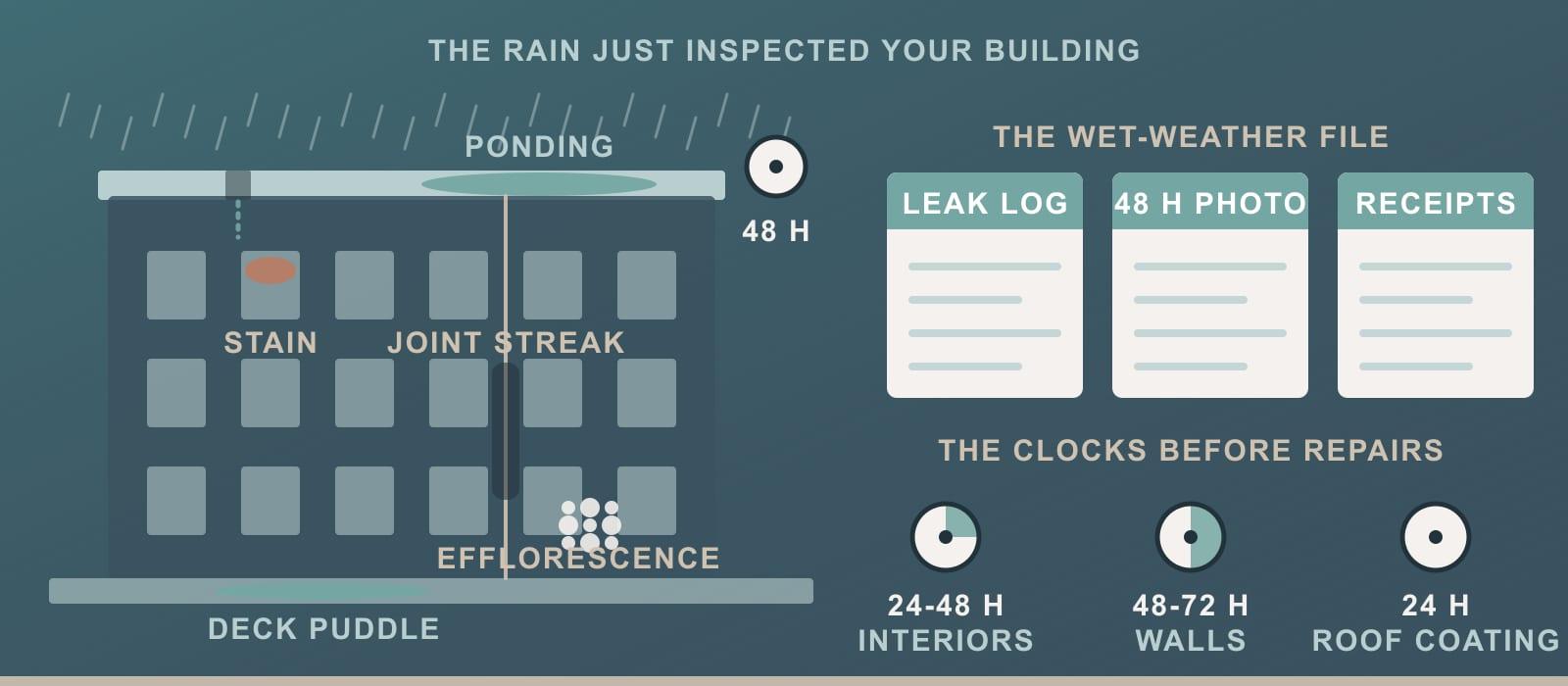
Forecasters are calling parts of this week's Florida rain a 1,000-year event. For most buildings it is not a claim; it is the most thorough leak test the envelope will get this year, and the evidence fades within about 72 hours of the rain stopping. This guide gives owners, property managers, facility managers, and multifamily operators the reading key (what each water symptom points at), the wet-weather file to build while it is still wet, the manufacturer and agency clocks that say when repairs can start, and the priority order that turns the findings into dry-season scope.
Beachfront Commercial Services ·
Forecasters are calling parts of this week's rain on Florida's southeast coast a 1,000-year event. For most buildings it is not a claim. It is the most thorough leak test your envelope will get this year, it was free, and most of the evidence it left behind evaporates within about 72 hours of the rain stopping. This is the reading key: what each water symptom usually means, what to record while it is still wet, what not to do until the building dries, and how the findings become the scope for the dry season that follows.
The numbers, as forecasters report them: 1 to 3 inches along Florida's southeast coast by Sunday afternoon per the National Weather Service in Miami, more than a foot in the hardest-hit parts of that coast, 17 inches in 6 hours at the worst of it, and more than 26 inches in 24 hours farther up the coast by Monday. The building implication is simpler: every drain, joint, flashing, and slope on your property was just tested at a load it may not see again for years, and the results are written on the building right now.
Why a rain week is a diagnostic, not just a cleanup
A fall wash is the cheapest envelope diagnostic there is, because a wet wall shows what a dry wall hides. Heavy rain does the same thing without the invoice. Water finds the low point, the open joint, the slab edge without a drip, and the deck that no longer slopes to its drain. Then it leaves marks: a tide line, a stain, a white bloom, a puddle that is still there on day three.
The catch is the clock. Stucco and concrete dry from the surface in, so a wet patch below a failed joint fades within days. Ponded water drains, evaporates, or soaks into the insulation, and only the first two are visible a week later. The window for reading the building is roughly the 72 hours after the rain stops. After that you are back to buying the information with a wash, a moisture survey, or a leak you did not plan for.
The reading key: what each water symptom usually points at
Water tells you where it got in by where it came out, if you read it before it dries. Each row is a pointer, not a diagnosis; the diagnosis comes from the walk and the file.
| What you see | What it usually means | What it points at | Record now |
|---|---|---|---|
| Water still standing on the roof 48 hours after the rain stops | Ponding by the roofing industry's definition, not a puddle still draining | A clogged drain or scupper, a low spot, or a slope the membrane never had | A photo at the 48-hour mark with something for scale, located on a roof sketch |
| Water sheeting over a parapet, or no flow from an overflow scupper during the rain | The primary drain backed up and the secondary path did not take over | Strainers, scupper openings, overflow sizing | Video of each drain and scupper during or right after the rain |
| A top-floor ceiling stain with no plumbing above it | Water through the roof assembly | The field of the roof, a penetration, or a flashing above that spot | Unit, room, time first seen, and a photo with a dated object in frame |
| A stain at the head or corner of a window or sliding door, any floor | Water through the wall or the opening, not the roof | The sealant joint, the head flashing, or a missing or failed sill pan | A photo inside and the matching spot outside |
| A dark, wet streak on stucco below a joint, a slab edge, or a railing post | A pathway through the wall, usually a joint that has let go or a crack behind the paint | The joint above the streak, the slab-edge drip, the post pocket | A photo while wet, then the same photo dry to see what stays |
| A white, chalky bloom on concrete or stucco once the surface dries | Efflorescence: water moved through the material and left its salts behind | A moisture path that keeps running until the entry point is closed | Photo and location; note whether it returns after the next rain |
| Puddles that stay on a garage, plaza, or pool deck | A deck that no longer slopes to its drains, or a drain that cannot take the flow | Slope, drains, and the joints the water sat over | Photos at 24 and 48 hours; note which joints sat under water |
| Drips or staining under a balcony slab edge, or at the deck-to-wall corner | Water running under the deck coating or into the wall where the deck meets it | Edge termination, deck-to-wall flashing, threshold | The underside and the edge above it |
Several rows have their own guides: the guide to ponding water on flat roofs (the 48-hour rule and the three causes), the guide to why balconies and decks leak at the edges, the guide to joint sealants on coastal buildings, and the drainage section of the parking-garage restoration guide.
One rule for the roof: nobody goes onto a wet membrane for the 48-hour photo. Wet single-ply is slippery, saturated insulation can hide a soft deck, and a picture from a drone, an adjacent floor, or the roof hatch is good enough for the file.
The wet-weather file: what to record while it is still wet
The file serves three readers who want the same evidence: the maintenance scope, so dry-season work is priced against facts; the warranty file, because membrane and coating warranties run on dated leak reports; and the claim, if any part of this becomes an insurance matter. Insurance educators give business owners the same instructions after every event: contact the insurer promptly, make temporary repairs and secure the property, photograph or video the damage before anything is discarded, and keep receipts, repair bills, and estimates together. Florida's Chief Financial Officer adds that most policies require emergency repairs to stop further damage, and to keep the receipts.
What goes in the file:
- Wide to tight, every elevation. The whole face, then the affected area in context, then the detail, so every close-up can be placed on the building later. It is the sequence adjusters, engineers, and estimators all read.
- Timestamps that survive. Leave the camera's date and time on the file, and put something dated in the frame when a photo matters.
- A leak log with four fields. Unit or room, where the water appeared, when it was first seen, and what was above or outside that spot. Tenant reports go into the same log through one channel.
- The 48-hour roof photo, from a safe vantage, located on a sketch of the roof. It is the single most useful picture in the drainage conversation.
- Drain and scupper video. Thirty seconds at each primary drain and each overflow during or just after the rain. Flow or no flow is the whole question.
- The deck puddle map. Which areas held water at 24 and 48 hours, and which joints sat under it.
- Mitigation, documented like damage. Every tarp, extracted room, and dehumidifier, with a photo and a receipt, kept separate from the permanent scope so emergency work never prices the permanent work.
- Your pre-rain baseline, attached. The last dated roof inspection, the last envelope assessment, the maintenance invoices. Roofing contractors and claims consultants report that the first question in any damage conversation is whether the condition was already there; a dated condition report answers it with evidence. If your building has no baseline, this week is the argument for one, and the roof preventive-maintenance guide shows what the file looks like.
For a multifamily operator the file has a fourth reader: the tenant. A log that shows when each report came in and what was done about it is the difference between a wet week and a retention problem.
What not to do yet, and the clocks
Most mistakes in the week after heavy rain come from doing the right repair on the wrong day. Every coating, sealant, and patch below is the right tool in its conditions. The conditions are the point.
| Do not do this yet | Why | The clock, and who sets it |
|---|---|---|
| Pressure wash the walls to "clean up" | The rain already did the diagnostic pass, and a wall washed again before it dries stays wet | 48 to 72 hours of dry weather before coating work (coatings guidance for stucco), confirmed with the plastic-sheet moisture test, ASTM D4263, at least 16 hours |
| Coat a roof that held water | Coating data sheets require a clean, dry surface, say not to apply when rain or heavy dew is expected within 24 hours of finishing, and exclude roofs that keep ponded water past 48 hours; most membrane warranties require positive drainage | 24 hours clear of rain after application and no ponding past 48 hours (roof coating manufacturers; the roofing industry's ponding definition) |
| Caulk a joint with water in it | Sealant sheets want a clean, sound joint; even the polyurethanes rated for damp concrete require all standing and excess water removed and about 60 minutes of drying before the bead goes in | Standing water out and a drying interval first; then 7 days of cure before paint goes over polyurethane (sealant manufacturers' data sheets) |
| Paint over a patch or a stain | Fresh stucco and concrete need their cure, and the stain needs its source closed first | 28 to 30 days of cure for mortar and concrete before coating, with a surface pH check (coating manufacturers' surface preparation guidance) |
| Leave wet interiors to "air out" | Drywall, insulation, and carpet that stay wet become a bigger scope than the leak that wet them | 24 to 48 hours: the EPA's guidance is that wet or damp materials dried within that window will not grow mold in most cases |
| Leave wet roof insulation under a dry membrane | Saturated insulation loses its insulating value, adds weight, and corrodes decks, and it does not show from above | Before any coating decision: a moisture survey or core sample where the 48-hour photo showed ponding |
What you can do this week: clear drains and scuppers from a safe position, tarp or dry-in anything actively letting water in, dry the interiors inside the 48-hour window, mark the ponds, and keep writing the file. That is mitigation. The permanent scope waits for a dry building and a documented inspection. The exterior coating timing guide covers the weather windows; the moisture test, not the calendar, decides when the coatings line starts.
From rain-week findings to dry-season scope
The dry season runs November through April by the regional climate definition, and this week's rain does not cancel it. It gives it an agenda. The first dry window after the rain, roughly 48 to 72 hours after it stops, is the best envelope walk of the year: the stains are fresh, the ponds are marked, the efflorescence has not been washed off, and every joint that let go is pointing at itself. A walk a month later finds a clean building and a shorter list, and the shorter list is wrong.
The walk turns the reading key into line items, in a fixed priority:
- Active water intrusion first. Anything on the leak log that put water inside a unit, a stairwell, or a mechanical room is scoped before anything cosmetic, because it compounds.
- Drainage second. Ponds that outlasted 48 hours and decks that held water get a drainage answer (strainers, scuppers, added drains, slope correction) before any coating goes on, because coating over a drainage problem buys nothing. The code's own assumptions are the yardstick: a membrane roof is designed to a slope of at least a quarter inch per foot, and where roof drains are required, secondary overflow drains or scuppers are required where the perimeter would otherwise trap water.
- Joints and terminations third. The sealant joints, slab edges, railing posts, and deck-to-wall corners the streaks pointed at, counted in linear feet by elevation so the scope is a number and not an adjective.
- Coatings last, with the clocks on the calendar. Roof and wall coatings go on dry substrates, after the repairs under them have cured, inside the manufacturer's conditions.
For a budget-season reader this is the order of the money. The rain just sorted your dry-season list by consequence. Capital that goes to intrusion and drainage first protects everything spent after it; capital that goes to coatings first gets spent twice.
What a fall envelope assessment gets you after a week like this
Our fall envelope assessment is the documented walk described above, done in the first dry window and written up as a file you can hand to a board, a lender, or an adjuster:
- The reading key applied to your building. Every stain, streak, pond, and bloom from this week tied to a location, a probable mechanism, and a recommended test, with timestamped photos.
- Drainage checked, not assumed. Drain and scupper function, the 48-hour ponds mapped on a roof sketch, deck slope and drain capacity on the garage and plaza levels.
- Joints and terminations in linear feet by elevation, and concrete and stucco sounded where the streaks pointed, so the scope carries quantities.
- A priced scope in priority order, intrusion first, drainage second, joints third, coatings last, with each cure clock placed on a dry-season calendar.
- Your baseline for next time. The file that answers "was it already like that" with a date on it.
Because we self-perform pressure cleaning, roofing, concrete restoration, waterproofing and sealants, and painting with W-2 crews, the findings go from the file to a schedule under one supervisor and one access plan. Licensed and insured, a Florida contractor with coastal properties as our specialty (CGC #1537131 · CCC #1333921 · CCC #1333373). After this week, the first dry days are the ones to book.
561-557-8534 · beachfrontcs.com · info@beachfrontcs.com
Frequently asked questions
How long after heavy rain should a building be inspected? In the first dry window, roughly 48 to 72 hours after the rain stops: late enough that ponding by the 48-hour definition is visible, early enough that stains, streaks, and efflorescence are still on the building. Interiors do not wait; wet materials need drying within 24 to 48 hours.
Is standing water on a flat roof after rain a problem? Water that drains or evaporates within 48 hours under drying conditions is normal. Water still standing after 48 hours is ponding by the roofing industry's definition, and it points at a clogged drain, a low spot, or a slope the roof never had. Most coating data sheets and membrane warranties treat it as outside their terms, so it is a drainage line item before it is a coating decision.
Can we paint or caulk right after the rain? Not with water on the surface. Coatings need a clean, dry substrate and about 24 hours clear of rain after application; sealants need standing water removed and a drying interval even on products rated for damp concrete. Walls want 48 to 72 hours of dry weather, confirmed with the moisture test, and patches need 28 to 30 days of cure.
Do we need to call the insurer for rain damage? For most buildings, most of what the rain revealed is maintenance, not a claim. Where water came inside and caused damage, insurance educators advise contacting the insurer promptly, making temporary repairs to prevent further damage, photographing before anything is discarded, and keeping receipts and estimates together. The policy's notice terms govern, and that is a conversation for your agent or carrier.
What should be photographed after heavy rain? Every elevation wide to tight, every interior leak location with a dated object in frame, the roof from a safe vantage at the 48-hour mark, each drain and overflow scupper during the rain, the deck areas that held water at 24 and 48 hours, and every piece of mitigation with its receipt, timestamps left on, kept in one place.
This article is general information about reading and documenting a building after heavy rain. It is not engineering, legal, or insurance advice. Policy terms, notice deadlines, and coverage are matters for your agent, carrier, or counsel; structural questions are matters for a licensed engineer.
Ready to Protect Your Property?
Tell us about your building and a Beachfront estimator will follow up with a clear scope and fair pricing.