Waterproofing & Sealants
"We'll Caulk It" Is Not a Sealant Scope: Joint Sealants on Coastal Florida Condos, Explained for Boards
Sealant joints are the first thing to fail on a coastal condo and the first thing cut from a low bid. A Florida board's guide to recaulk cadence, silicone vs. urethane, ASTM C920/C1193 joint design, and why paintability and staining decide the spec.
Beachfront Commercial Services ·
Direct answer: On a coastal Florida building, correctly installed facade sealant joints last roughly 7 to 15 years (less than that on the windward, sun-loaded elevations), so a condo board should treat sealant as a funded waterproofing component on its own maintenance clock, not as a line buried inside a repaint bid. The joint is what actually keeps water out of the wall; the paint is what makes the wall look finished. When a proposal says "caulk as needed," the board has not bought a sealant scope, and it will pay for the difference twice.
This is one of the least glamorous scopes on a building and one of the most consequential. A stucco crack is visible from the parking lot. A failed sealant joint at a window head is invisible from anywhere, until a unit owner on the third floor calls about a stain running down the drywall beside the slider.
General information for boards, CAMs, and owners, not engineering or legal advice. Joint design and product selection on a specific building should be confirmed against the manufacturer's technical data sheet and, where structural or life-safety conditions exist, a licensed design professional.
What a "sealant joint" actually is (and the four families on your building)
A sealant joint is an intentional gap between two building elements, filled with an elastomeric material that is designed to stretch and compress as those elements move. It is a moving waterproofing detail, not glue.
Every coastal condo has four families of them:
1. Expansion joints. Wide, deliberate gaps that let the structure grow and shrink with temperature and let separate structural sections move independently. Common at building wings, at the garage-to-tower interface, and across long plaza and podium decks.
2. Control joints. Narrower joints tooled or sawn into stucco, CMU, and precast to control where cracking happens. They are supposed to crack. That is the point.
3. Perimeter joints. The joint between a window frame, a sliding-glass-door frame, or a louver and the wall opening. This family causes the most water-intrusion complaints on Florida condos because it sits directly above occupied interior space.
4. Penetration and terminal joints. Railing base plates, shutter and screen anchors, hose bibs, conduit, light fixtures, and the top and bottom terminations of a balcony coating. On the coast, these are also the chloride entry points into the slab edge.
Add them up on a 12-story tower and you are frequently looking at tens of thousands of linear feet of sealant. It is the longest single line of defense on the building, and it is one continuous material that is only as good as its weakest 3 feet.
The coastal service-life clock: 7–15 years, and less where the sun is
A quality sealant, correctly specified and correctly installed, generally holds 7 to 15 years in Florida's coastal climate. Coastal properties in Fort Lauderdale, Miami Beach, Singer Island, and Jupiter tend toward the lower end; sheltered inland elevations toward the upper end.
Four things are eating the joint:
- UV. South Florida runs a UV index of 10–11 for a large part of the year. UV is what breaks down the polymer backbone of an organic sealant.
- Thermal cycling. A dark south- or west-facing wall surface can run 30°F above ambient. The joint opens and closes every single day, thousands of cycles per decade.
- Salt air and wind-driven rain. Airborne chloride deposits on windward elevations between rains; hurricane-season rain is driven horizontally into the joint rather than falling past it.
- Building movement. Structural movement, settlement, and (on high-rises) wind sway all show up as joint strain.
The practical consequence: the sealant clock (7–15 years) and the coating clock (8–12 years on a coastal repaint) are not the same clock. Boards that recaulk only when they repaint leave the envelope open for the gap between the two. The right answer is not "recaulk when we paint." It is "inspect the joints on a schedule, replace them when they are done, and coordinate one of those replacements with the repaint so you only mobilize access once."
Silicone vs. polyurethane vs. hybrid: the three axes that actually decide it
Most articles on this compare silicone and urethane on "durability" and stop. That is not the decision. Here is the decision.
Axis 1: Weatherability (why silicone wins on UV)
The base polymer in silicone sealant is polydimethylsiloxane, built on a silicon–oxygen (Si–O) bond. Polyurethane is built on a carbon–oxygen (C–O) bond. The Si–O bond is inherently more stable under ultraviolet light. That is not a formulation advantage a good urethane can simply engineer around. It is a property of the backbone. Urethanes compensate with UV absorbers, antioxidants, and inhibitors, and good ones perform well, but on a fully exposed oceanfront elevation the chemistry is doing silicone a favor.
This is also why the warranty conventions diverge: silicone weatherproofing sealants commonly carry 10–20 year manufacturer warranties, while the industry-standard urethane warranty has historically been closer to 5 years. Over a 20-year horizon, that can be the difference between sealing the building once and sealing it three times.
Axis 2: Paintability (the trap on a repaint building)
Cured silicone is hydrophobic and low-surface-energy. Paint does not wet it. Waterborne acrylic applied over cured silicone fisheyes, beads, and peels. "Paintable" acrylic caulk applied over cured silicone will not bond to it either. You cannot fix a silicone joint by painting or caulking over it.
So on a building that will be repainted (which is most condos), the joint has to be assigned before the sealant is chosen:
- Joints that must disappear into the paint (stucco control joints, patched joints in the field of the wall) → polyurethane or a silane-terminated hybrid, which accept coating.
- Joints that must never be painted (window and door perimeters, glazing, high-movement expansion joints) → silicone, specified in a color, and masked and protected during the repaint so no one "helpfully" paints over it.
The single most common defect we find on a recently repainted coastal condo is a ribbon of cracked, peeling paint tracing every window perimeter on the building. That is not a paint failure. That is a crew that painted over silicone.
Axis 3: Staining on porous substrates
Some silicones can exude low-molecular-weight material into an adjacent porous substrate (stucco, limestone, coquina, cast stone, precast), leaving a permanent dark halo along both sides of the joint that no amount of washing removes. The test method for this is ASTM C1248, Standard Test Method for Staining of Porous Substrate by Joint Sealants, and manufacturers publish non-staining formulations tested against it.
Board takeaway: if silicone is going against stucco or stone, the scope should say non-staining silicone, tested to ASTM C1248. Two words in a spec that prevent a defect you cannot undo.
Quick reference
| Silicone | Polyurethane | Hybrid / STPE | |
|---|---|---|---|
| UV / weatherability | Best (Si–O backbone) | Good with UV package; degrades faster fully exposed | Very good |
| Typical warranty | 10–20 yr | ~5 yr (industry convention) | Varies; often 10+ yr |
| Paintable? | No | Yes | Usually yes (verify on the TDS) |
| Staining on porous stone/stucco | Possible. Specify non-staining per ASTM C1248 | Low | Low |
| Abrasion / traffic (decks, garages) | Weaker | Strong, the traffic-joint default | Good |
| Best home on a coastal condo | Window/door perimeters, glazing, high-movement facade joints | Painted facade joints, horizontal deck and garage joints, plaza decks | Where paintability and weathering both matter |
There is no universally correct chemistry. There is a correct chemistry per joint, and a real sealant scope says which goes where.
The two specifications that decide whether the joint survives
If a board learns nothing else from this article, learn these two. They are the sealant equivalent of specifying dry-mil build on a paint job: concrete, checkable, and routinely skipped.
1. ASTM C920: the classification, and movement capability
ASTM C920, Standard Specification for Elastomeric Joint Sealants, is how a sealant is classified: by Type (single- or multi-component), Grade (pourable/self-leveling vs. non-sag), Class, and Use. The number a board should care about is the Class, the movement capability: how far the sealant can stretch and compress relative to the joint width without failing. The common classes are ±12½%, ±25%, and ±50%.
A wide expansion joint on a building that moves (and every high-rise moves) needs a high-movement product. Putting a ±12½% sealant into a joint that opens and closes 30% is a scheduled failure. The scope should name the ASTM C920 class, not just the brand.
2. ASTM C1193: joint geometry, backer rod, and the failure nobody sees
ASTM C1193, Standard Guide for Use of Joint Sealants, governs the shape of the installed bead. Two rules matter:
The 2:1 rule. For joints roughly ½ to 1 inch wide, the sealant depth should be about half the joint width (with a practical minimum around ¼ inch). For joints wider than 1 inch, depth generally holds at about ½ inch regardless of how wide the joint gets. A sealant bead that is too deep is not stronger. It is stiffer, and it tears.
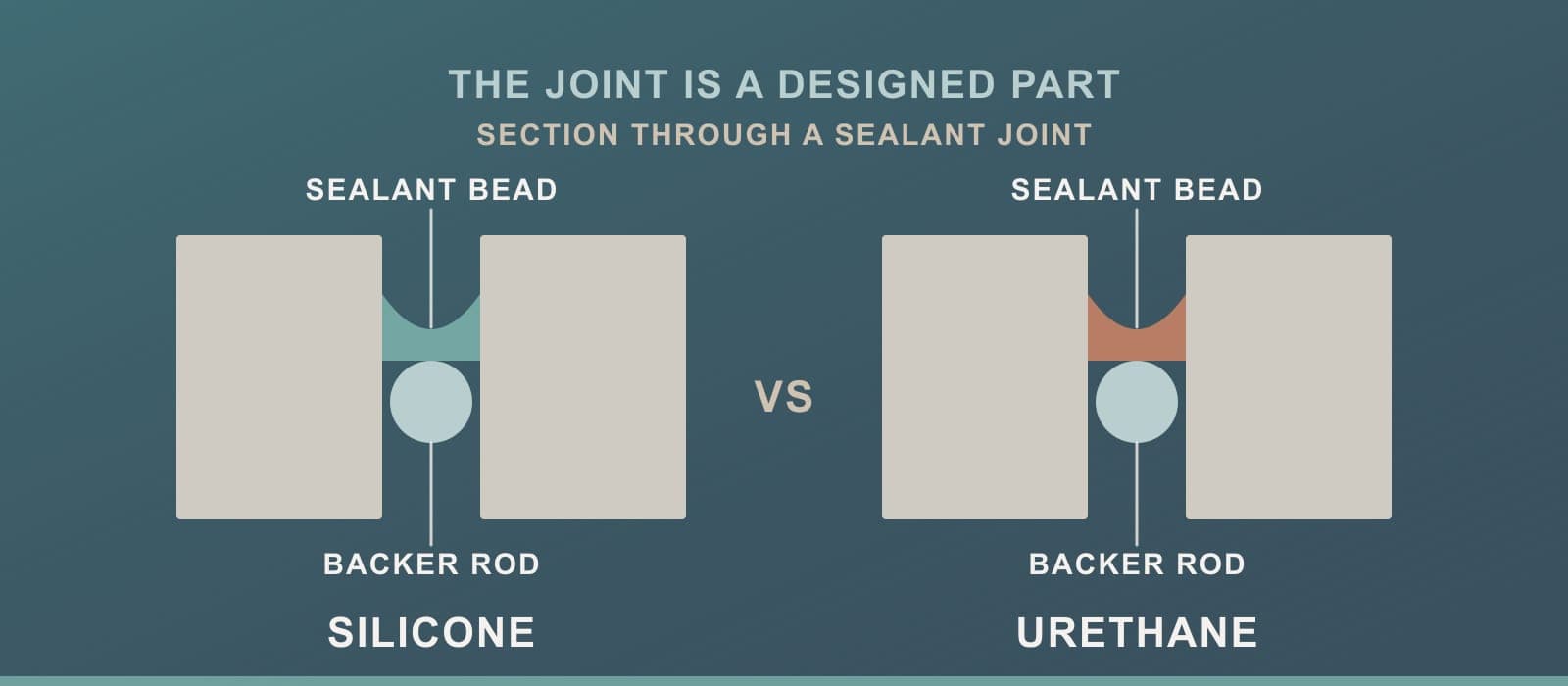
Two-sided adhesion, never three. A backer rod (a closed- or open-cell foam rod compressed into the joint behind the sealant) does three jobs at once: it sets the depth, it forms the concave hourglass profile that lets the bead stretch, and it acts as a bond breaker so the sealant adheres only to the two joint faces and not to the back of the joint.
That last job is the one that matters most. Three-sided adhesion, sealant bonded to both faces and the back, is the single most common avoidable sealant failure in the field. A bead glued on three sides cannot stretch. The building moves, the bead cannot accommodate it, and it splits straight down the middle. It looks like a bad product. It is a missing $0.10 piece of foam.
How a board checks this without being a waterproofing expert: ask the contractor, on site, to show you the backer rod going into the joint. If nobody can point to a bag of it, you are buying a three-sided failure.
How coastal sealant joints actually fail: a field taxonomy
Learn to read a failed joint and you can tell whether your last recaulk was done correctly.
| What you see | What it means |
|---|---|
| Sealant has pulled cleanly away from one face, leaving a smooth-backed strip | Adhesive failure: the joint face was dirty, wet, chalky, or unprimed. A workmanship/prep failure. |
| Sealant split down the middle but is still stuck to both sides | Cohesive failure: either the movement exceeded the product's C920 class, or the bead is three-sided/too deep. A design failure. |
| Bead is hard, glossy, and crazed; cracks when you press it | UV and thermal degradation: end of service life. It has done its job. |
| Layers of sealant visible in the joint, bulging or lumpy | Caulk over old caulk. The new bead is bonded to a failing bead, not to the building. It will fail on the old bead's schedule, not the new one's. |
| Dark halo in the stucco or stone on both sides of a joint | Staining: a non-tested silicone against a porous substrate (see ASTM C1248). |
| Cracked, peeling paint ribboning every window perimeter | Paint applied over silicone. Not a paint defect. |
| Rust-staining or hollow-sounding stucco below a failing joint | The joint is no longer the problem. Water has reached the reinforcing steel. See below. |
The escalation: why a $12/LF joint becomes a $100/SF repair
This is the part boards do not see coming, and it is the reason sealant deserves its own budget line rather than a checkbox in a paint proposal.
Commercial sealant work in South Florida generally runs on the order of $5 to $18 per linear foot, depending on joint size, removal method, building height, and access (swing stage and boom time drives this more than the material does).
Leave the joint open and the coastal failure chain runs on its own:
- Water enters the joint at a window perimeter or a railing base plate.
- It reaches the CMU or concrete behind the finish and stays there. Walls on the coast do not get a chance to dry out for long.
- Airborne chlorides ride in with the water to the reinforcing steel.
- Steel corrodes. Corrosion product occupies several times the volume of the original steel.
- The concrete cracks, delaminates, and spalls.
Now you are not buying sealant. You are buying concrete restoration (chip to sound concrete, treat or replace the steel, patch with polymer-modified mortar, re-profile, re-waterproof, and recoat), which on a South Florida condo commonly runs $50 to $150+ per square foot of repaired area, plus access, plus engineering, plus the reserve consequence.
A recaulk is maintenance. A spall is a capital event. The joint is where you choose which one you are funding.
Where sealant sits in the board's paperwork: milestone, SIRS, and the reserve
Three places a Florida board will encounter its sealant joints whether it planned to or not:
The milestone inspection (F.S. §553.899). A milestone walk is looking for substantial structural deterioration. Perimeter water intrusion at joints and penetrations is precisely how that deterioration gets started, and the visible evidence (staining, efflorescence, spalling below a joint line, corroded railing anchors) is exactly what an inspecting engineer photographs.
The DBPR HR-7020 balcony inspection (F.S. §509.2112), where it applies. Railing-post base plates and balcony coating terminations are sealant joints. Corroded, loose, or leaking railing anchorage is a life-safety finding, not a cosmetic one.
The SIRS (F.S. §718.112(2)(g)). Waterproofing and exterior painting are among the components a Structural Integrity Reserve Study must address. Remaining useful life drives the reserve contribution, and documented, on-cadence joint maintenance is part of the evidence that the envelope's RUL is what you say it is. A board that can produce a dated sealant inspection log and a linear-foot replacement record is a board making a defensible case to its reserve professional. A board that cannot is guessing.
Funding: routine joint inspection and spot repair generally belongs in the operating budget. A full building recaulk (tens of thousands of linear feet, mobilized access, a defined service life) behaves like a reserve component. Mixing them up is how associations quietly drain the reserve on maintenance and then get surprised by a special assessment.
What a real sealant scope of work contains
Print this. It is the difference between three comparable bids and three numbers that mean nothing.
- A linear-foot quantity, by joint type. Expansion joints, control joints, window perimeters, door perimeters, penetrations: counted, not "as needed."
- The product, by ASTM C920 Type / Grade / Class / Use, per joint family, not "high-quality sealant."
- Non-staining certification (ASTM C1248) for any silicone against stucco, stone, or precast.
- Full removal of existing sealant to sound substrate, explicitly stating that new sealant will not be applied over old sealant.
- Joint preparation: cleaning method, solvent wipe, and primer where the manufacturer's TDS requires it on that substrate.
- Backer rod: type and size, with joint geometry per ASTM C1193 (2:1 width-to-depth; two-sided adhesion only).
- Tooling: the bead is tooled to a concave profile, not left as-gunned.
- A field adhesion mock-up on the actual substrate before full production. Most reputable manufacturers will run project-specific adhesion testing at no charge, and it is the cheapest insurance in the scope.
- Paint coordination: which joints get coated, which get masked and protected, and who is responsible if silicone gets painted.
- Warranty: the manufacturer's material/system warranty and the contractor's workmanship warranty, in writing, with what voids each.
If two bids differ by 30% and only one of them contains items 4 through 8, you now know exactly what the cheaper bid removed.
Where Beachfront fits
Beachfront Commercial Services is a licensed and insured Florida contractor (CGC #1537131 · CCC #1333921 · CCC #1333373), with coastal properties as our specialty. Sealants are one of our core self-performed service lines, and we are certified applicators for coating and sealant systems from manufacturers including Sika, Tremco, Pecora, and Dow, which means the joint is specified against a real technical data sheet, not against whatever is on the truck.
Because we also self-perform concrete restoration, waterproofing, and painting, we can do the thing that actually saves an association money: sequence the joints, the substrate repairs, and the coating into one mobilization of access. Swing stage and boom time is often the largest single cost on a high-rise envelope project. Sealing the joints on one trip and painting on another is paying for the building twice.
We do not perform milestone inspections or write SIRS reports, and we think boards should keep the inspecting engineer separate from the repair contractor. What we do is execute the remediation and hand the board the documentation (quantities, products, dates, photos) that feeds the reserve study and the next inspection.
Frequently Asked Questions
How often should a Florida condo replace its exterior sealant joints?
Plan on a 7-to-15-year replacement cycle, with coastal and sun-exposed elevations at the short end of that range. Inspect the joints annually, walking the ground-level and accessible elevations and pressing the bead for hardness, checking for pull-away at the joint faces, and looking for staining below joint lines. Replace them when they are done, not only when you happen to be repainting; the sealant clock and the 8-to-12-year coastal coating clock are different clocks.
Should we use silicone or polyurethane on our building?
Both, in different places. Silicone for window and door perimeters, glazing, and high-movement facade joints, because its silicon–oxygen backbone is inherently more UV-stable. But it cannot be painted, and it should be a non-staining formulation tested to ASTM C1248 where it meets stucco or stone. Polyurethane (or a silane-terminated hybrid) for joints that need to be painted and for horizontal, trafficked joints on decks and in parking garages, where abrasion resistance matters. A proper scope assigns a chemistry to each joint family.
Can we just caulk over the existing caulk to save money?
No. New sealant applied over a failing bead bonds to the old bead, not to the building. It will fail on the old sealant's schedule, and you will have paid to install a failure. The existing sealant must be fully removed to sound substrate, the joint faces cleaned and primed as the manufacturer's data sheet requires, new backer rod installed, and the new bead tooled. Full removal is the line item cut-rate bids delete.
What is "three-sided adhesion" and why does it matter?
It means the sealant has bonded to both faces of the joint and to the back of it. A bead stuck on three sides cannot stretch, so when the building moves it splits down the middle. It is the most common avoidable sealant failure in the field, and it is prevented by a backer rod, a foam rod that sets the depth, forms the hourglass profile, and acts as a bond breaker so the sealant adheres to two sides only. ASTM C1193 also sets the geometry: roughly a 2:1 width-to-depth ratio on typical joints. If a bid does not mention backer rod, it is not a sealant scope.
What does building caulking cost per linear foot in South Florida?
Commercial sealant replacement generally runs in the range of $5 to $18 per linear foot, driven mostly by joint size, the difficulty of removing the existing sealant, and, above all, building height and access. Compare that to concrete restoration, which commonly runs $50 to $150+ per square foot of repaired area once water has reached the reinforcing steel. The joint is the cheapest place on a coastal building to stop water.
Does sealant work belong in the operating budget or the reserve?
Routine inspection and spot repair generally belongs in operating. A full building recaulk (a defined quantity of linear feet, a mobilization of access, and a known service life) behaves like a reserve component, and waterproofing is among the items a Structural Integrity Reserve Study under F.S. §718.112(2)(g) must address. Documented, on-cadence joint maintenance also supports the remaining-useful-life case that drives your annual reserve contribution.
Ready to Protect Your Property?
Tell us about your building and a Beachfront estimator will follow up with a clear scope and fair pricing.