Painting
The Best Time of Year for Exterior Coating Work in South Florida: A Condo Board's Weather-Window Guide
When should a South Florida condo repaint, waterproof, or roof-coat? The dry season (roughly November–April) is best, but the real rule is daily: surface temperature 5°F above the dew point, humidity under 70%, and 24–48 hours dry to cure. Here's how boards schedule it.
Beachfront Commercial Services ·
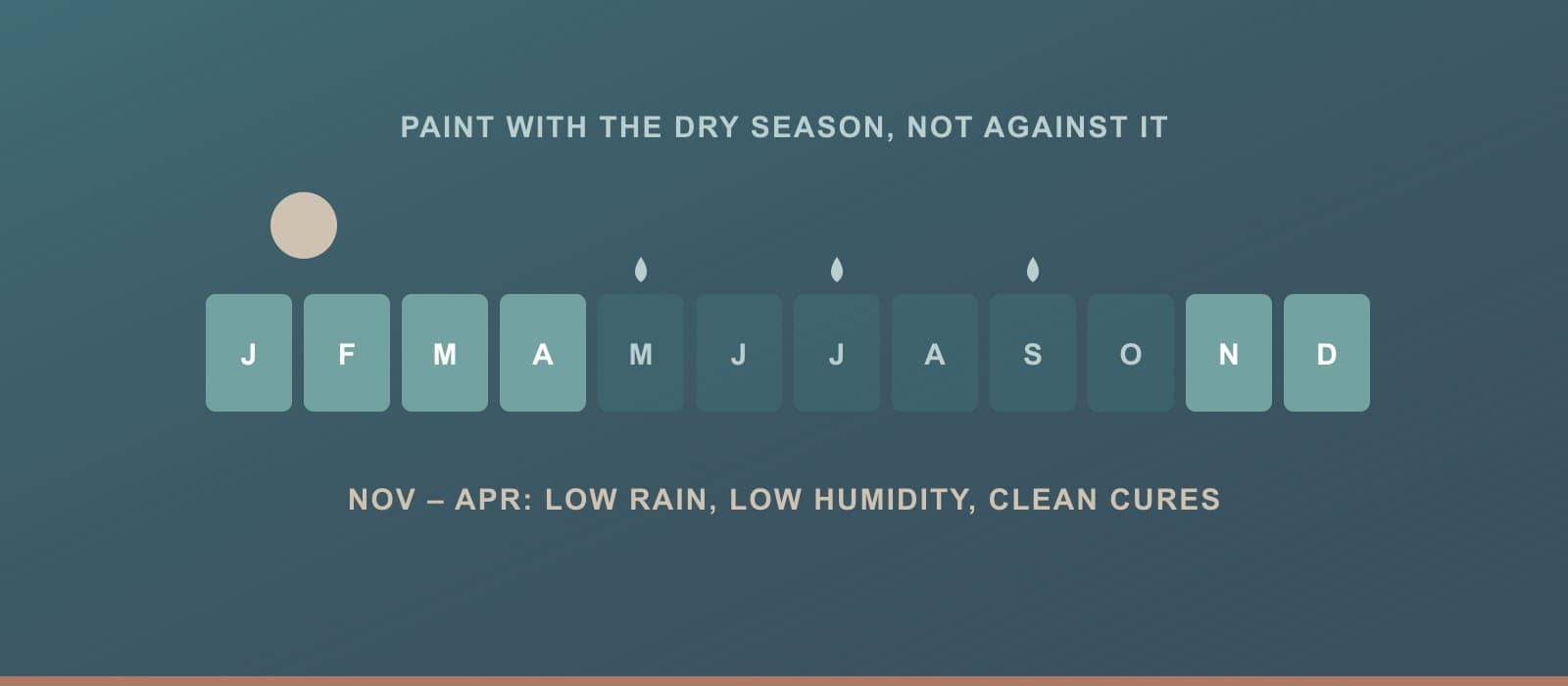
The best time for exterior coating work in South Florida is the dry season (roughly November through April), when lower humidity, fewer storms, and a wider dew-point spread let paint, elastomeric, waterproofing, and roof coatings cure the way they were engineered to. But the most important thing a board can understand is that the right window is not really a month on the calendar. It is a set of daily conditions: the surface must be at least 5°F above the dew point, relative humidity should be under about 70%, air and surface temperatures should sit between roughly 50°F and 85°F, and the forecast needs to give the coating 24 to 48 hours of dry weather to cure. Hit those numbers and a coating can last its full service life. Miss them (by washing and painting the same afternoon, or by racing a repaint to beat a summer storm) and you can blister, peel, or trap moisture into a film that should have protected the building for a decade.
For a Florida condo or HOA board, timing is also a project-management problem, not just a weather problem. The usable dry window is narrow, reputable crews book out, and milestone or reserve deadlines can push a job into exactly the wrong season if you wait too long to plan. This guide explains the South Florida coating calendar, the science behind the conditions, how the timing changes by coating system, and how boards schedule the work so a deadline never forces a bad-weather application.
A note on scope: This is general planning information for boards, CAMs, and owners, not engineering advice or a substitute for a coating manufacturer's written specification or a structural engineer's report. Always follow the product data sheet and your engineer's direction for your specific building.
South Florida Has Two Seasons, and Coatings Care About Both
Most of the country plans exterior work around temperature: you avoid the cold. South Florida is the opposite. Our limiting factor is water in the air and on the wall, and our year splits into two very different regimes.
The dry season runs roughly from November through April. Humidity drops, afternoon storms become the exception rather than the rule, dew points fall, and the daily window when a wall is safe to coat gets long and reliable. This is when the most demanding coatings (high-build elastomerics, waterproofing membranes, roof coatings) should ideally be applied.
The wet season runs roughly from mid-May through mid-October, and the Atlantic hurricane season officially runs June 1 through November 30. This is the period of daily convective thunderstorms, dripping morning dew points, and relative humidity that routinely sits above 80%. Coating work absolutely happens in these months (Florida buildings cannot all wait for winter), but it has to be weather-managed day by day, with early starts, tight forecast discipline, and staging that never leaves a wall or roof exposed before a storm.
Understanding why these seasons matter to a coating means understanding what a coating is actually doing while it dries.
Why Humidity, Dew Point, and Heat Decide Whether a Coating Lasts
A waterborne (latex/acrylic) coating doesn't just "dry." The water has to evaporate so the resin particles can flow together and fuse into a continuous, durable film, a process called coalescence. Anything that interferes with that evaporation interferes with the film.
Humidity slows the cure
When the air is already saturated with moisture, water can't leave the film efficiently. The coating stays soft and tacky far longer than the label suggests, which leaves it vulnerable to dirt, insects, runs, and washout. At sustained relative humidity above roughly 85%, the risk of blistering and weak adhesion climbs sharply. The practical target for exterior coating in our market is humidity under about 70%, which the dry season delivers and the wet season frequently does not.
Dew point is the rule the amateurs skip
Here is the single most important number in coastal coating work, and the one neither typical homeowner-focused article quantifies: the surface being coated must be at least 5°F (about 3°C) warmer than the dew point during preparation, application, and cure. This isn't a Beachfront house rule. It's the consensus of coating-inspection standards including ASTM D3276, ISO 8502-4, and the SSPC/AMPP painting manual, used on bridges, tanks, and high-rises worldwide.
Why it matters on a Florida morning: surfaces can be colder than the air: a shaded north wall or a slab that radiated heat away overnight can sit several degrees below ambient. If that surface temperature is at or near the dew point, invisible condensation forms on it even when the day "feels dry." Coat over that thin film of moisture and you've built a debond layer into the system. A professional checks surface temperature and dew point with instruments, not by touch, and waits for the 5°F spread before the first gallon opens.
Heat can be as bad as cold
Florida's other trap is the sun-loaded wall. A dark stucco elevation in direct sun can run 20–30°F hotter than the air, easily exceeding 120°F. On a surface that hot, the coating skins over before it can wet out and bond to the substrate. It sits on top instead of gripping, and peels later. That's why crews "chase the shade," coating elevations as the sun moves off them rather than baking a fresh film at midday.
The Daily Go / No-Go Checklist
Within the dry season, and on workable wet-season days, a coating crew should be making a daily decision against measurable conditions, not a hunch. The practical band for exterior architectural and masonry coatings in Florida:
| Condition | Target for exterior coating | Why |
|---|---|---|
| Air temperature | ~50°F–85°F (check product min/max) | Below the minimum, the film won't coalesce; above it, it skins too fast |
| Surface temperature | Within the product range and ≥5°F above dew point | Hot surfaces skin; surfaces near dew point trap condensation |
| Relative humidity | Under ~70% (avoid >85%) | High RH stalls evaporation, keeps film tacky, invites blistering |
| Dew-point spread | Surface at least 5°F above dew point (ASTM D3276 / SSPC) | The condensation safeguard during prep, application, and cure |
| Rain-free window after application | 24–48 hours dry (longer for elastomeric/membranes) | "Dry to touch" ≠ cured; early rain washes out and blisters the film |
| Time of day | Start mid-morning after dew burns off; chase shade; avoid 11am–3pm sun on dark walls | Avoids trapping morning dew and baking the film |
That rain-free rule deserves emphasis because it's where summer schedules fall apart. A quality exterior latex may be dry to the touch in one to two hours, but durable cure takes 24 to 48 hours, and high humidity stretches it further. In wet season, an afternoon storm can arrive before that window closes, which is exactly why the dry season is worth scheduling around.
Timing Changes by Coating System
"When should we paint" is really several questions, because a condo envelope isn't one coating. It's a stack of systems that cure differently. A board approving a combined repaint-and-waterproofing scope should know that the most weather-sensitive system sets the schedule.
Exterior wall paint (premium acrylic). The most forgiving of the group. It still wants the 50–85°F / <70% RH / dew-point-spread conditions, but its thinner film and faster cure give the most workable days, including managed wet-season mornings.
Elastomeric and high-build masonry coatings. Built at 10–20 mils, these thick films release water slowly. Recoat windows are commonly 24 hours or more and lengthen in high humidity, so they strongly favor the dry season. Manufacturer data sheets set hard limits. For example, Sherwin-Williams Loxon and Loxon XP masonry/waterproofing coatings specify application above 35°F with air, surface, and material temperatures all verified first. (Cold is rarely our problem; the humidity and moisture-in-substrate limits on the same sheets are.)
Waterproofing membranes and traffic coatings (balconies, decks, plaza). These polyurethane and acrylic systems are the most moisture- and substrate-sensitive of all. They require a genuinely dry substrate (verified by moisture testing, not appearance), tight dew-point control, and longer cure windows between coats. Dry season is strongly preferred, and rushing them in summer is a common cause of early failure.
Roof coatings (silicone, acrylic). Low-slope roof restoration coatings need a dry deck, no ponding, and a clear cure window before rain. Silicones tolerate humidity better than acrylics, but both want a reliable forecast. A roof coating applied with a storm hours away is a coating you'll redo.
Sealants and joint work. Joint sealants depend on clean, dry, properly primed joints; moisture in the joint at application is a leak waiting to happen. They're typically sequenced into the dry-out portion of the schedule.
Because the membrane and elastomeric systems are the constraint, a board's combined envelope project is, in practice, a dry-season project, even though the paint portion alone could flex into more of the year.
"Can We Just Do It in Summer?" The Honest Answer
Yes, and Florida contractors do it every week, but with discipline, and with a frank conversation about which parts of the scope are summer-appropriate. Here's how responsible wet-season work differs from a gamble:
- Early-day starts. Crews begin after the morning dew burns off and aim to have each section past its critical early-cure stage before the typical afternoon storm window.
- Forecast-driven go/no-go. Work is planned in short, defensible weather windows, never "we'll beat the rain." If the dew-point spread or the forecast fails, the wall waits.
- Stage so the building is never exposed. The cardinal rule before a storm: don't leave a wall stripped, a membrane half-applied, or a roof opened up. Sequencing keeps the building weather-tight at the end of every day.
- Right system for the season. Simple repaint touch-ups and acrylic wall coating tolerate managed summer days far better than a full balcony membrane replacement, which belongs in the dry window.
What separates a coating that lasts from one that fails in our climate is rarely the product. It's whether these conditions were respected. A reputable contractor will tell a board when a piece of scope should wait for November rather than risk it in August.
How Florida Boards Should Schedule the Work
The narrow dry window plus high demand means timing is a planning discipline. A few practices keep boards out of the trap of a deadline forcing a bad-weather job:
Book the dry season early, months ahead. The best crews fill their November–April calendars during the prior summer. A board that waits until October to solicit bids for a winter repaint is often pushed into spring or into managed summer work. Plan the procurement in the prior wet season.
Sequence a multi-week occupied job realistically. A full building envelope project runs wash → dry-out → repairs (stucco, concrete, sealants) → coating, often zone by zone so residents are never boxed in. Each stage has its own weather needs, and the dry-out and coating stages are the weather-critical ones. Build slack into the schedule for lost weather days rather than assuming a perfect run.
Write hurricane-season contingency into the contract. If any portion may run into June–November, the scope should spell out storm-staging responsibilities, who secures the site before a named storm, and how weather delays are handled, so the board isn't negotiating that during a watch.
Align coating work with compliance deadlines on purpose. Buildings three or more habitable stories may be coordinating a milestone inspection (Florida Statute §553.899) and a Structural Integrity Reserve Study (§718.112(2)(g)). If a milestone or reserve-driven scope (balcony waterproofing, concrete restoration, repaint) has to be executed, schedule the engineer and contractor early so the coating lands in the dry window. The worst outcome is a compliance clock forcing an elastomeric or membrane application into peak humidity. (See our companion guides on SIRS and reserve studies and on avoiding special assessments through preventive maintenance.)
Where Beachfront Fits
Beachfront Commercial Services is a licensed and insured Florida contractor (DBPR CGC #1537131, CCC #1333921, and CCC #1333373), with coastal properties as our specialty. Because we self-perform painting, waterproofing, sealants, concrete restoration, and roof coatings rather than handing the weather-critical stages to a chain of subs, one team owns the daily go/no-go decision across the whole envelope. We apply certified-applicator coating systems (Sherwin-Williams, Sika, Tremco, Pecora, and others) to their written specifications, verify surface temperature, dew point, and substrate moisture before coating, and stage occupied-building work so the structure stays protected through hurricane season. For boards coordinating a repaint or waterproofing scope around a milestone or SIRS deadline, we help plan the calendar so the work lands in the right weather window, not whenever the deadline happens to fall.
Frequently Asked Questions
What is the best month to paint a condo exterior in South Florida?
There's no single best month, but the most reliable window is the dry season, roughly November through April, with the heart of it often December through March. Lower humidity, fewer afternoon storms, and a wider dew-point spread give coatings the conditions they need to cure. The exact day still has to meet the conditions: humidity under ~70%, surface temperature at least 5°F above the dew point, and 24–48 hours of dry weather afterward.
Can you paint or coat a building exterior during summer or hurricane season in Florida?
Yes, with discipline. Wet-season work (mid-May through October) is done routinely, but it must be weather-managed: early-day starts, a forecast-driven go/no-go decision, the right system for the season, and staging that never leaves the building exposed before a storm. Full balcony membrane or high-build elastomeric work is best reserved for the dry season; simpler repaint scopes flex more easily into managed summer days.
What humidity is too high to paint?
As a working rule, exterior coating gets risky above about 70% relative humidity and should generally stop above 85%, where evaporation stalls, the film stays tacky, and blistering and adhesion problems become likely. Just as important is the dew-point spread. Even at moderate humidity, if the surface is within 5°F of the dew point, condensation can form and ruin adhesion.
How long should exterior paint dry before it rains?
Plan for 24 to 48 hours of dry conditions after application for a durable cure. A latex coating may be dry to the touch in one to two hours, but that is not the same as cured, and high humidity extends the time. Elastomeric coatings and waterproofing membranes need even longer. This rain-before-cure window is the main reason Florida's afternoon-storm summers are harder to schedule than the dry season.
Why does my condo's coating keep failing even though we use good paint?
In a coastal climate, premature failure is usually a conditions problem, not a product problem: coating over a damp wall after a same-day pressure wash, applying near the dew point, racing a storm, or baking the film onto a sun-loaded wall at midday. Verifying surface temperature, dew point, and substrate moisture before coating, and giving the system its full cure window, is what makes a quality product actually last its rated service life.
Ready to Protect Your Property?
Tell us about your building and a Beachfront estimator will follow up with a clear scope and fair pricing.