Roofing
Ponding Water on Flat Condo Roofs in Florida: The 48-Hour Rule, the Three Causes, and How Drainage Is Actually Corrected
A Florida condo board and property manager's guide to ponding water on flat and low-slope roofs: what the 48-hour rule means, why standing water voids warranties and adds structural load, the three root causes (inadequate slope, blocked drains, structural deflection), how each is corrected with tapered insulation, crickets, and scuppers, what it costs, and how it fits your milestone and SIRS reserve plan.
Beachfront Commercial Services ·
Short answer: On a flat or low-slope Florida roof, water that is still standing 48 hours after the rain stops is "ponding" (a recognized defect, not a normal puddle), and the correct fix depends on why the water sits, not on patching the spot where it pools. There are three root causes: inadequate slope, blocked or undersized drains, and structural deflection. Each one calls for a different correction (tapered insulation, drain work and overflow scuppers, or structural repair plus added drainage). Left alone through one wet season, ponding can void your roof warranty, soak the insulation under the membrane, and add thousands of pounds of unplanned load to the deck.
This guide is written for condo and HOA boards, community association managers (CAMs), and commercial building owners across Florida. It explains what counts as ponding, why it is worse on the coast, the three causes and their corrections, how it interacts with your manufacturer warranty and your reserve plan, and the questions to ask before anyone hands you a bid. (This is general information for planning, not engineering, structural, or code-interpretation advice. See the note at the end.)
What counts as "ponding": the 48-hour rule
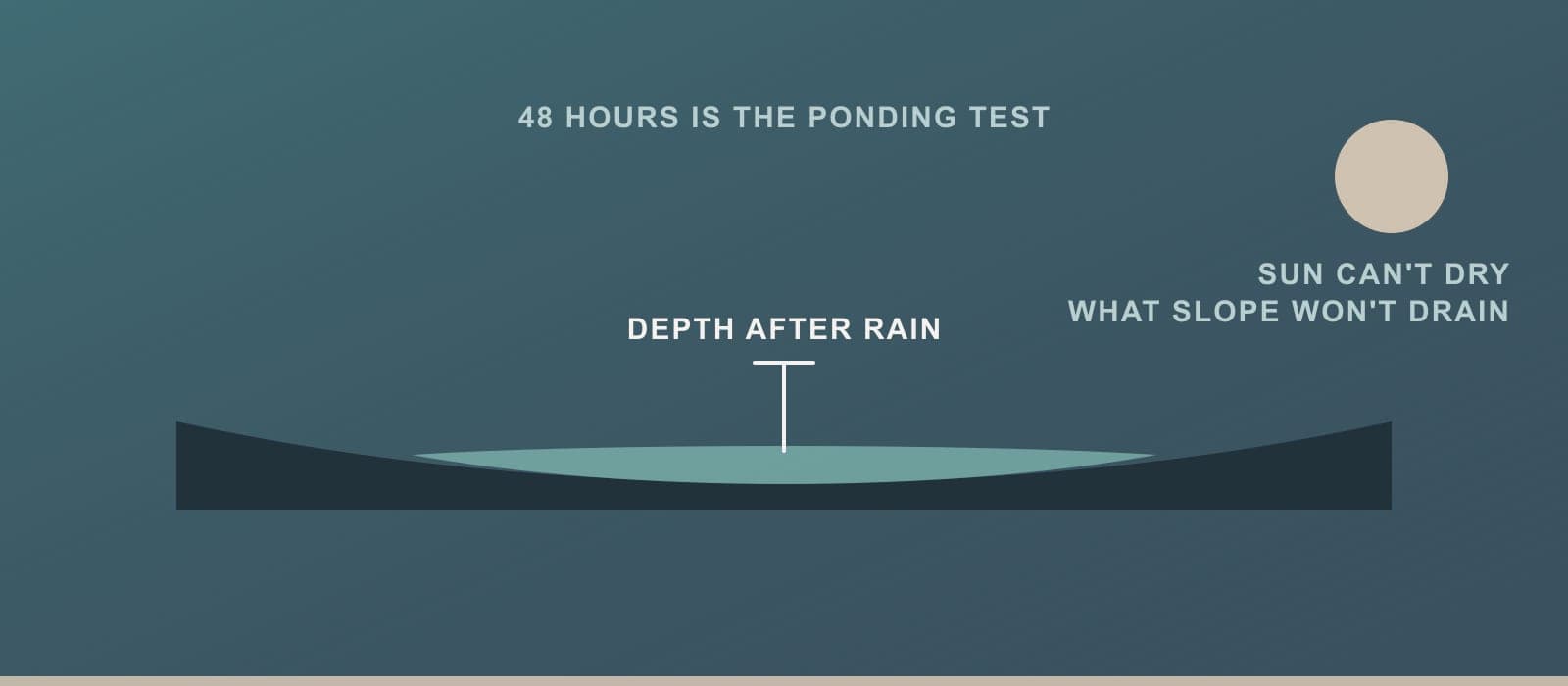
Not every puddle is a problem. After a heavy Florida downpour, a properly built low-slope roof will move most water to its drains within minutes and evaporate or shed the rest within roughly 24 to 36 hours. Roofing terminology standard ASTM D1079 and National Roofing Contractors Association (NRCA) guidance define ponding as water that remains on the roof surface longer than 48 hours under drying conditions. That two-day line is the practical test: a puddle that clears the morning after the storm is normal; a pool that is still there two dry days later is a drainage defect that needs to be diagnosed.
The reason the 48-hour threshold matters is that the damage is cumulative and largely invisible from the ground. A roof can pond after every rain for two or three years before the first ceiling stain appears inside a top-floor unit, by which point the membrane, the insulation beneath it, and sometimes the deck have all been compromised.
Why ponding is worse on a Florida coastal roof
The same standing water does more damage here than it would in a dry climate, for reasons specific to the coast:
- A six-month wet season. From roughly mid-May through mid-October, near-daily afternoon convective storms refill ponds before they can dry, so a "48-hour" pool effectively never gets its 48 dry hours.
- Hurricane-season debris. The Atlantic hurricane season runs June 1 to November 30. Wind events strip leaves, seed pods, and organic debris from dense coastal landscaping onto the roof, where it migrates to and clogs drains exactly when rainfall is heaviest. A drain basket that was clear in April can be more than half blocked by November.
- Thermal cycling and salt air. A dark membrane surface in South Florida cycles through daily temperature swings on the order of 80–110°F. Under a standing pool, that expansion and contraction fatigues seam adhesives and flashing bonds at precisely the perimeter where the water sits.
Why ponding water actually damages the roof
Three mechanisms work at once, and understanding them is what separates a real correction from a cosmetic patch.
1. Hydrostatic pressure plus thermal fatigue at seams and flashings. A standing pool exerts continuous downward and lateral pressure against every seam, lap, pipe boot, and flashing detail at its edge. Combine that constant pressure with daily thermal cycling and you get seam separation and flashing lift far sooner than thermal movement alone would cause. The leak almost always shows up at the edge of the pond, where the stress concentrates.
2. Accelerated UV degradation. Counterintuitively, the membrane under a shallow pool ages faster than the dry roof around it. The thin water layer concentrates ultraviolet radiation at the membrane surface, speeding photo-oxidation of the polymer. On most ponding roofs the membrane is visibly more degraded in the center of the pond than at its dry margins under the same sun.
3. Structural dead load: the weight math. Water weighs about 62.4 pounds per cubic foot, which works out to roughly 5.2 pounds per square foot for every inch of standing water. A 1,000-square-foot ponding zone holding just two inches of water adds more than 10,000 pounds of load the original design may never have anticipated. Worse, ponding can be self-reinforcing: water collects, the deck deflects slightly under the weight, the deflection deepens the low spot, and the next storm pools even more. Structural engineers call this ponding instability (it is addressed in the ASCE 7 load standard), and it is why a soft or visibly sagging ponding zone is a structural question, not just a roofing one.
The warranty hook every board should know
Here is the detail that turns ponding from a maintenance nuisance into a board-finance issue: most manufacturer membrane warranties (TPO, PVC, EPDM, and modified bitumen) specifically exclude damage in areas where water stands beyond 48 to 72 hours. In other words, an uncorrected ponding condition can void warranty coverage at the very spot where the roof is failing fastest. A board that pays for a 20-year roof system and then lets it pond for years may discover, at the worst moment, that the warranty no longer applies to the leaking area.
How different flat-roof membranes handle standing water
Ponding stresses every low-slope system, but they fail in different ways. This matters when you are deciding whether to correct drainage on the existing roof or fold the fix into a recover or replacement.
| Membrane system | Typical behavior under chronic ponding | Notes for coastal Florida |
|---|---|---|
| TPO / PVC (thermoplastic) | Generally the most ponding-tolerant single-plies; can still show surface crazing, weld/seam stress, and accelerated wear at pond edges | Reflective white surface popular on coastal commercial roofs; seams are heat-welded, so seam quality is decisive |
| EPDM (rubber) | Seams and laps can loosen as adhesive performance drops under constant wet; edges lift | Black membrane runs hot; thermal cycling compounds seam stress |
| Modified bitumen | Less ponding-tolerant; standing water promotes surface erosion, blistering, and granule loss | Common on older Florida condos; ponding shortens an already shorter service life |
| Built-up roof (BUR / "tar and gravel") | Blistering, gravel displacement, and exposure of underlying plies under sustained water | Frequently the legacy system on 1970s–80s buildings now facing milestone inspections |
The takeaway is not "pick a different membrane." It is that no membrane is a substitute for drainage. A new TPO roof installed over an uncorrected ponding condition still ponds, and now you have spent reserve dollars sealing the defect in rather than fixing it.
The three root causes, and how each is actually corrected
A drain clearing will not fix a slope problem, and new insulation will not fix a clogged drain. Correct diagnosis comes first; the correction follows the cause.
Cause 1: Inadequate slope
The Florida Building Code requires low-slope roofs to be designed for positive drainage with a minimum slope of 1/4 inch per foot (about 2%) toward drains and scuppers (consistent with the International Building Code §1507.10 and ASCE 7 drainage provisions). Slope falls below that minimum when the original tapered insulation was undersized, when insulation has compressed over decades, or when the roof was built dead-flat with no taper at all. Water then pools in the low points after every meaningful rain.
The correction is to rebuild positive slope. On a roof whose membrane still has life left and whose structure can carry the added weight, that means a tapered-insulation overlay: a new layer of tapered boards installed above the existing system to re-create the 1/4-inch-per-foot fall. When the membrane is near end of life, or the structure can't accept the extra dead load, it means a full replacement with a redesigned tapered system. Either way, the work should begin with a drainage plan that locates every drain and scupper and specifies insulation thickness at each point to achieve positive slope throughout. That plan is an engineering exercise, not a back-of-the-envelope estimate, and a serious contractor produces it as part of the proposal.
Cause 2: Blocked or undersized drains and scuppers
The most common cause of ponding on a roof that was sloped correctly is simply that the water has nowhere to go. Coastal Florida's landscaping and hurricane-season winds deliver a constant load of organic debris to the roof, and drains clog from the basket down into the drain body.
The correction has to be complete, not cosmetic. A drain cleared only at the visible basket, while compacted debris remains in the drain body below, re-blocks within weeks. Effective drain service means pulling the basket, clearing the full drain body until water runs free, and upgrading to a basket design that resists re-clogging. On roofs with a blockage history, the durable fix is an overflow (secondary) scupper or drain set 1–2 inches above the primary drain, so that if the primary clogs mid-storm, water escapes before it can build structural load. Where the original drains are simply undersized for the rainfall intensity South Florida produces (a code-compliance shortfall on some older buildings), the correction is to calculate the required capacity for the roof area and rainfall rate and add or upsize drainage accordingly.
Cause 3: Structural deflection
On commercial buildings with long-span steel deck, the deck naturally bends downward at midspan under load, creating a low point that collects water no matter how good the insulation slope is elsewhere. Deflection also worsens over time as a deck deteriorates or as equipment is added.
The correction depends on what's driving the sag. Where deflection is a normal structural condition that wasn't accounted for in the drainage design, the fix is to add drainage capacity at the low points (supplementary drains or scuppers) or build tapered insulation saddles over the deflection zone to restore positive slope. Where the deflection is caused by a deteriorating deck, the deck repair must come first. A new membrane laid over a failing deck will not hold the design slope and will pond again. This is the cause that most often crosses from roofing into structural engineering, and it is the one where a soft or spongy walking surface should stop the conversation until a qualified professional has looked at it.
Diverting water around obstacles: crickets and saddles
A recurring Florida culprit is the rooftop HVAC curb, parapet, or skylight that dams water on its uphill side. The standard fix is a cricket (also called a saddle), a rigid, triangular structure built under the membrane behind the obstruction that acts like a traffic director, splitting and steering water around the curb and into the drains. Crickets are a medium-cost correction that solves a large share of "localized pond behind the air handler" complaints without touching the rest of the roof.
Scan before you correct, and definitely before you coat
A roof that has ponded for more than one wet season very often has saturated insulation hidden beneath the membrane. That insulation stays wet long after the surface dries, holding moisture against the underside of the membrane, feeding mold in the assembly, and destroying the insulation's thermal value. You cannot see it from the roof surface.
Before specifying any drainage correction, and absolutely before applying a restoration coating, the roof should get a non-destructive moisture survey (infrared thermography, typically read near dusk, or a nuclear moisture scan) to map where the substrate is wet. Correcting the slope or recoating over saturated insulation seals the water in and installs a new system over a compromised base. This is the same principle behind never coating a wet wall: a coating is only as good as the dry substrate under it.
What ponding correction costs
Corrections scale with the cause, and the right way to read a proposal is to match the price to the scope:
- Drain and scupper work (lowest cost). Clearing and upgrading drains, adding overflow scuppers, and installing drain domes is the cheapest and fastest win.
- Crickets, saddles, and tapered insulation saddles (medium cost). Diverting water around curbs or building up a deflection zone. Correcting a localized ponding area with crickets or new drains commonly runs in the range of ~$1,500 to $4,000+ depending on size and access.
- Full tapered-insulation redesign, added internal drains, or deck repair (highest cost). Priced per square foot and usually folded into a recover or replacement project, this is the scope when the whole roof lacks slope or the deck itself needs work.
These are planning ranges, not quotes. Every roof's access, membrane, and structural condition move the number. The point for a board is to make sure the scope matches the cause before comparing prices.
How ponding fits a board's compliance and reserve plan
For condo and HOA boards, ponding water is not just a roofing problem. It lands squarely inside Florida's structural-integrity and reserve framework.
- Milestone inspections (§553.899). For buildings three or more habitable stories, the milestone inspection looks at the structural condition of the building. Chronic ponding, deck deflection, and water intrusion are exactly the kinds of findings that draw scrutiny and can drive a Phase 2 evaluation.
- SIRS and reserves (§718.112(2)(g)). The roof is one of the reserve components a Structural Integrity Reserve Study must fund. Correcting drainage before a reserve-funded recoat or reroof protects the new system's warranty and full service life, and the contractor's condition data (slope, moisture mapping, drain capacity) becomes a useful input to the reserve professional's remaining-useful-life calculation.
- Permitting. Any correction that modifies the roof assembly (adding tapered insulation, new drains, or replacing membrane sections) requires a permit in South Florida's municipalities. An unpermitted drainage "fix" carries the same compliance and insurance exposure as any other unpermitted roofing work, and in Broward and Miami-Dade it must also satisfy High-Velocity Hurricane Zone (HVHZ) product-approval requirements.
- Who pays. Routine drain clearing is preventive maintenance that typically comes out of the operating budget; a tapered-insulation redesign or reroof is a capital project funded from reserves. Keeping drains clear on a maintenance schedule is one of the cheapest ways a board can protect a six-figure roof asset and keep a special assessment off the table.
Why this is a Beachfront project
Ponding correction sits exactly where roofing meets waterproofing meets structural repair, and Beachfront Commercial Services self-performs across that whole seam rather than subbing out the hard half. We are a licensed, insured Florida contractor, with coastal properties as our specialty, holding Florida DBPR licenses CGC #1537131, CCC #1333921, and CCC #1333373. That means one accountable team can diagnose the cause, perform the moisture survey, correct the drainage (drains, scuppers, crickets, tapered insulation), repair the flashing and membrane details where the pond stressed them, and address the concrete or deck condition underneath when that's what's driving the deflection, all while documenting the work in the condition record your milestone engineer and reserve professional will ask for. We work on certified-applicator roofing and waterproofing systems, which keeps the manufacturer warranty intact instead of voided by the ponding it was never allowed to drain.
A note on scope: This article is general guidance to help boards and managers plan and ask better questions. It is not engineering, structural, or code-interpretation advice. Standing water accompanied by visible deck deflection, sagging, or a soft walking surface is a potential structural condition that should be evaluated by a licensed engineer before any roofing work proceeds.
Frequently Asked Questions
How long can water sit on a flat roof before it's a problem? Up to about 24–36 hours after rain stops is generally considered normal drying for a sound low-slope roof. Water still standing 48 hours after the rain ends meets the standard definition of ponding (ASTM D1079 / NRCA) and should be evaluated, because beyond that point it begins to degrade the membrane, soak the insulation, and add structural load.
Does ponding water really void a roof warranty? Often, yes. Most manufacturer warranties for TPO, PVC, EPDM, and modified-bitumen membranes exclude damage in areas where water stands beyond roughly 48–72 hours. An uncorrected ponding condition can leave the leaking area outside warranty coverage, so correcting drainage protects both the roof and the warranty you paid for.
Can't we just patch the spot where the water pools? A patch may stop a specific leak, but it does not stop the ponding. If the underlying cause (inadequate slope, a blocked or undersized drain, or structural deflection) isn't corrected, the same area keeps holding water and aging faster than the rest of the roof. The fix has to match the cause.
What's the difference between tapered insulation and a cricket? Tapered insulation rebuilds slope across an entire roof area so water flows to the drains; it's the answer to a whole-roof slope deficiency. A cricket (or saddle) is a localized triangular diverter built behind an obstruction like an HVAC curb or parapet to steer water around it. Many roofs need both: overall slope plus crickets at the obstacles.
Should drainage be corrected before recoating or reroofing? Yes. Applying a restoration coating or a new membrane over an uncorrected ponding condition, and especially over saturated insulation, seals the problem in. Best practice is a non-destructive moisture scan, replacement of any wet insulation, and a drainage correction first, so the new system starts dry and drains properly.
Who pays for ponding correction in a condo association: operating budget or reserves? Routine drain clearing and minor scupper work are usually preventive maintenance funded from the operating budget. Larger corrections like a tapered-insulation redesign or a reroof are capital projects funded from reserves, and on buildings three or more stories they connect to the SIRS reserve study and milestone inspection. Keeping drains clear on a maintenance schedule is the low-cost way to protect the bigger roof asset.
Ready to Protect Your Property?
Tell us about your building and a Beachfront estimator will follow up with a clear scope and fair pricing.