Guidance
The 9th Edition Price Tag: What a Permit Filed After December 30 Adds to a Coastal Florida Building, Line by Line (and What It Does Not)
Florida's building code turns over on December 31, 2026, and the question owners are asking this budget season is what a January permit costs. The honest answer is not a percentage. It is a short list of line items read off one table (Table 1711.1, the coastal fastener rule), a list of things that do not change for a commercial building, and one line that goes down. This guide gives commercial owners, property managers, facility managers, and general contractors the distance-and-exposure read, the order of magnitude in dollars, the reach past the roof, and the three bid lines that prove a bid was priced to the right row.
Beachfront Commercial Services ·
The question in this year's capital-planning meetings is simple: if the roof, the railings, or the envelope work slips past December 30 and the permit lands in January, what does the new code cost?
The loud answer going around is a percentage. The honest answer is a list. Florida's building code turns over on December 31, 2026, and for a coastal commercial building the price of a 9th Edition permit is a short set of line items read off one table, a longer list of things that do not change, and one line that goes down.
The calendar, precisely
The permit application date decides the edition. Florida Statute 553.73 says the code in effect in the permitting jurisdiction on the date of the application governs the permitted work for the life of the permit and any extension. Not the bid date, not the contract date, not the day the crew shows up.
Miami-Dade County has published the operational detail: applications and plans submitted on or after December 31 must comply with the new edition, and online portal submissions after 4 p.m. on December 30 are treated as 2026-edition submittals. An application filed before the deadline that expires can be extended only on a written good-faith request made within 180 days; otherwise it is a new process number, new fees, and plans redone to the 9th Edition. That 4 p.m. rule is one county's portal instruction. Every city that runs its own building department sets its own intake rules, and the safe move is to ask yours in writing.
The text is settled. The Florida Building Commission approved Supplement 1 to the 9th Edition on October 13, 2026, the last round of edits before the effective date, and one of those edits widened the list of acceptable stainless grades.
The table, read as an owner
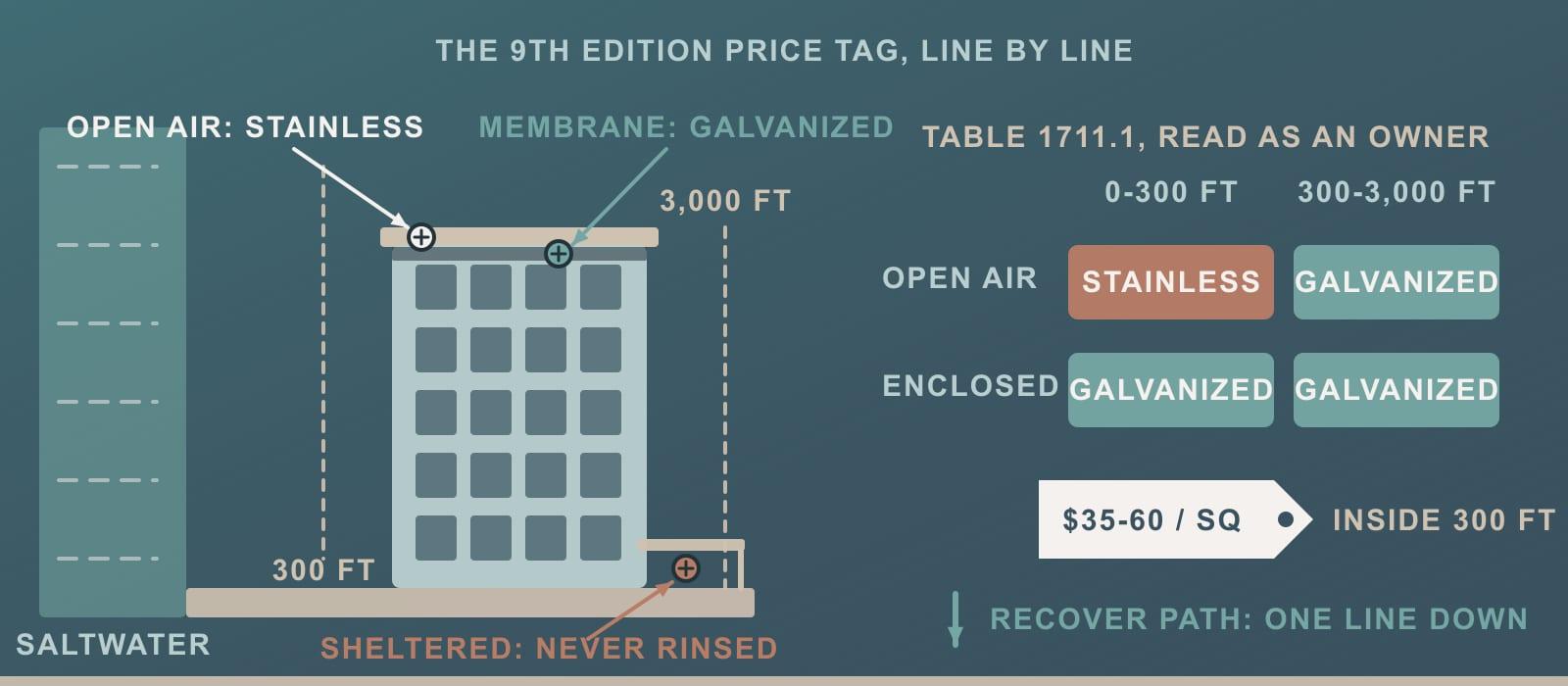
The change estimators call the one most likely to move numbers on coastal jobs is new Section 1711, Corrosion Resistance in Saltwater Environments. It applies to fasteners and connectors on buildings within 3,000 feet of a saltwater coastline, and it works by asking two questions about every fastener.
Question one: how far from the shoreline. The table has two columns: 300 feet or less, and more than 300 feet up to 3,000 feet. Past 3,000 feet nothing changes.
Question two: how exposed to salt air. This is where the money is decided. The table has four rows, and the code's own commentary gives the examples:
| Exposure row | What the code means | Where it shows up on a commercial building |
|---|---|---|
| Exterior, partially sheltered | Exposed to salt air but never rinsed by rain | Under overhangs and canopies, balcony soffits, covered walkways, slab edges |
| Exterior, open exposed | Exposed to salt air and rinsed by rain, so it also dries | Exterior walls, coping, edge metal, counterflashing, vents, equipment curbs, railing bases, through-fastened panels |
| Unconditioned interior, vented enclosed | Inside the building but ventilated to the outside | Ventilated attics, fasteners under tile or concealed under metal panels |
| Unconditioned interior, unvented enclosed | Inside the building, outside the conditioned space | Wall cavities, and roof fasteners sealed under a membrane |
Now the answer that matters. Stainless steel is required in exactly one case: 300 feet or less from the shoreline AND one of the two exterior rows. Everywhere else the fastener tier is galvanizing to a named standard: ASTM A153 Class D or ASTM A641 Class 3S for small fasteners, or a coating that shows not more than 5 percent red rust after 1,000 hours of salt-spray testing. Connectors and plates have parallel tiers. And one exception is worth memorizing: fasteners and connectors fully embedded in concrete or mortar are out.
The roofing trade association's reading makes it concrete. Fasteners sealed under a membrane are the unvented interior row; tile fasteners and concealed metal-panel clips are the vented row; the fasteners that read as exterior are the ones you can see: coping, metal edge, counterflashing, vents, curbs, and through-fastened panels.
Why the galvanized tier reads the way it does has a Florida answer. A University of Florida study presented to Palm Beach County's building code board in 2016 ran roofing fasteners bought across the state through the HVHZ salt-spray protocol: not one electro-galvanized sample passed, while hot-dipped nails, with roughly ten times the zinc, and mechanically galvanized tile screws showed no corrosion in any sample. The galvanized tier mostly names what the better products already were; the association's own summary is that the new rules change what is needed in very few situations, mainly very close to salt.
What it costs: the arithmetic
A carton of 7,200 hot-dipped galvanized ring-shank coil roofing nails lists at about $146, which is 2 cents a nail. A 316 stainless ring-shank roofing nail from a marine fastener supplier lists at about $19 a pound at roughly 165 nails to the pound, which is 12 cents a nail. Call the ratio six to one.
Multiply by the few hundred nails a square takes and the premium is tens of dollars a square. A Treasure Coast roofer who already specifies by distance published the whole-roof version of the same math last year: on a typical 4,000-square-foot roof, galvanized fasteners run $400 to $800, 304 stainless $1,200 to $2,000, 316 stainless $1,800 to $3,200. The galvanized-to-316 difference is $1,400 to $2,400 on 40 squares, which is $35 to $60 a square.
On a steep-slope roof inside the 300-foot line that is real money and worth its own line, and it is not a project multiplier.
On a low-slope commercial roof the arithmetic is smaller still, because of the rows. Field fasteners under a membrane are the unvented interior row, which means the galvanized tier at either distance, and commercial roofing screw catalogs already carry coatings rated at 1,000 hours of salt spray and screws in 410, 304 and 316 stainless. The stainless requirement lands on the perimeter and the penetrations: coping, edge metal, counterflashing, curbs and termination bars. That is a count, not an area, and it belongs in a bid as a per-linear-foot or per-penetration line, not a percentage on the whole job.
Supplement 1 helped here: the stainless list now reads Types 304, 305, 316 and 410, and Type 410 is the grade already common in commercial roofing screws, so a bidder has a compliant stainless option without moving every exposed fastener to marine-grade 316.
Three honest caveats belong next to the numbers. The fastener is not the only cost: verification work, the purchase-order language the trade association recommends (galvanized fasteners stated to comply with a named method, otherwise stainless), and the first months of a new edition, when a supplier substitution can stall an inspection, all carry labor. Inside the 300-foot line the exposed metal is not only roofing fasteners, the subject two sections down. And the line itself is still being argued: the code does not define "coastal shoreline," the engineers behind the best public bulletin read it as a saltwater body with breaking waves rather than an inland brackish canal, the trade association reports a declaratory statement question on exactly that, and the building official having jurisdiction decides. Price a building on a saltwater canal or the Intracoastal as in scope until its jurisdiction says otherwise, as the September piece on the permit-timing decision advised.
What does not move for a commercial building
Three items turn up in January bids as "new code" that are nothing of the kind.
The wind map. The 9th Edition references ASCE 7-22, the same wind-load standard the 8th Edition uses. Design wind speed does not change on December 31. A bid that carries a wind-load redesign line because of the edition is describing something else.
The roof-to-wall and secondary-water-barrier mandates. These are the two upgrades most often quoted at owners, and both have a scope. The statute writes them for site-built, single-family homes permitted before the Florida Building Code, in the wind-borne debris region, valued at $300,000 or more, with the roof-to-wall work not required beyond about 15 percent of the cost of reroofing. The existing-building code's Sections 706.7 and 706.8 open with the same limiting clause, a roof covering on an existing structure with a sawn lumber, wood plank or wood structural panel roof deck, and exempt structures permitted under the Florida Building Code. A concrete-deck or steel-deck commercial roof is outside both. A wood-decked commercial building permitted before 2002 can be inside 706.8, and that is a question for the bid to answer by section number, not a line to accept on the phrase "code-mandated."
The 25 percent rule's mechanics. Repair, replace or recover more than a quarter of a roof section in any 12-month period and the whole section comes to the code in effect, unless the roof was permitted under the 2007 code or later, in which case only the worked portion conforms. None of that changes on December 31; what changes is the meaning of "the code in effect," which becomes the 9th Edition. The rule and the one-recover limit are covered in their own guide. (Two more items, the drip-edge rule and the hip-and-ridge shingle test, are steep-slope only: real labor on a shingle, tile or metal roof, nothing on a low-slope membrane.)
Where the 9th Edition gives money back
Section 706.3 of the existing-building volume lists the conditions that force a full tear-off before a new covering goes on, among them two or more existing coverings. The 9th Edition adds an exception: where two coverings exist, the upper one may be removed and the lower one left in place when the substrate below is adequate.
For a commercial building that means a defined route to a recover instead of a full tear-off: less demolition, less disposal, less time with the interior exposed. The operative word is "adequate," which the building official reviews, and buildings in the High-Velocity Hurricane Zone (Miami-Dade and Broward) follow Sections 1512 through 1525 instead. But a sound existing layer is no longer condemned by default, and on the right roof this line is larger than the fastener line going the other way.
The decision needs four facts from the roof file: covering count, substrate type and condition, whether an adhered membrane is present, and the permit history; the preventive-maintenance program post describes the file.
Past the roof
Section 1711 lives in Chapter 17 of the Building volume, not in the roofing chapter. The roofing sections and the HVHZ roofing provisions point to it, but the rule itself is general, and Miami-Dade's product-testing page states it that way: fasteners and connectors on structures within 3,000 feet of a saltwater coastline satisfy Section 1711. The engineers' bulletin reads the affected parts as the anchors, bolts, nails, connectors, clips, straps and plates that secure a system to the building, rather than every internal part of it.
On a coastal commercial building that reach lands on the exterior metal permitted after the turnover: railing base plates and their anchors, shutter tracks and hardware, rooftop equipment supports and curbs, sign and canopy attachments, counterflashing and termination bars. Fully embedded anchors are excepted; a surface-mounted base with its bolts, nuts and washers in the open is the exterior row.
That changes how a dry-season restoration scope should be written if its permit lands in January. A railing refinish keeps the existing anchors and never meets the section; a railing replacement buys new anchors to the table, and on an exposed balcony edge inside 300 feet that is stainless. The refinish-or-replace decision for railings and frames was covered in October; the code now adds a line to the replacement column. The same logic applies to a waterproofing scope's termination bars and counterflashing, and to any surface-mounted anchor a concrete repair re-sets.
For general contractors and design teams carrying coastal work across the date, the spec note is the same: name the row and the fastener standard for each exterior attachment, and have every sub bid price to it.
The maintenance lesson inside the table
The table's two exterior rows are maintenance advice with a section number. Sheltered metal, exposed to salt air but never rinsed by rain, is the harsher row; open metal that rain rinses and that dries after a storm is the milder one, because, as the commentary behind the code says, fresh water removes the accumulated salt. So the fasteners that corrode first on a coastal building are the ones under overhangs, in balcony soffits, along covered walkways and under slab edges, where salt lands and nothing washes it off. A fresh-water rinse of sheltered metal, written into the wash cycle, is the cheapest corrosion control a building can buy, and the same commentary says fasteners that cannot be inspected or readily replaced deserve enhanced protection, which argues for a routine inspection program as much as for a better screw.
Three bid lines that prove the row
Whether the permit lands in December or January, three questions, asked in writing, separate a bid priced to the table from a bid priced to a headline.
-
Which code edition is this bid priced under, and what happens to the price if the application date slips past December 30? A bid that spans the date should carry a code-escalation clause, not a silent allowance.
-
Which Table 1711.1 row does each exterior attachment fall in, and what is the fastener and connector specification for each? The answer is a standard, not an adjective: A153 Class D, A641 Class 3S, a 1,000-hour salt-spray coating, or a stainless type.
-
Which tear-off condition or recover exception applies under Section 706.3, from the covering count and substrate finding in the roof file? The answer decides the largest line on the sheet.
If the January bid is higher than the November one, this is what should explain it: a fastener and connector finish called out per element, a perimeter and penetration count in stainless where the building sits inside the 300-foot line, and, if the roof qualifies, a recover line that is lower. What should not explain it: a wind-load redesign, a roof-to-wall retrofit on a concrete deck, or a percentage with no table behind it.
What a fall envelope assessment gets you
The January question depends on facts most owners do not have on hand: distance to the shoreline, the exposure row of every exterior attachment, covering count, substrate condition, whether an adhered membrane is present. A fall envelope assessment collects them in one visit. We walk the roof and the envelope, produce timestamped photo documentation, and hand you a prioritized scope with numbers: the distance-and-exposure read for each attachment, the fastener and connector schedule written into the scope, the covering count and substrate call that decides the recover path, the permit-date column chosen on purpose, and a priced dry-season plan. Roofing, waterproofing and sealants, painting, concrete restoration and pressure cleaning are self-performed lines, with W-2 crews and state certified licenses, so the row named in the scope is the row the crew buys to.
The code turns over on December 31. The permit date is the one variable still yours to set.
561-557-8534 · beachfrontcs.com · info@beachfrontcs.com
FAQ
Does the 9th Edition make every coastal reroof more expensive? No. Stainless is forced only within 300 feet of the shoreline and only on fasteners open to the salt air; elsewhere the tier is galvanizing to a named standard that hot-dipped and mechanically galvanized fasteners already meet. On a steep-slope roof inside the line the premium is tens of dollars a square; on a low-slope membrane roof it is a count of perimeter and penetration fasteners. The same edition adds a recover exception that can remove a tear-off.
Does the roof-to-wall retrofit apply to our commercial building? Usually not. The statute writes the roof-to-wall, secondary water barrier and deck-attachment mitigation for site-built single-family homes permitted before the Florida Building Code, and the existing-building code's Sections 706.7 and 706.8 apply to roofs on a wood deck in the wind-borne debris region at $300,000 of value, exempting structures permitted under the Florida Building Code. A concrete- or steel-deck commercial roof is outside both; a wood-decked commercial building permitted before 2002 can be inside 706.8, so ask for the section number behind any "code-mandated" retrofit line.
This article is general information for Florida commercial property owners, managers and contractors, not engineering or legal advice. Code interpretations, including how the saltwater coastline is measured, rest with the building official having jurisdiction; confirm project-specific requirements with your design professional and permitting authority. Fastener prices are published list prices read on the date in the sources and will vary by supplier and quantity.
Ready to Protect Your Property?
Tell us about your building and a Beachfront estimator will follow up with a clear scope and fair pricing.