Guidance
Electrostatic Painting or Replacement? A Three-Layer Test for Railings, Slider Frames, and Metal Doors
Electrostatic painting refinishes railings, sliding door and window frames, storefronts, and metal doors where they stand, usually for a fraction of replacement. It only works when the metal and its anchorage are sound. This guide gives Florida owners, property managers, facility managers, and homeowners a three-layer test, applied in order (anchorage, metal, finish), that decides refinish, repair-then-refinish, or replace, plus the code and evidence trade-offs most refinish-versus-replace advice leaves out.
Beachfront Commercial Services ·
On a railing, a slider frame, or a metal door, the paint is the only layer a coating can fix. Electrostatic painting refinishes that metal where it stands, with a finish close to factory work and no removal, fabrication, or install crew. When the metal and its anchorage are sound, it is usually the lowest-cost way to make a building's metal look and perform like it should. When they are not, a new coat of paint is a well-finished cover over the problem. The decision is made below the paint, in a set order. Here is the test.
What electrostatic painting is, and why it suits installed metal
The spray gun gives the paint an electrical charge as it leaves the tip. The metal being painted is grounded, so the charged paint is pulled onto it. Refinishing shops that publish on the method describe the result the same way: an even film that wraps edges, corners, and the back side of pickets, with far less overspray than a conventional sprayer. The electrostatic painting service page shows the process step by step: protect, prepare, prime, finish.
The alternative finish for metal is powder coating, and it is an excellent finish in a shop. Railing manufacturers point out the catch: powder is cured with heat, so an installed railing has to be removed, coated, and reinstalled. For a balcony stack, a storefront, or a wall of slider frames, removal is the expensive part. That is the opening electrostatic painting fills.
None of that matters if the metal underneath is failing. So the test runs from the inside out.
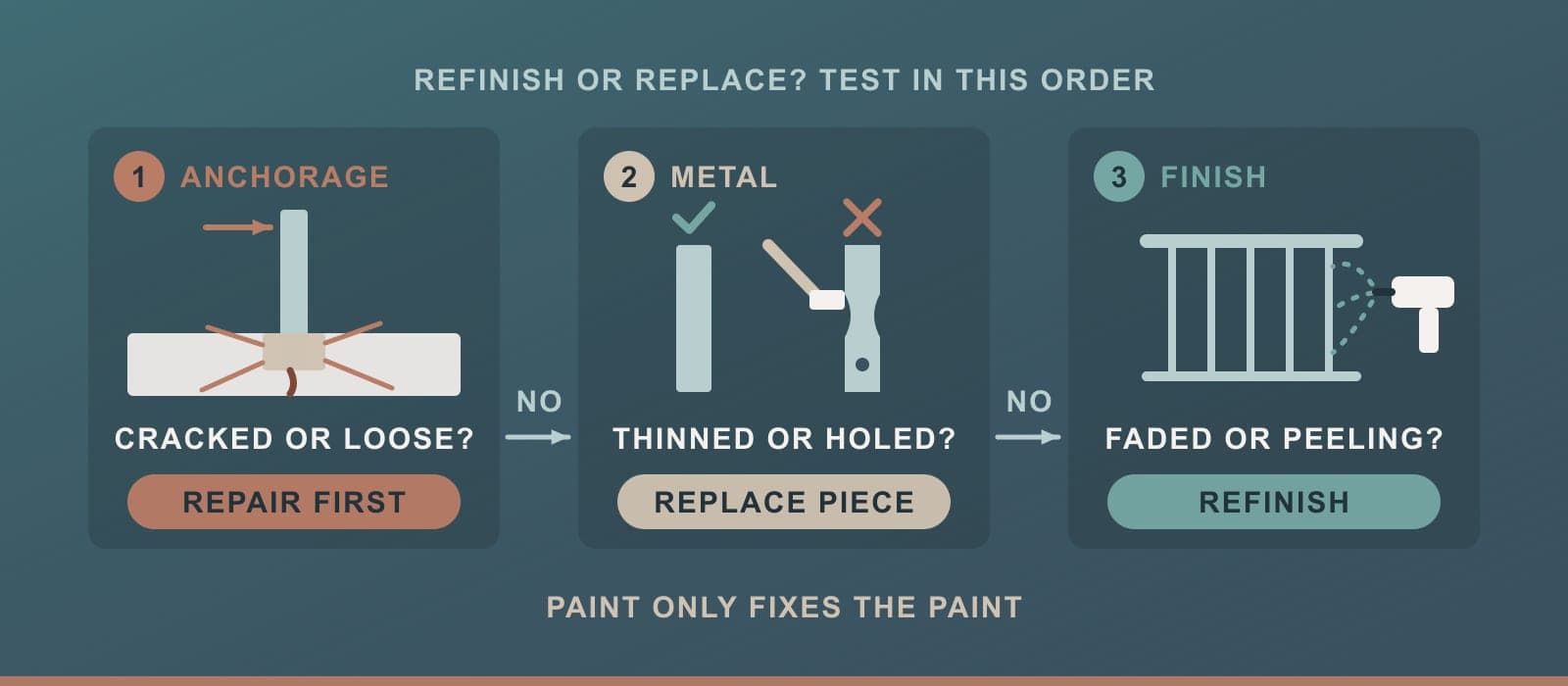
The three-layer test, in order
| Layer | What to check | Pass | Fail means |
|---|---|---|---|
| 1. Anchorage | Post bases, post pockets, fasteners, door and frame anchors | Tight, dry, no cracking or staining at the base | Repair first; refinish after |
| 2. Metal | Scrape and probe the worst spots | Corrosion cleans back to sound metal | Replace that piece |
| 3. Finish | Fading, chalking, peeling, color | Anything in this row | Refinish |
Run it in that order. A railing that fails layer 1 is a repair job, no matter how good layer 3 looks.
Layer 1: anchorage, where the metal meets the building
Most coastal railing failures start at the base of the post, not along the rail. A forensic investigation of an aluminum-railing condominium in Miami, published by the engineering lab CTLGroup, found the pattern in one building: paint delaminating and blistering with the aluminum corroding underneath, and the grout in the post pockets and the balcony concrete around the posts cracked, delaminated, and spalling. The embedded aluminum had no alkali-resistant coating, and reinforcing steel sat close to it.
Railing fabricators explain the mechanism. Salt spray and condensation collect inside a hollow post, which carries the water into the concrete. Alkaline grout attacks embedded aluminum. Mismatched fasteners set up galvanic corrosion (one metal sacrificing itself to another), which eats the post and swells the concrete around it. The same expansion that spalls a balcony edge works at every post pocket.
What to look for at each post:
- Cracks radiating from the post pocket or a hollow sound when the surrounding concrete is tapped.
- Rust staining or white powder (aluminum corrosion product) at the base.
- Movement. Push the top rail at a post. A guard is designed for a 200-pound concentrated load and 50 pounds per linear foot under the Florida Building Code; one that moves under a firm hand push is telling you about its anchorage.
- Fasteners that are rusting, mismatched, or missing.
For doors and frames, the anchorage is the frame-to-wall fasteners and the sill: rust bleeding from anchor locations, a frame that flexes, or a door bottom that has rusted through at the threshold.
A post that fails here needs its pocket opened, the corrosion addressed, the concrete repaired, and the post re-anchored and sealed so water stops entering. Where the railing is a life-safety guard or an inspection has flagged it, that repair is scoped by an engineer. Refinishing first does more than waste the coat. It paints over the crack and the stain, which are the evidence the next inspector needs to see. The balcony-edge detailing guide covers how the post penetration should be sealed once it is rebuilt.
Layer 2: the metal itself
Pick the three worst-looking spots on a run (usually post bases, bottom rails, and welds) and scrape them with a pull scraper or wire brush. You are asking one question: does the corrosion clean back to sound metal?
- Surface rust or oxidation that comes off to sound metal: pass. Prep and primer handle this.
- Pitting that leaves the metal visibly thinned, a picket or rail you can dent with a screwdriver, or a perforation: fail for that piece. Coatings protect metal; they do not put metal back.
- A failure spread across most of a run: that run is a replacement candidate, and layer 1 almost certainly failed too.
Refinishing shops note that shallow pits can be filled before priming, and that is legitimate on non-structural surfaces. On a post, a top rail, or a door's bottom rail, lost section is a structural question, not a cosmetic one.
Layer 3: the finish
This is the only layer a coating fixes, and it is often the only one that is wrong. Faded, chalking, or peeling paint on solid metal, a color that no longer matches a building that was just repainted, frames that look dated against new stucco: all of it is refinish work. The prep matters more than the spray. Failed coating comes off, rust is cleaned back, the surface is scuffed for adhesion, then primer and topcoat go on. The service page describes the system: an epoxy primer and a urethane topcoat.
How long it lasts depends on exposure and prep. Railing suppliers put painted exterior railings in harsh conditions at roughly 5 to 7 years between refinishes; shops selling marine-grade primer and electrostatic topcoat systems advertise 7 to 12 years on the coast. Budget to the low end on the ocean face and the high end on sheltered elevations.
Frames and doors: looks or performance
Sliding door frames, window frames, and storefronts add a fourth question before layer 3: is the complaint how the unit looks, or how it works?
A coating fixes appearance and protects the aluminum. It does not fix rollers, weatherstripping, a failed glazing seal, a missing sill pan, or water coming in at the sill. If the unit leaks, sticks, or whistles, diagnose that first; refinishing a frame that leaks gives you a good-looking frame that still leaks.
There is also an insurance detail. Impact-rated windows and doors carry permanent labels on the frame or etched in the glass, and wind mitigation inspectors rely on them. Window specialists who work with those inspections are blunt about it: if the product labels are painted over or removed, the inspector cannot verify the rating. Any frame refinishing scope should photograph every label first and mask it during the work. That one line protects an insurance credit the building or the homeowner already paid for.
The trade-off most refinish-or-replace advice leaves out
Refinishing leaves the existing railing or frame in place: its original approval, its anchorage, its permit history. Replacing it starts that record over under today's rules.
- Railings and guards. New guards are built to the current Florida Building Code: 42 inches minimum height, openings that will not pass a 4-inch sphere, and the 200-pound and 50-plf loads above. Life Safety Code language requires replacements to meet the requirements for new installations, and at least one Florida county building department has said a removed railing section that does not meet current code must come back to current code, even for a small portion. An older run replaced piece by piece can turn into a full-run redesign.
- Windows and doors. In Miami-Dade and Broward (the High-Velocity Hurricane Zone), replacing a window or exterior door requires a permit even for a same-size swap, with a current Notice of Acceptance for the design pressures at the address. Elsewhere in Florida, the unit carries Florida Product Approval. Refinishing the frame in place is maintenance on the unit you already have.
Neither path is wrong. Replacement is the right call when layer 2 fails across the run or the existing system no longer meets what the building needs. Just make the call knowing that "replace" includes permits, approvals, engineering, and fabrication lead time, and "refinish" includes none of them.
The money math, and the hybrid scope
Published installed prices for aluminum railing run about $50 to $200 per linear foot, with picket systems at $50 to $100 (Florida fabricators quote installation alone at $60 to $150 or more). That is before the costs specific to a building: removing the old railing, rebuilding every post pocket, engineering, permits, and access.
On-site refinishing shops advertise savings of up to 75 percent against replacement. The bigger saving on most buildings comes from refusing to treat the whole run as one decision. Take a building with 600 linear feet of balcony railing:
| Scope | What it includes | Railing cost at published rates |
|---|---|---|
| Replace everything | 600 LF of new railing, new pockets at every post, permit, engineering | $30,000 to $120,000 for the railing alone |
| Hybrid | Repair the 14 posts that failed layer 1; replace the 40 LF that failed layer 2; refinish all 600 LF to one color | 40 LF at $50 to $200 = $2,000 to $8,000, plus the post repairs and the refinish |
The hybrid is the scope the three-layer test produces: anchorage fixed where it failed, metal replaced where it failed, and one finish across the whole run so the new sections do not stand out. Its cost depends on what the walk finds, which is why the walk comes before the number.
Price it per year of service as well. A refinish that holds 7 years on a sheltered elevation and 5 on the ocean face should be scheduled that way in the capital plan, alongside the building's repaint cycle.
When to do it
Budgets for the coming year are being set now. Coatings, sealants, and concrete repair mortars all prefer the dry season, which the regional climate compact defines as November through April, and the coating go/no-go rules in the exterior coating timing guide apply to metal as much as to stucco.
If the building has a repaint coming, put the metal in the same scope and the same mobilization. Access, masking, and protection are already paid for, and the frames and railings come out matching the walls. The pre-bid walk guide shows how to write a repaint scope that bidders price the same way; the metal belongs in it as linear feet by element type.
- October: walk the metal. Post bases, scrape tests, label photos, linear feet by element.
- November: budget the anchorage repairs, the replacement pieces, and the refinish as separate lines.
- Dry season: concrete and anchorage repairs first, then refinishing, with the cure time confirmed before each balcony, door, or gate goes back into use.
What a fall envelope assessment gets you
Our fall envelope assessment walks the roof and envelope, and the metal is part of the walk:
- Every post base checked for cracking, staining, and movement, with the failures mapped by location.
- Scrape tests at the worst spots on each run, so the replace pieces are identified before anyone prices them.
- Label photos for impact-rated windows and doors, filed before any refinishing starts.
- Linear feet by element (railing, frames, storefront, doors) and a priced scope that separates anchorage repair, replacement pieces, and refinishing.
- A timestamped photo file behind every line.
Because we handle concrete restoration, waterproofing, and electrostatic painting, the post-pocket repair, the re-sealing, and the finish land in one scope with one crew sequence instead of three contractors' calendars. We are a licensed, insured Florida contractor, and coastal properties are our specialty.
Assessments are scheduling now for October walks, ahead of budget adoption and the dry-season window.
561-557-8534 · beachfrontcs.com · info@beachfrontcs.com
Frequently asked questions
Is electrostatic painting cheaper than replacing railings? When the metal and its anchorage are sound, usually yes, because refinishing skips removal, fabrication, installation, and permits. Published installed prices for new aluminum railing run about $50 to $200 per linear foot before building-specific costs such as post-pocket repair and engineering. When posts are loose or the metal has lost section, those pieces need repair or replacement first, and refinishing is the last step, not the alternative.
How do I know if a railing needs replacement instead of painting? Check three things in order. The anchorage: cracks, rust stains, or white powder at the post base, or a post that moves when pushed. The metal: scrape the worst spots; if the corrosion does not clean back to sound metal, or the metal is visibly thinned or perforated, that piece needs replacement. Only if both pass is the problem the finish, and the finish is what a refinish fixes.
Can impact window and sliding door frames be painted? Yes, aluminum frames can be refinished in place with the glass, gaskets, and hardware masked. Photograph and mask every product label first: wind mitigation inspectors use those labels to verify the impact rating, and a painted-over label can cost the credit. Refinishing fixes appearance and protects the frame; it does not fix leaks, rollers, or weatherstripping.
How long does an electrostatic finish last on the coast? It depends on exposure and prep. Railing suppliers put painted exterior railings in harsh coastal conditions at about 5 to 7 years between refinishes, and shops using marine-grade primer and electrostatic topcoat systems advertise 7 to 12 years. Plan the ocean-facing elevations at the short end.
Does replacing part of a railing require bringing it up to current code? It can. New guards are built to the current Florida Building Code (42-inch minimum height, 4-inch sphere openings, 200-pound and 50-plf loads), and building officials can require a replaced section to meet current code. Check with the local building department before planning a piecemeal replacement on an older railing.
This article is general information about maintaining and refinishing building metal. It is not engineering, legal, or insurance advice. Railing anchorage and guard repairs that affect life safety are scoped by a licensed engineer, and code requirements are set by the local building official.
Ready to Protect Your Property?
Tell us about your building and a Beachfront estimator will follow up with a clear scope and fair pricing.