Guidance
Permit by December 31 or Wait for the 9th Edition? The Roof Decision to Make on Purpose This Budget Season
Florida's building code turns over on December 31, 2026, and the permit application date decides which edition governs a roof project. For South Florida commercial buildings, most of which sit inside the new code's 3,000-foot coastal fastener zone, that creates a real capital-planning decision this fall: some projects save money permitting under the 8th Edition, others gain from the 9th Edition's more flexible recover rules. How owners and managers make that call deliberately.
Beachfront Commercial Services ·
One date in your FY27 capital plan matters just as much as the budget line next to it: the date your roofing contractor files the permit application.
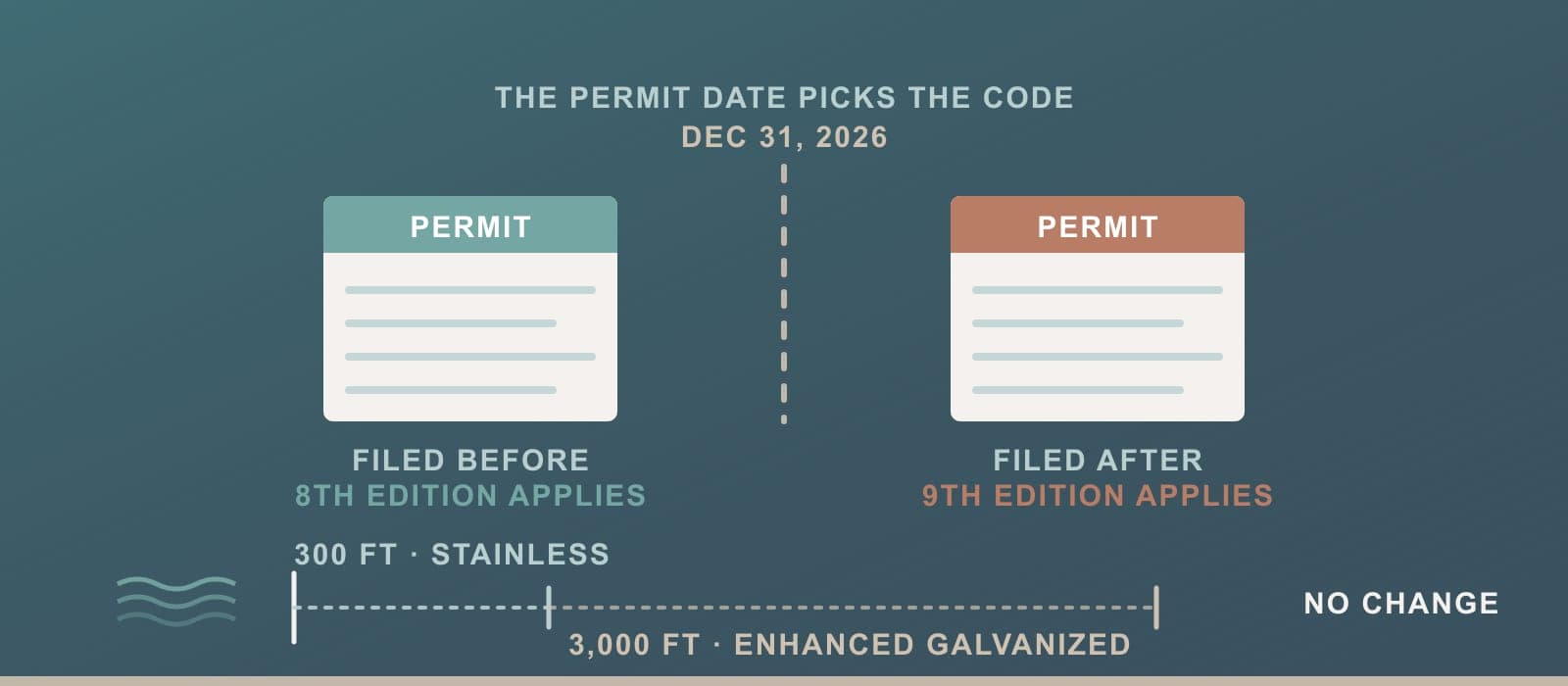
Florida's building code turns over on December 31, 2026. The 8th Edition gives way to the 9th, and the rule that decides which one governs your project is simple and absolute: the permit application date. File before December 31 and the job is reviewed under the 8th Edition, even if the crew works in February. File after, and the 9th Edition applies, with everything it adds and everything it relaxes.
For a Florida commercial building, that is not trivia. It is a capital-planning decision with money on both sides, and this budget season is when it gets made, on purpose or by accident.
First, the myth to put down
The loudest claim circulating about the new code is that wind loads are going up. They are not. The 9th Edition keeps ASCE 7-22, the same wind standard the 8th Edition already uses. Your design wind speed does not change on December 31, and a roof permitted in January is not engineered to a different wind map than one permitted in November.
The state's own change analyses and the roofing trade association's code series both confirm it: the real changes are narrower, more technical, and in several places more useful than the headline suggests. A bidder who uses the new code to press urgency about wind speeds is telling you something about the bid, not the code.
What actually changes for a roof
Four changes matter for a commercial building's planning, each with a section number you can ask a bidder about.
Coastal fastener corrosion tiers (new Section 1711). The most discussed change. Ferrous fasteners and connectors on buildings near saltwater must now meet corrosion-resistance tiers set by distance from the coastline. Nails fall under it within 3,000 feet of saltwater; screws within 300 feet. Those are two different lines, on purpose. Within 300 feet with exposed conditions, stainless steel is the requirement. From 300 to 3,000 feet, enhanced galvanizing options qualify. Beyond 3,000 feet, nothing changes.
Recover rules get more flexible (Existing Building Section 706.3). The 9th Edition adds exceptions that let more of an existing roof assembly stay in place. Where two coverings exist and the upper one is removed leaving an adequate substrate, and where an adhered vapor barrier or self-adhering membrane is bonded to the deck, the existing layer is now permitted to remain. On a commercial building that means a defined path to a recover instead of a full tear-off: less demolition labor, less disposal, less time with your interior exposed mid-job. The operative word is "adequate": the substrate still has to be sound and the building official still reviews it. But a compliant existing layer is no longer condemned by default.
Coatings over asphalt shingles (new Section 1507.2.10). For the first time the code addresses coating shingle roofs directly, and it ties the practice to the shingle manufacturer's approved installation instructions. That is a leash, not a license. Most shingle manufacturers approve very little over their product, so the section mostly closes the door on spray-coat "restorations" of tired shingle roofs.
Flashing, tile, and detail updates. Flashing requirements expand to more locations (Section 1503.2), and the tile protocols are modernized: fasteners must now penetrate three-quarters of an inch into sheathing even when battens are used, and tile underlayment systems need product approval with tested uplift values.
The 3,000-foot question, South Florida edition
Draw a line 3,000 feet inland from saltwater and look at what falls inside it: the barrier islands, everything fronting the Intracoastal, most of the older commercial corridors on the coastal ridge. A large share of South Florida's commercial building stock sits inside the nail-tier zone, and the oceanfront and Intracoastal-front properties sit inside the 300-foot stainless tier.
Two honest qualifiers belong next to that map. The trade association's own analysis is that Florida's existing fastener requirements are already stringent, and the new rules change what is needed in relatively few situations, mainly buildings very close to salt. This is a fastener line item, not a project multiplier. And there is an open interpretation question the industry has already flagged to the state: whether the 3,000-foot measurement follows brackish inland rivers and canals or only the coastline proper. Until that is settled by the building officials and the declaratory process, a building near a saltwater canal should be planned as if it is in scope.
One more South Florida wrinkle: if your building is in Miami-Dade or Broward, the High-Velocity Hurricane Zone has run stricter fastener and testing rules for years. The tile standards there already require copper, monel, aluminum, or stainless within 1,500 feet of the mean high tide line. For HVHZ buildings the 9th Edition's corrosion change is a smaller step than it is for Palm Beach County and points north.
The permit date is the decision
Here is the mechanism worth writing into your budget calendar. The permit application date decides the edition. Working backward from December 31: a project that wants 8th Edition review needs its scope settled, its contract signed, and its application filed before the holidays, which in practical terms means bids compared in October and a contractor authorized by November. Permit offices do not speed up in December.
A project that files in January inherits the 9th Edition. That is not automatically worse. It is a different set of rules, and for some buildings a better one.
Permitting before December 31 tends to favor:
- Buildings inside the fastener tiers, especially within 300 feet of saltwater, where stainless and enhanced-galvanized requirements add a line item and, more meaningfully, add first-year interpretation risk while building departments settle questions like the brackish-water line.
- Projects already scoped and funded, where waiting buys nothing.
- Tile reroofs specified under the current protocols, where crews and purchase orders are set.
Waiting for the 9th Edition tends to favor:
- Recover candidates. If your roof has two coverings and the upper one can come off over a sound substrate, or an adhered membrane bonded to the deck, the new Section 706.3 exceptions give your contractor a defined path to keep it, potentially the difference between a recover and a full tear-off.
- Buildings well inland of the 3,000-foot line, where the corrosion tiers never applied and the flexibility gains come free.
One interaction to keep in view: the 25 percent rule does not go away. Repair or replace more than a quarter of a roof section within 12 months and the whole section comes up to the current code, unless the roof was already built to the 2007 code or later, in which case only the worked portion must conform. After December 31, "current code" means the 9th Edition either way. A January repair that crosses the threshold on an older roof pulls the whole section into the new rules regardless of when the building was built. If a marginal roof is going to cross 25 percent this season anyway, that argues for deciding the full-scope question now rather than backing into it.
Five moves before year-end
-
Map the portfolio against the two lines. Which buildings sit within 3,000 feet of saltwater? Which within 300? Flag anything on a saltwater canal as in-scope pending the interpretation question.
-
Pull the roof file on any building with roof work in the five-year plan. Age, number of coverings, substrate type, whether an adhered membrane is present. Those four facts decide whether the 9th Edition's recover exceptions are worth waiting for.
-
If a reroof is in the FY27 budget, pick the permit-date column now. Before December 31 means scope locked and bids compared in October and November. After means the bid should be priced to the 9th Edition from the start.
-
Ask every bidder two questions, in writing. Which code edition is this bid priced under? And which Section 1711 tier does this building sit in, with the fastener specification named in the bid? A bidder who cannot answer the second question has not priced the first one correctly.
-
Document the decision. Whichever way it goes, the permit date, the code edition, and the reasoning belong in the roof file, the same file the reserve schedule, the carrier, and the next inspection will ask about.
What a fall envelope assessment gets you
The permit-date call depends on facts most owners do not have on hand: covering count, substrate condition, distance-to-salt, whether an existing membrane can stay. A fall envelope assessment collects them in one visit. We walk the roof and envelope, produce timestamped photo documentation, and hand you a prioritized scope with numbers, including the code-vintage call and a permit-timing recommendation written into a priced dry-season plan. Roofing is one of our self-performed lines, with W-2 crews and state certified roofing licenses, so the recommendation and the execution come from the same house.
The dry-season window opens in November. The code turns over on December 31. Both calendars are fixed; the only variable is whether your decision is made before they arrive.
561-557-8534 · beachfrontcs.com · info@beachfrontcs.com
FAQ
Does the 9th Edition change wind speeds or wind loads? No. The 9th Edition keeps ASCE 7-22, the same wind load standard the 8th Edition uses. Design wind speeds do not change on December 31, 2026. The real changes are in fastener corrosion requirements, recover rules, flashing details, and tile protocols.
If we permit in December but the work happens in February, which code applies? The 8th Edition. The permit application date determines which edition governs the project, not the construction date. A permit filed before December 31, 2026 is reviewed under the 8th Edition even if the work is performed in 2027.
Our building is on the Intracoastal. Does the 3,000-foot fastener rule reach us? The new Section 1711 measures from the saltwater coastline, and whether brackish inland rivers and canals count toward that line is an open interpretation question the industry has formally raised with the state. Until it is settled, the prudent planning assumption for a building on saltwater canals or the Intracoastal is that the corrosion tiers apply.
Does the new code force our existing roof to be upgraded? No. An existing roof is evaluated under the code that governed its construction. The 9th Edition's requirements apply when you reroof, recover, or make a repair large enough to trigger current-code compliance, including the 25 percent rule, which brings a whole roof section to current code when more than a quarter of it is worked on within 12 months (roofs already built to the 2007 code or later bring only the worked portion to current code).
Is permitting before December 31 always the cheaper move? No, and that is the point of deciding deliberately. Buildings deep inside the coastal fastener tiers with settled scopes generally do better filing under the 8th Edition. Buildings with sound existing assemblies that qualify for the 9th Edition's new recover exceptions can save the cost of a full tear-off by waiting. The roof file tells you which building you have.
This article is general information for Florida commercial property owners and managers, not engineering or legal advice. Code interpretations rest with the building official having jurisdiction; confirm project-specific requirements with your design professional and permitting authority.
Ready to Protect Your Property?
Tell us about your building and a Beachfront estimator will follow up with a clear scope and fair pricing.