Painting
Elastomeric vs. Acrylic Exterior Coatings for Florida Condos: Mil Build, Perm Rating, and the Coastal Moisture Trap
A Florida condo board's decision guide to elastomeric vs. acrylic exterior coatings: film build, crack-bridging, perm rating, the coastal moisture-trap failure, dark-color fade, overcoat compatibility, and how to spec the job so the low bid can't under-apply.
Beachfront Commercial Services ·
Direct answer: For a Florida condo or commercial building, choose an elastomeric coating when the wall needs waterproofing or hairline-crack bridging: bare or first-time-sealed stucco, concrete block (CMU), and the wind-driven-rain elevations that face the water. Choose a premium 100% acrylic coating on a sound, already-sealed repaint where breathability and dark-color fade resistance matter more. On the coast, the single deciding factor is usually whether the wall can dry: a low-perm elastomeric film over a damp or poorly drained wall traps moisture and blisters, so the coating you pick has to be matched to the wall's actual condition, not just to whichever product a bidder happens to favor.
That nuance is exactly what gets lost in the typical "elastomeric is thicker, so it's better" sales pitch. This guide is written for the people who actually sign the contract: condo and HOA boards, property managers (CAMs), and commercial owners across Florida. It puts numbers, named test standards, and a decision table behind the choice so you can spec the right system and verify you got it.
(This is general information for planning and budgeting, not engineering advice. Specific coating selection and any structural finding should be confirmed by your licensed contractor and, where required, a Florida-licensed engineer.)
The Two Coatings, Defined
Elastomeric coatings are high-build, flexible, water-based coatings engineered for stucco, masonry, and concrete block. They're applied far thicker than ordinary paint (roughly 10–20 wet mils per coat, versus 2–3 mils for conventional acrylic), and that film build is the source of nearly every advantage and every drawback. The thick, rubbery film forms a true waterproofing membrane and can stretch with the wall as it expands and contracts, which is what lets it bridge hairline cracks a thin paint film would split open. Common named systems include Sherwin-Williams Loxon XP, SherLastic, and ConFlex; Tropical, Henry/Uniflex, and Gaco lines; and similar high-build products from other certified-applicator manufacturers Beachfront works with.
Premium acrylic exterior coatings are 100% acrylic, water-based coatings built for durability, color retention, and breathability across many substrates. The premium tier, products engineered with UV-resistant pigment systems, holds color longer under intense sun than most elastomerics, breathes more freely, and bonds to a wider range of surfaces (stucco, fiber-cement, primed wood and metal trim), but it does not waterproof or bridge cracks the way a high-build elastomeric does.
Neither is "better" in the abstract. They solve different problems, and on the coast the problems are specific.
The Numbers That Actually Decide It
Here's the head-to-head a board should be looking at: not adjectives, but measurable properties you can write into a bid and verify on site.
| Property | Elastomeric coating | Premium 100% acrylic |
|---|---|---|
| Dry/wet film build per coat | ~10–20 mils (high-build) | ~2–3 mils |
| Crack-bridging | Strong on hairline / minor movement | Limited |
| Waterproofing | True membrane on the substrate | Water-resistant, not a membrane |
| Water-vapor permeance (perm rating) | Lower; e.g., Loxon XP ≈ 13.4 perms, SherLastic ≈ 22.3 perms (ASTM D1653) | Higher; generally more breathable |
| Breathability (can the wall dry?) | Lower (the coastal risk) | Higher |
| Dark-color fade resistance (FL sun) | Darks can fade in ~4–6 yrs | Better long-term color hold |
| Coverage rate | ~100 sq ft/gal | ~250–300 sq ft/gal |
| Relative installed cost | Higher (more material + prep + labor) | Lower |
| Best coastal use case | Bare/CMU/hairline-cracked, wind-driven-rain walls | Sound repaints, dark colors, mixed substrates |
A few of these deserve a closer look, because they're where coastal projects go right or wrong.
Film build and crack-bridging
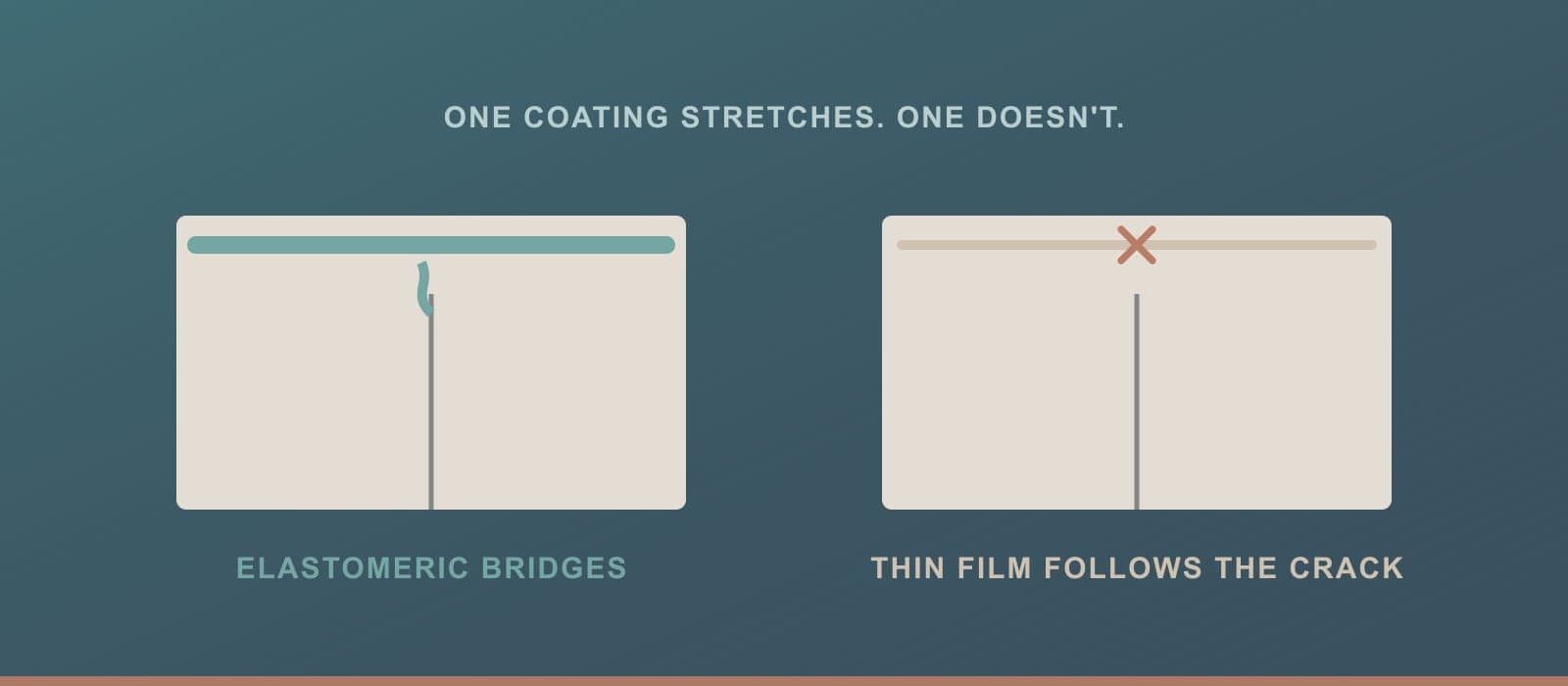
Elastomeric's whole value proposition is film build. At 10–20 mils, the cured film has enough mass and elasticity to bridge a hairline crack and keep wind-driven rain out of a porous wall. That's real protection on a building that takes horizontal rain off the Atlantic or Intracoastal. But it comes with a hard caveat: bridging works on hairlines and future micro-movement, not on an active or structural crack. A crack that's wider than about 1/16", that's actively moving, or that traces a beam, column, or balcony edge has to be V-routed and sealed, or the concrete underneath repaired, before coating. Skip that step and the crack telegraphs back through the new film within roughly 12–18 months. (See our companion guides on stucco cracks: cosmetic vs. structural and concrete spalling in coastal condos.)
Perm rating: the property nobody quotes, and the one that fails coastal walls
"Breathability" gets thrown around qualitatively, but it has an actual unit: the perm, measured by ASTM D1653 (or ASTM E96): grains of water vapor passing through a square foot of film per hour per inch of mercury pressure difference. Sherwin-Williams publishes Loxon XP at about 13.4 perms at 9.4 mils dry film, and SherLastic at roughly 22.3 perms; premium acrylic masonry coatings are typically more permeable still. As a rough field rule, a coating above about 5–10 perms is considered "breathable."
Why does a board care about a vapor number? Because coastal Florida walls get wet from the inside, too: humidity migrates, flashing leaks, irrigation overspray hits the base of walls, and a slab can wick moisture. If you wrap that wall in a low-perm film and it can't dry inward, the trapped vapor pushes the coating off. Which leads directly to the failure mode the desert and inland articles underplay.
The Coastal Moisture Trap (Why Elastomeric Fails Down Here)
The most expensive elastomeric mistake in coastal Florida isn't picking elastomeric. It's putting a low-perm membrane over a wall that can't dry. When there's trapped moisture behind the film (a hidden leak, a failed window or deck-to-wall flashing detail, a stucco wall that was pressure-washed and painted the same day and never dried), the elastomeric holds that water against the substrate. The result is blistering, sheet peeling, and mold growth behind the paint, often within a year or two. Acrylic's higher perm rating lets a marginal wall breathe and dry; elastomeric's lower perm rating doesn't forgive a wet wall.
Two practical rules protect against this:
- Let the wall dry and verify it. After soft-washing or rain, the substrate should read below roughly 12% moisture (meter-verified) before any high-build coating goes on. "Washed and painted the same day" is the classic premature-failure story.
- Fix the water source first. If a wall is staining, leaking, or efflorescing, find and correct the intrusion (flashing, sealant joints, drainage) before you seal it under a membrane. Coating over an active leak just buries it.
This is also why the cheapest, fastest bid is so often the one that fails: prep over a dirty, chalky, or damp surface, and under-application below the spec'd mil build, are the two leading causes of early elastomeric failure on the coast.
The Dark-Color Fade Trap
Boards frequently choose elastomeric for a dramatic dark scheme (charcoal, deep navy, espresso, black) and regret it. On south- and west-facing elevations, where the afternoon sun is most intense, dark elastomeric colors can fade noticeably within about 4–6 years, well before the film itself wears out. The failure is pigment breakdown under UV, not coating failure, and premium acrylic pigment systems generally hold dark colors longer. If a board is committed to dark accents on sun-blasted elevations, premium acrylic is usually the smarter choice for those walls, and the architectural-review process should weigh sun exposure by elevation, not just pick a swatch indoors. (Florida light reads very differently in full sun versus a shaded breezeway.)
A Decision Framework by Wall Condition
Most real buildings aren't "all elastomeric" or "all acrylic." A good contractor specs by elevation and substrate condition. Here's the logic Beachfront applies on a coastal condo:
- Bare stucco or never-properly-sealed CMU → elastomeric. Porous, first-time-sealed walls benefit most from the waterproofing membrane, especially on the water-facing, wind-driven-rain elevations.
- Hairline-cracked but sound stucco → elastomeric, after crack repair. Bridge hairlines with film build, but V-route and seal anything moving or wider than ~1/16" first.
- A crack with rust staining, or one tracing a beam/column/balcony edge → stop and evaluate. That can be chloride-driven rebar corrosion and concrete spalling, not a paint problem. Coating it hides a structural issue your milestone inspection cares about.
- Sound, already-coated repaint → premium acrylic. If a 4–8-year-old elastomeric layer is still bonded and doing its waterproofing job, a premium acrylic topcoat refreshes color, adds fade resistance, and costs less than another full elastomeric coat.
- Dark colors on south/west elevations → premium acrylic.
- Mixed substrates (stucco plus fiber-cement, wood, or metal trim) → premium acrylic across the trim; elastomeric doesn't bond well to wood or metal and can trap moisture against them.
- Any wall that can't dry, or has an active leak → fix the water first, then choose.
Can You Recoat One Over the Other?
This comes up on almost every repaint, and the answer is "it depends. Verify first."
Premium acrylic over existing elastomeric: usually fine if the elastomeric is clean, dry, well-bonded, and not significantly chalking. The catch: a thin acrylic won't fill the pinholes that elastomeric films sometimes develop, and as it dries it shrinks and those pinholes reopen as water-entry points. The fix is a block-filling or bridging primer that bonds to the elastomeric and fills the pinholes before the acrylic topcoat. And never put a rigid, non-elastomeric topcoat over a moving elastomeric undercoat without that intermediate system. The flexible layer keeps moving and cracks the rigid one.
Elastomeric over existing acrylic: sometimes, with the right prep and a compatibility check against the elastomeric manufacturer's data sheet. Often the smarter move is targeted (seal cracks, recaulk joints, and apply elastomeric primer to the most exposed elevations) rather than wrapping the whole building in a membrane and inheriting the breathability and fade trade-offs.
The non-negotiable in both directions: if the existing coating is failing (peeling, blistering, or separating), recoating doesn't fix it. The failure telegraphs through the new coat within months. Failing coating gets removed or repaired first.
Why This Is a Board Decision, Not Just a Painter's Pick
For a condominium of three or more habitable stories, the exterior coating isn't cosmetic. It's part of the waterproofing system that a milestone inspection (Florida Statute §553.899) and a Structural Integrity Reserve Study (§718.112(2)(g)) care about, and it's a reserve-funded component. Two things follow:
Spec the film build and perm rating in the bid. The most common way a board overpays is by accepting the lowest number and getting an under-applied coating. If your scope says "high-build elastomeric at X dry mils, minimum Y perms (ASTM D1653), two coats, moisture-verified substrate below 12%," the low bidder can no longer win by applying half the film. Mil thickness is verifiable on site with a wet-film gauge during application and a dry-film check after.
Tie the coating cycle to the reserve. Recoating the envelope on a planned cadence, rather than waiting for blistering and emergency repaints, is preventive maintenance that protects the concrete and waterproofing the reserve is already funding, and it's the kind of documented upkeep that makes a milestone inspection go smoothly. (See our guides on repaint and waterproofing cadence and SIRS and reserve studies for boards.)
How Beachfront Approaches the Choice
Beachfront Commercial Services is a licensed, insured Florida contractor (DBPR CGC #1537131, CCC #1333921, CCC #1333373) that self-performs both the painting and the waterproofing and concrete restoration behind it, with coastal properties as our specialty. That matters here because the elastomeric-vs-acrylic decision sits exactly on the seam between those trades: the right answer often isn't "which paint," it's "repair the crack and the flashing, let the wall dry, then apply the right film at the right build." When one company owns the crack repair, the moisture verification, and the coating, there's no finger-pointing between a painter and a waterproofer when a wall blisters.
We apply certified-applicator systems (Sherwin-Williams, Tremco, Pecora, Dow, Tropical, Henry, and others), spec the dry-mil build and perm rating in writing, meter-verify substrate moisture before coating, and phase work to keep an occupied building livable. On a coastal envelope, that discipline is the difference between a coating that lasts its full cycle and one that peels off a damp wall in eighteen months.
Frequently Asked Questions
Is elastomeric paint better than acrylic for a Florida stucco condo?
Not automatically. Elastomeric is better when the wall needs waterproofing or hairline-crack bridging: bare or first-time-sealed stucco and CMU, and wind-driven-rain elevations. Premium acrylic is better on a sound, already-sealed repaint where breathability and dark-color fade resistance matter. On the coast, if the wall can't dry, acrylic's higher perm rating is often the safer call regardless.
Why is my building's elastomeric coating peeling or blistering?
The most common cause is trapped moisture: a low-perm elastomeric film was applied over a wall that couldn't dry: a hidden leak, failed flashing, or a surface that was washed and painted the same day. The second most common cause is poor prep or under-application (too little film build over a dirty, chalky, or damp surface). Both trace back to process, not to the product itself.
Does elastomeric paint trap moisture?
It can. Elastomeric has a lower water-vapor permeance than acrylic (for example, Loxon XP is about 13.4 perms by ASTM D1653, versus higher numbers for premium acrylics). If moisture is getting into the wall and the film can't let it dry outward, that vapor pushes the coating off. The fix is to correct the water source and verify the substrate is dry (below roughly 12% moisture) before coating.
Can you paint acrylic over elastomeric?
Usually yes, if the elastomeric is clean, dry, well-bonded, and not heavily chalking. But a plain acrylic won't fill the pinholes elastomeric can develop, so a block-filling or bridging primer should go down first. Never apply a rigid acrylic over a still-moving elastomeric undercoat without that intermediate system, or it will crack.
How long does elastomeric last on a Florida coastal building?
Properly applied, elastomeric and premium acrylic both commonly deliver around 7–10 years of service on coastal stucco, with manufacturers citing up to 10–20 years for elastomeric in ideal conditions. Appearance usually fails first. Dark colors on sun-facing walls can fade in 4–6 years. Chalking, uneven fade, bubbling, or peeling are the recoat triggers, not a fixed calendar date.
How do we keep the lowest bid from under-applying the coating?
Write the film build and perm rating into the scope, for example "high-build elastomeric at a specified dry-mil thickness, minimum perms by ASTM D1653, two coats, substrate moisture verified below 12%." Mil thickness can be checked on site with wet- and dry-film gauges, so the spec is enforceable rather than a promise.
Ready to Protect Your Property?
Tell us about your building and a Beachfront estimator will follow up with a clear scope and fair pricing.