Concrete Restoration
Concrete Spalling in Florida Coastal Condos: Causes, Repair, and Inspection Readiness
Why concrete spalls on Florida's coastal condos and commercial buildings, how engineers detect and repair it, what it costs, and how to prevent recurrence before your milestone inspection.
Beachfront Commercial Services ·
Concrete spalling is the cracking, flaking, and breaking-away of concrete that happens when the steel rebar inside it corrodes and expands. On the Florida coast it is rarely "just cosmetic." It is the visible stage of a corrosion process that began months or years earlier inside the slab. Along Florida's salt-laden shoreline, that process runs faster than almost anywhere else in the country. For a condo board or property manager, knowing how to read spalling early is the difference between a planned repair and an emergency assessment that lands on the wrong side of a milestone inspection.
This guide explains exactly why spalling happens here, how restoration professionals detect and repair it, what it typically costs, and how to keep it from coming back.
What concrete spalling actually is
Reinforced concrete works because steel and concrete cooperate: the concrete handles compression, the embedded steel handles tension, and the concrete's high alkalinity (pH around 12–13) forms a microscopic "passive" layer that keeps the steel from rusting. Spalling begins when that protection breaks down and the rebar starts to corrode.
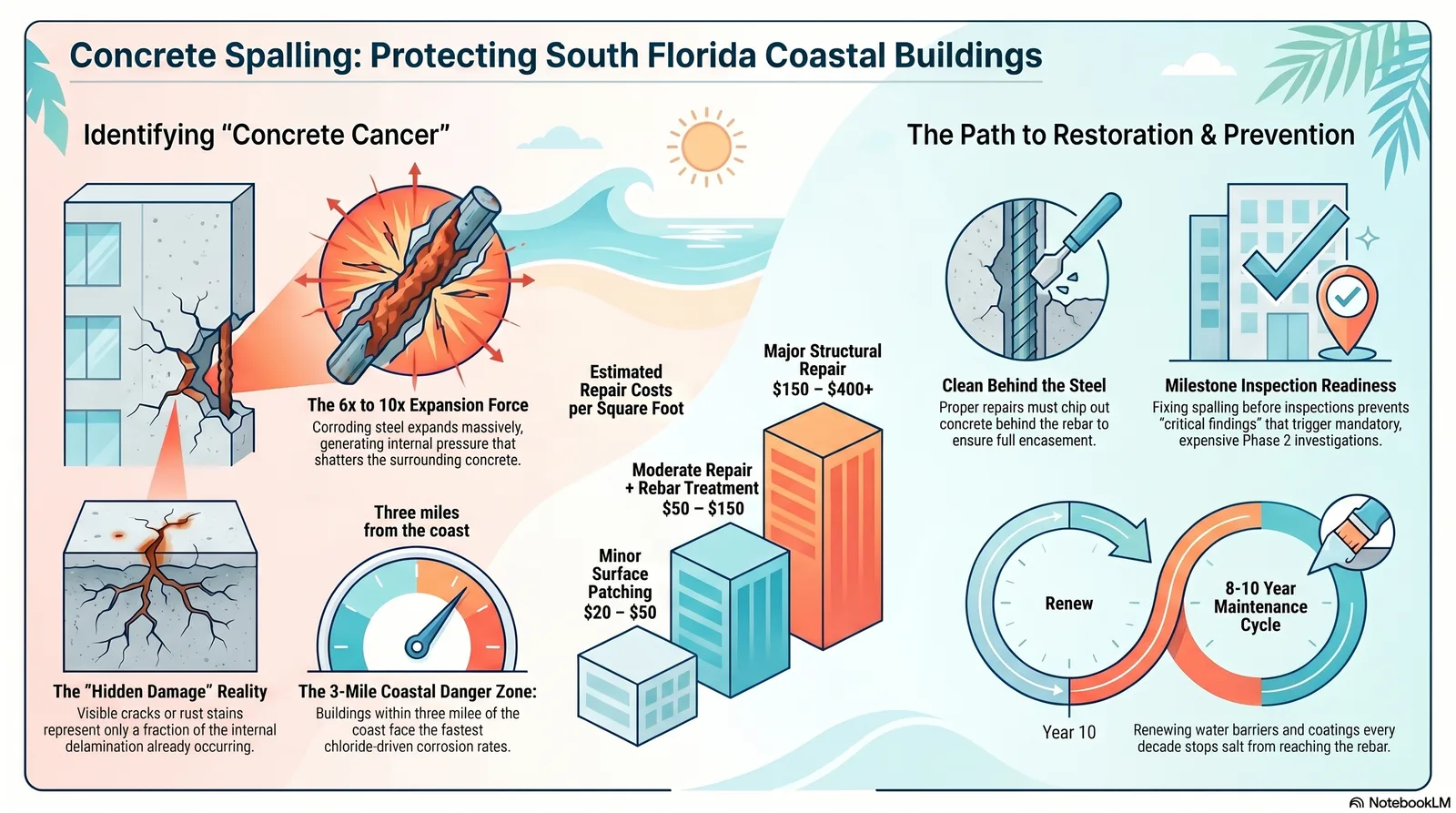
Here is the mechanism that matters: as steel rusts, the corrosion products occupy roughly 6 to 10 times the volume of the original metal. That expansion generates enormous internal pressure, far more than the surrounding concrete can resist in tension. The concrete first delaminates (separates into a hidden internal crack plane), then cracks to the surface, then sheds a chunk. By the time you can see a spall or a rust stain, the steel underneath has usually been corroding for a long time.
That is why spalling is sometimes called "concrete cancer": the damage you see is a fraction of the damage that's already there.
Why Florida's coast accelerates it
Two coastal forces dominate here, and they compound each other.
Chloride attack from salt air. Wind-borne salt and salt spray carry chloride ions that soak into porous concrete with every humid day and every wind-driven rain. Once enough chloride reaches the steel, it chemically destroys the passive layer and switches corrosion on, even when the concrete looks intact. Buildings within about three miles of the shoreline absorb chlorides fastest, which is precisely why Florida's inspection law lets local building officials require coastal buildings to be inspected earlier (more on that below).
Water intrusion through failed barriers. Hairline stucco cracks, tired sealant joints, failed balcony waterproofing, and porous facades all let water reach the steel. Water is the carrier; salt is the accelerant; Florida's heat and humidity keep the reaction running year-round. Add hurricane-season wind-driven rain (which finds every gap a calm day wouldn't) and a building with deferred waterproofing can move from "fine" to "spalling" in a few seasons.
Two secondary contributors round it out: carbonation (atmospheric CO₂ slowly lowering the concrete's pH and stripping the passive layer over decades) and inadequate concrete cover (steel placed too close to the surface during original construction, leaving too little concrete to protect it).
Where spalling shows up first
On coastal multifamily and commercial buildings, deterioration tends to appear in a predictable order. The most exposed, most water-loaded elements go first:
- Balcony edges, soffits, and railing posts: where waterproofing fails and embedded railing steel channels water straight to the rebar.
- Parking-garage decks, ramps, and beams: constant traffic, standing water, and tight rebar cover.
- Walkways, catwalks, and stair landings: horizontal surfaces that pond water.
- Building facades and columns near the waterline elevation: maximum salt exposure.
- Window and door perimeters: old sealant joints leak first.
Spalling in a load-bearing column or beam is the most serious case. It signals that the steel carrying the building's loads is compromised, and it warrants urgent engineering evaluation rather than a patch.
Early warning signs a board or manager can spot
You do not need to be an engineer to catch the early indicators. Watch for:
- Rust-colored stains bleeding down walls, columns, or balcony soffits.
- Cracks that follow a straight line a few inches inside and parallel to an edge, often the rebar telegraphing through.
- Bulging, blistering, or "tenting" paint over a hard surface.
- Hollow or drummy sounds when a surface is tapped (a sign of hidden delamination; see detection below).
- Exposed or visible rebar, which is already an advanced, critical-finding stage.
- Efflorescence (white mineral residue) and recurring damp spots, which point to active water intrusion feeding the problem.
Two or more of these on the same elevation mean it's time for a professional assessment, not another coat of paint over the top, which only hides the corrosion while it continues.
How professionals detect spalling (including the hidden kind)
The repairs that fail are the ones that only fix what's visible. A proper assessment maps the full extent of delamination, including the sound-looking concrete that's already separated underneath. Restoration teams and engineers use:
- Delamination sounding: dragging a chain or tapping with a hammer across the surface; solid concrete rings sharp, delaminated concrete sounds hollow. It's low-tech and remarkably effective for mapping hidden damage.
- Chloride content testing: drilling powder samples at depth and titrating for chloride concentration to learn whether the surrounding concrete will keep corroding new steel after a patch.
- Half-cell potential testing: measuring electrical potential to map where active corrosion is occurring, not just where it has already shown.
- Cover meters / GPR: locating rebar depth and spacing.
- Carbonation (phenolphthalein) testing: confirming whether the concrete has lost its protective alkalinity.
This is also where Florida's milestone inspection intersects with restoration: a Phase 1 milestone inspection is a visual review by a licensed engineer or architect, and widespread spalling that exposes reinforcing steel is exactly the kind of "critical" finding that pushes a building into a Phase 2 investigation and a repair mandate. Detecting and addressing spalling before your inspection window keeps you ahead of that process.
The repair process, stage by stage
Durable concrete restoration follows the sequence the International Concrete Repair Institute (ICRI) guidelines describe. Cutting any stage short is the most common reason repairs fail within a year or two.
- Engineering assessment & scope. Map delamination, test chlorides, and determine whether the issue is surface-level or structural. Load-bearing damage requires an engineer's repair design.
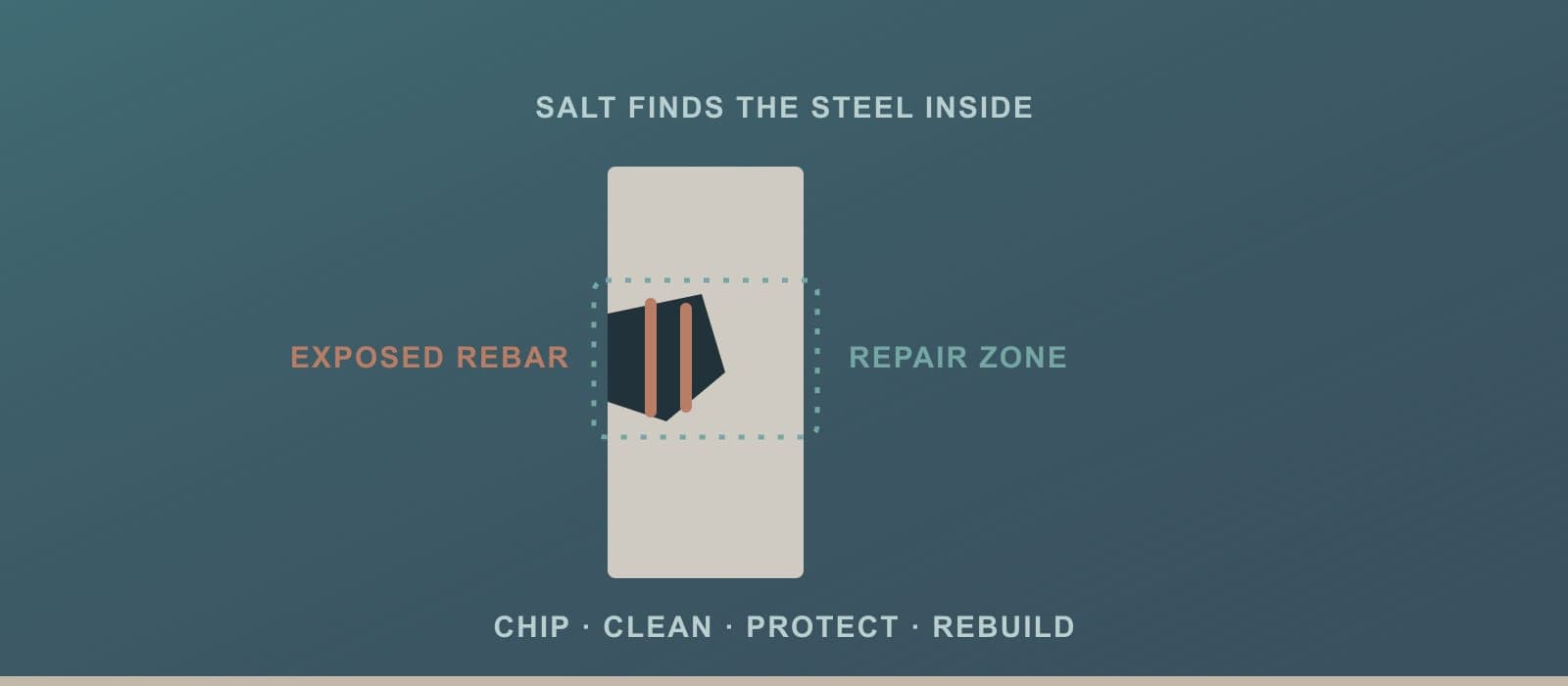
- Remove unsound concrete. Saw-cut a clean perimeter and chip out all delaminated concrete and, critically, continue behind the rebar so the steel can be cleaned and fully encased. Stopping at the face of the bar traps corrosion inside the repair.
- Clean and treat the steel. Abrasive-blast the rebar back to bright metal, evaluate section loss, and supplement or replace bars that have lost capacity. Apply a corrosion-inhibiting or bonding coat.
- Address ongoing corrosion where needed. On chloride-saturated structures, embedded galvanic anodes or, in severe cases, cathodic protection stop the "ring-anode" effect, where a fresh patch accidentally accelerates corrosion in the adjacent old concrete.
- Rebuild the profile. Apply a polymer-modified or low-shrinkage structural repair mortar engineered for the substrate, built up to the original line.
- Re-establish the water barrier. This is the step that determines whether the repair lasts: restore waterproofing, deck coatings, sealant joints, and an anti-carbonation or elastomeric coating so chlorides and water can't restart the cycle.
What concrete spalling repair costs in Florida
Costs vary widely because they track the depth of deterioration, access (swing stage vs. ground level), and whether the work is cosmetic or structural. As general planning ranges for coastal work:
- Minor surface patching: roughly $20–$50 per square foot.
- Moderate repair with rebar treatment: roughly $50–$150 per square foot.
- Major structural repair or replacement: roughly $150–$400+ per square foot.
The most important cost lesson is about timing: deterioration accelerates once steel is exposed, so a balcony edge that's an inexpensive patch this year can become a structural repair (with shoring, engineering, and access equipment) in a couple of seasons. Early intervention is almost always the cheaper path, which is why proactive boards budget restoration into their reserves rather than waiting for a failure.
Preventing recurrence: the part most repairs skip
Concrete restoration that isn't paired with a renewed water barrier is a countdown timer. Prevention on the coast means:
- Keep the building watertight. Re-coat exterior waterproofing and repaint on a roughly 8–10 year cycle on the coast, and replace failed sealant joints as a maintenance item rather than waiting for them to leak.
- Maintain balcony and deck membranes. Traffic-bearing coatings on balconies, walkways, and garage decks are sacrificial. They're meant to be renewed, and renewing them resets protection (and often the system warranty).
- Inspect on a schedule. An annual or biannual envelope walk catches rust stains and joint failures while they're cheap.
- Budget it in reserves. Florida's reserve-study requirements now treat painting, waterproofing, and structural elements as fundable items. Plan for them deliberately.
Done together, restoration plus envelope renewal converts spalling from a recurring emergency into a predictable, scheduled line item.
How Beachfront approaches coastal concrete restoration
Beachfront Commercial Services is a licensed Florida general contractor (CGC #1537131) that pairs concrete restoration with the waterproofing, sealant, and coating work that makes a repair last, the two disciplines that competitors often split between two vendors. We work with certified-applicator systems (Sika, Pecora, Tremco, and others) and serve condo and HOA boards, property managers, and commercial owners, with coastal properties as our specialty. Because we self-perform both the structural repair and the envelope renewal, the steel gets fully encased and the water barrier gets restored in one coordinated scope, and your building is ready when the milestone inspector arrives.
If you're seeing rust stains, cracking, or exposed rebar (or you simply want to get ahead of an upcoming inspection), a restoration assessment is the right first step.
Frequently Asked Questions
What is concrete spalling, and why is it so common on the Florida coast? Concrete spalling is when concrete cracks, flakes, and breaks away because the steel rebar inside it has corroded and expanded: the rust occupies 6–10 times the volume of the original steel, fracturing the concrete from within. It's common on the Florida coast because wind-borne salt drives chloride ions into porous concrete, and constant heat, humidity, and wind-driven rain keep the corrosion reaction running year-round. Buildings within about three miles of the shoreline are affected fastest.
Is concrete spalling a structural problem or just cosmetic? It can be either, and you can't reliably tell from the surface. Minor edge spalling may be cosmetic, but spalling on columns, beams, or balcony structures signals that load-carrying steel is corroding, which is a structural concern. Because the visible damage is usually smaller than the hidden delamination beneath it, any spalling that exposes rebar, or appears on a structural element, should be evaluated by a restoration professional or engineer.
Can you just patch over spalling concrete? No. A surface patch that doesn't remove all unsound concrete, clean the rebar behind the bar, and restore the water barrier will typically fail within a year or two. Worse, patching chloride-contaminated concrete can accelerate corrosion in the surrounding area (the "ring-anode" effect). Durable repair means removing delaminated concrete past the steel, treating or replacing the rebar, sometimes adding galvanic anodes, rebuilding with a structural mortar, and re-establishing waterproofing.
How does spalling affect my building's milestone inspection? Florida's milestone inspection law (SB 4-D) requires structural inspections for condo and co-op buildings three or more stories tall, at 30 years of age, or at 25 years where the local enforcement agency determines that local circumstances, including environmental conditions such as proximity to salt water, require it. Widespread spalling that exposes reinforcing steel is a classic "critical" finding that can push a building from a Phase 1 visual inspection into a more involved Phase 2 investigation and a repair requirement. Identifying and repairing spalling before your inspection window keeps you ahead of that process.
How can a condo board prevent spalling from coming back? Pair every concrete repair with a renewed water barrier, then maintain it: re-coat waterproofing and repaint on roughly an 8–10 year coastal cycle, renew balcony and deck membranes before they fail, replace tired sealant joints as routine maintenance, walk the envelope for rust stains once or twice a year, and fund restoration and waterproofing in your reserve study so the work happens on a schedule instead of as an emergency.
Beachfront Commercial Services: licensed commercial painting, waterproofing, roofing, and concrete restoration across Florida, with coastal properties as our specialty. CGC #1537131 · CCC #1333921 · CCC #1333373. This article is general information, not engineering advice; have a licensed engineer evaluate structural concerns specific to your building.
Ready to Protect Your Property?
Tell us about your building and a Beachfront estimator will follow up with a clear scope and fair pricing.