Roofing
TPO, PVC, EPDM, Modified Bitumen, or BUR? Choosing a Flat-Roof Membrane for a Florida Condo
Three reroof bids, three different systems. A Florida condo board's guide to low-slope membrane selection: welded vs. glued seams, 60 vs. 80 mil, HVHZ Notice of Acceptance, coastal service life, and how the choice lands in your SIRS reserve.
Beachfront Commercial Services ·
Three roofers walk your low-slope roof and hand you three proposals for three different systems, each one described as the obvious choice. Here is the short version: for most Florida condo and commercial low-slope roofs, a 60- or 80-mil white thermoplastic membrane (TPO or PVC, with hot-air-welded seams, installed as an assembly carrying a Miami-Dade Notice of Acceptance or Florida Product Approval) is the right default. PVC earns its premium where there is grease, chemical exposure, or a plaza/paver deck. Modified bitumen still makes sense on high-traffic roofs, complex geometry, and like-for-like re-roofs over existing asphaltic plies. EPDM is rarely the right answer here, and built-up roofing is now a legacy system.
But the membrane name on the cover sheet is the least important thing in the bid. What actually determines whether your roof reaches twenty years on the coast is the seam technology, the membrane thickness, the attachment method, and whether the drainage was corrected before anyone rolled out a sheet. This guide walks a board through all of it, and through the part no roofing blog covers: how the system you pick lands in your SIRS reserve line and on your insurance file.
This is general information for board education, not engineering advice. Roof assemblies for occupied coastal buildings should be specified by a licensed design professional and permitted through your local building department.
Why the seam, not the material, is the real decision
Roofs in a windstorm do not fail uniformly across the field. They fail where the system is discontinuous: at seams, terminations, penetrations, and edge metal. So the first question about any membrane is how are two sheets joined?
- Thermoplastics (TPO and PVC) are hot-air welded. The two sheets are fused into one continuous membrane. A properly welded seam is stronger than the field of the membrane itself. It does not peel, and it does not care that it is 92°F and humid.
- EPDM is a thermoset synthetic rubber. It cannot be welded; its seams are joined with adhesive or seam tape. Adhesives soften under sustained heat and age under thermal cycling. In a market that runs a UV index of 10–11 from April through October, that is a structural disadvantage, not a footnote.
- Modified bitumen and BUR get their resistance from multi-ply redundancy: two, three, or four asphaltic layers, so a defect in one ply is not a leak. That redundancy is genuinely valuable; it is just heavier, hotter, and shorter-lived than a welded white sheet.
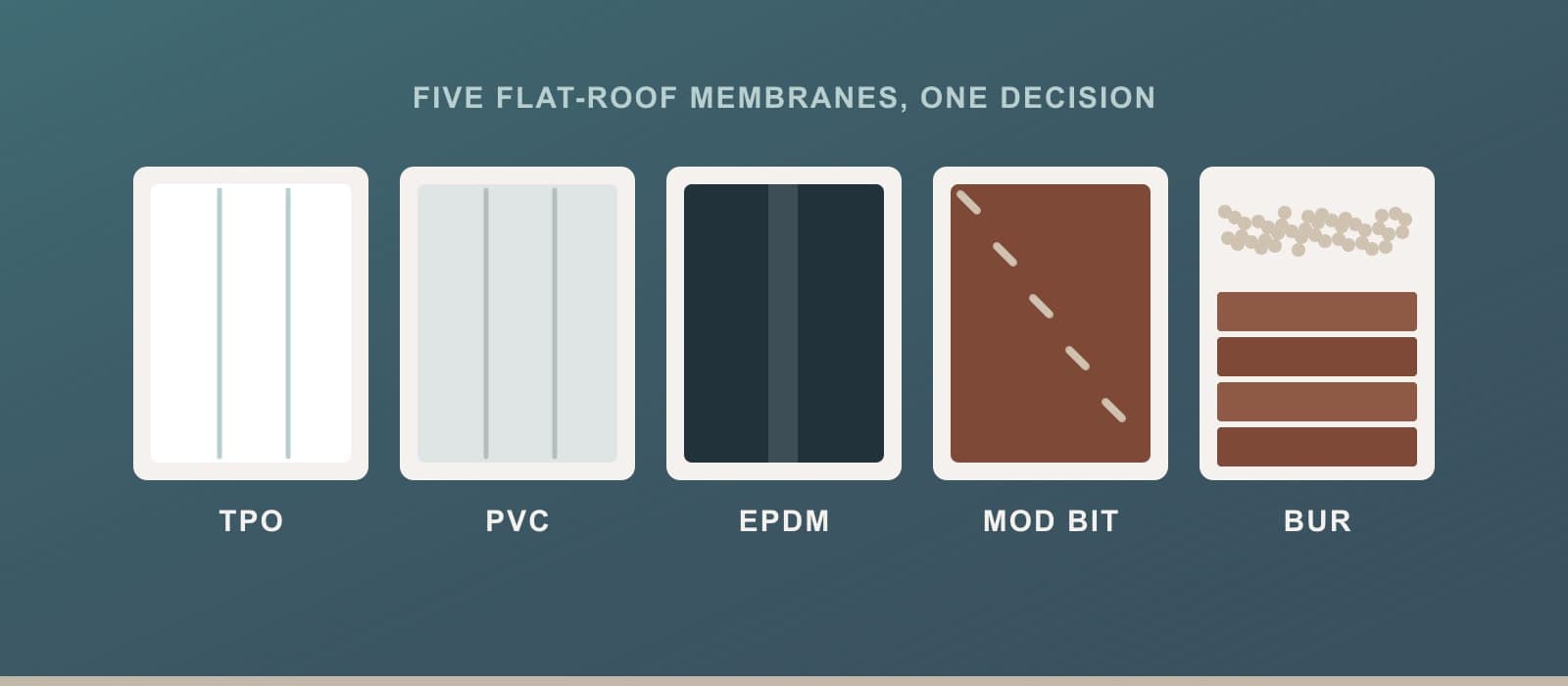
That single distinction (welded, glued, or layered) explains most of the performance gap in the table below.
The five systems, compared for a coastal building
| TPO | PVC | EPDM | Modified bitumen | BUR (built-up) | |
|---|---|---|---|---|---|
| Seam | Hot-air welded | Hot-air welded | Adhesive / tape | Torch, self-adhered, or cold-applied plies | Hot asphalt / cold plies |
| Installed cost (FL) | ~$5.50–$8.50/SF | ~$7–$11/SF | ~$4.50–$7.50/SF | ~$5–$9/SF | ~$7–$12/SF |
| Coastal service life | 15–25 yr (60–80 mil reaching 20–30) | 20–30 yr | 15–20 yr in Florida | 15–20 yr | 12–20 yr |
| Reflectivity | White, SRI 90+ | White, SRI 90+ | Black absorbs heat (white costs more, reflects less) | Dark unless coated | Dark unless coated |
| Ponding tolerance | Good | Best of the group | Moderate (seams at risk) | Moderate | Poor–moderate |
| Traffic / equipment | Good at 80 mil | Good at 80 mil | Punctures more easily | Excellent | Excellent |
| Grease / chemical | Moderate | Excellent | Moderate | Moderate | Moderate |
| Coat over at end of life? | Yes (silicone) | Limited | Yes (silicone) | Yes (silicone/acrylic) | Yes |
Cost ranges are for planning, not quoting. On an occupied coastal high-rise, access (crane picks, staging, resident notice, hoisting tear-off debris off a rooftop with no lay-down space) routinely moves the number more than the membrane does.
A note on EPDM's reputation: you will read that EPDM lasts 30 to 50 years. Those figures come from Ohio and Pennsylvania. In Florida, the same membrane realistically returns 15 to 20 years, because a black EPDM roof can reach 160–180°F on a July afternoon while a white thermoplastic under the identical sun runs roughly 50–80°F cooler. That daily thermal cycling is exactly what fatigues glued seams. EPDM is a good system in the right climate. Florida is not that climate.
And TPO's dominance, roughly 40% of the U.S. low-slope market, cuts both ways. It is the default for good reason, which is precisely why a board should confirm it is the right default for this building rather than assume it.
The three spec numbers that decide the outcome
1. Thickness: 60 mil is the floor, 80 mil is the answer more often than not
TPO and PVC are sold in 45, 60, and 80 mil. Forty-five mil is where a cheap bid hides. It is a legitimate product in a mild climate on a roof nobody walks; on a Florida condo with rooftop HVAC, elevator equipment, satellite dishes, and a service tech on the roof every month, it is a false economy that shows up as punctures and premature chalking.
Treat 60 mil as the practical minimum and specify 80 mil wherever there is rooftop equipment, regular service traffic, or an expectation of holding the roof for two decades. The upcharge from 60 to 80 mil is a small fraction of the project; the difference in remaining useful life is not, and RUL is what your reserve study capitalizes.
2. Attachment: your deck type decides this, not the salesman
- Mechanically attached: fastened through the membrane and insulation into the deck. Fast and economical, but it introduces thousands of fastener penetrations and lets the membrane "flutter" under uplift.
- Fully adhered: the membrane is bonded across its full area. Quieter under wind, better uplift performance in the field, and generally the preferred approach for high-rise coastal work.
- Induction-welded: plates are fastened to the deck and the membrane is bonded to the plates electromagnetically, with no fasteners through the sheet. A strong middle path.
Here is the part most comparison articles miss entirely: most South Florida condo low-slope roofs sit on a structural concrete deck, not steel or plywood. That changes the conversation. Fastening into concrete means drilled anchors, not screws into flutes; adhesion means the deck must be sound, dry, and properly primed; and a wet lightweight or insulating concrete fill under an old membrane is a well-known trap that will strand a brand-new roof over saturated material. Which is why:
3. Insulation and cover board
The membrane is the raincoat; the insulation is the sweater, and the cover board is the layer that keeps a dropped tool from becoming a leak. On a coastal reroof, expect a cover board (high-density polyiso or gypsum-based) above the insulation under any single-ply. It improves puncture resistance, hail and impact performance, and the wind-uplift rating of the assembly, and it costs a fraction of what a premature reroof costs.
The South Florida layer everyone skips: HVHZ approval
In Miami-Dade and Broward, the High-Velocity Hurricane Zone, a roof system is not approved because the brochure says it is hurricane-rated. The assembly must carry a Miami-Dade Notice of Acceptance (NOA) or a Florida Product Approval, and it must be installed exactly as that approval describes: the same membrane, the same insulation, the same fasteners or adhesive, at the same spacing, over the same deck. Swap one component and you no longer have an approved assembly.
Those approvals are earned through the Florida Building Code's Test Protocols for the High-Velocity Hurricane Zone (TAS), among them TAS 114 (simulated uplift-pressure resistance of a 12-ft × 24-ft roofing assembly) and the TAS 117(A)/(B)/(C) series (fastener withdrawal resistance, dynamic pull-through of a membrane over fastener heads, and dynamic pull-off of fastener heads and plates). Systems are commonly also specified to FM 1-90 or UL 580 Class 90 uplift ratings.
Two practical consequences for a board:
- Ask for the NOA or Florida Product Approval number in the bid, and check that the components listed on the bid match the components listed in the approval. This one request separates serious proposals from brochure proposals.
- Perimeters and corners are not the field. Uplift pressures at a roof's corners and edges are a multiple of what the middle sees, so an approved assembly calls for enhanced fastening or adhesion density in those zones, plus properly engineered edge metal. When roofs peel in a named storm, they almost always start at an edge.
Palm Beach County sits outside the HVHZ boundary, but the wind-borne-debris and uplift design requirements on a coastal high-rise are still severe, and Florida Product Approval still governs. The rigor should not change at the county line.
Before you pick a membrane: fix the drainage
No membrane in this article fixes slope. If water still sits on the roof 48 hours after the rain stops, you have ponding, and installing a new sheet over an unchanged slope simply buys you a new roof with the same problem, often with the manufacturer's warranty explicitly excluding the ponded area.
Two prerequisites belong in front of any membrane decision:
- Drainage correction. The Florida Building Code's minimum positive drainage design is ¼ inch per foot. Where the deck cannot be re-sloped, tapered insulation, crickets and saddles behind HVAC curbs, added drains, and correctly set overflow scuppers are how it gets corrected.
- A moisture survey. Infrared or nuclear scanning finds saturated insulation hiding under the old membrane. Roofing over wet insulation is how a board spends reserve money twice.
We cover both in depth in our post on ponding water on flat condo roofs.
What you're actually allowed to install
Before price narrows the menu, the code does. Two Florida Building Code rules constrain the choice:
- The one re-cover limit (FBC §706.3). You generally may not add a second layer over an existing covering. Tear-off to the deck is required where the roof already has two or more applications, is water-soaked or deteriorated, has un-repaired blisters, or cannot meet securement requirements. Most aging South Florida low-slope condo roofs land in at least one of those buckets, meaning "we'll just go over it" is often not on the table.
- The 25% rule (FBC Existing Building §706.1 / Building §1511.1). Repair, replace, or re-cover more than 25% of a roof or roof section in any 12-month period and the whole section normally has to come up to current code, unless the roof was built or last replaced to the 2007 FBC or later, in which case SB 4-D (F.S. §553.844(5)) lets you fix only the damaged portion.
We wrote a full plain-English explainer on both: Florida's 25% roof rule and the "one re-cover" limit. Establish your roof's code vintage from permit records before you evaluate systems. It may decide the scope for you.
How the choice lands in your reserve, and on your insurance file
This is the half a roofing sales page never writes.
SIRS. Under §718.112(2)(g), the roof is a mandatory Structural Integrity Reserve Study component, and the annual contribution is driven by remaining useful life and replacement cost, not by the roof's age. Choosing an 80-mil welded system with a documented maintenance program and defending a 25-year RUL produces a materially different reserve line than a 45-mil membrane a reserve professional will only credit for 15 years. The system you buy is a reserve decision, not just a construction decision.
Milestone. A roof replacement on a building approaching its §553.899 milestone inspection should be sequenced with the structural work, not against it. If the engineer is going to call for concrete repair at parapets and roof-to-wall junctions, doing that work before the new membrane goes down is the difference between one mobilization and two.
Insurance. Carriers read roof age and remaining useful life (see §627.7011 and the commercial equivalents that govern condo master policies). A full replacement resets that clock; a maintenance coating does not. We covered that trap in does a roof coating help your Florida insurance?
Energy. A white membrane at SRI 90+ is not a marketing line. It cuts rooftop surface temperature by 50–80°F and typically trims $0.10–$0.30 per square foot per year in cooling load. On a 30,000 SF roof, that is $3,000–$9,000 a year that never appears in a roofing bid comparison but does appear in your operating budget.
How a board compares three bids apples-to-apples
Ask every bidder the same six questions and put the answers side by side:
- What membrane and what thickness? (TPO/PVC/mod-bit; 45, 60, or 80 mil, and why.)
- What is the NOA or Florida Product Approval number, and do the components in your bid match it?
- What attachment method, and what is the enhanced fastening/adhesion at perimeters and corners?
- What insulation and cover board, and what is the assembly's uplift rating (FM 1-90 / UL 580 Class 90)?
- What are you doing about drainage and wet insulation before the membrane goes on? (Slope correction, tapered insulation, drain/scupper work, moisture survey.)
- What warranty (material-only, workmanship, or a manufacturer NDL system warranty), and are you a certified installer for that manufacturer?
A bid that cannot answer #2 and #5 is not cheaper. It is incomplete.
Where Beachfront fits
Beachfront Commercial Services is a licensed, insured Florida contractor (DBPR CGC #1537131, CCC #1333921, CCC #1333373), with coastal properties as our specialty. We are certified applicators for coating and waterproofing systems from manufacturers including Sika, Tremco, Pecora, Henry, Karnak, Gaco, Uniflex, and Progressive Materials, and we self-perform roofing, waterproofing, and concrete restoration.
That combination matters more on a reroof than it sounds. Coastal low-slope roofs rarely fail in the field of the membrane; they fail at the parapet, the roof-to-wall junction, the equipment curb, and the drain: the places where roofing meets waterproofing and, often, spalling concrete. When one crew can repair the parapet, re-detail the termination, and lay the membrane in sequence, the board pays for access once.
We do not write your reserve study and we are not your engineer of record. We assess the assembly you have, tell you honestly what it will and will not support, and install a permitted, approval-compliant system we can stand behind.
Frequently Asked Questions
Is TPO or PVC better for a Florida condo? Both are white, hot-air-welded thermoplastics and both are strong choices. TPO is the value default and covers most condo roofs well at 60–80 mil. PVC costs roughly $1.50–$2.50 more per square foot but typically returns 20–30 years and offers markedly better resistance to grease, chemicals, and plant roots, so it is the better call for a roof with restaurant exhaust, mechanical rooms, or a plaza/paver amenity deck above occupied space.
How long does a TPO roof actually last in Florida? Realistically, 15–25 years, with 60- and 80-mil systems reaching the top of that range when they are properly welded, correctly detailed at penetrations, and maintained. A thin 45-mil membrane with unresolved ponding and no maintenance program can need replacement in 12–15. Thickness, drainage, and documented maintenance, not the brand, decide where you land.
Is EPDM a bad choice in Florida? Not "bad", just mismatched. Its adhesive seams and heat-absorbing black surface both work against it in a climate with a UV index of 10–11 for seven months a year and surface temperatures reaching 160–180°F. In Florida, expect roughly 15–20 years rather than the 30-plus commonly quoted in northern markets. If you already have EPDM and it is performing, maintain it; we would rarely specify it new on the coast.
Is modified bitumen obsolete? No. Multi-ply mod-bit remains the right answer on roofs with heavy service traffic, complex geometry with many curbs and penetrations, and like-for-like re-roofs over existing asphaltic plies where compatibility and code favor staying in the same family. Its trade-offs are weight, heat absorption unless coated, and a shorter coastal service life of about 15–20 years.
Do I need a Miami-Dade NOA if my building is in Palm Beach County? Palm Beach County is outside the High-Velocity Hurricane Zone, so the Miami-Dade NOA regime does not apply the same way, but your system still needs a valid Florida Product Approval, and a coastal high-rise still faces severe uplift and wind-borne-debris design requirements. Ask for the approval number and confirm the installed components match it, regardless of which county you are in.
Does replacing the membrane reset our roof's age for the insurance carrier? A true replacement (tear-off or a permitted re-cover to a code-approved system, installed by a licensed roofer) resets roof age and remaining useful life for underwriting. A maintenance coating brushed over an old covering generally does not. That distinction has cost Florida associations real money, and we walk through it in our roof-coating-and-insurance post.
Ready to Protect Your Property?
Tell us about your building and a Beachfront estimator will follow up with a clear scope and fair pricing.