Waterproofing & Sealants
Drummy Tile on a Condo Balcony? How to Repair It Without a Full Tear-Off: A Coastal Florida Board's Guide
Hollow, drummy, or loose balcony tiles in a Florida condo almost always mean water already got under the finish. Here's how to tell whether it's the tile, the buried membrane, or the structural slab, and when you can waterproof over the tile versus tear off to the concrete.
Beachfront Commercial Services ·
When the tiles on a Florida condo balcony sound hollow underfoot, lift at the corners, or start leaking into the unit below, the loose tile is almost never the real problem. It is a symptom that water has already gotten under the finish. The right repair depends entirely on what actually failed: the tile and grout at the surface, the waterproofing membrane buried beneath the tile, or the structural concrete slab underneath all of it. Get that diagnosis right and you may be able to re-waterproof over the existing tile for a fraction of the cost. Get it wrong, and seal a coating over a slab that is quietly spalling, and a board can pay twice and still fail its milestone inspection.
This guide walks Florida condo and HOA boards, community association managers (CAMs), and building owners through how a licensed waterproofing and concrete-restoration contractor decides between resetting tile, coating over it, or tearing off to the slab, and how that decision ties into Florida's milestone inspection and SIRS reserve requirements.
A note on scope: This is general information from a licensed building-services contractor, not legal or engineering advice. Structural questions on a specific balcony should be evaluated by a Florida-licensed engineer, and who pays for the repair is governed by your association's declaration.
What "Drummy" and "Hollow" Tile Actually Mean
"Drummy" is the term tile and waterproofing professionals use for tile that has lost its bond to the substrate. Tap it or walk on it and it produces a hollow, drum-like sound instead of a solid one, because there is now an air gap (or worse, a water-filled gap) between the tile and the mortar bed below.
On a balcony, drummy tile is a downstream symptom, not the original cause. The usual sequence runs like this: water finds a way past the surface (a cracked grout line, a failed perimeter sealant, an unsealed railing-post penetration, or a breached membrane edge), saturates the mortar bed, and breaks down the bond holding the tile down. The tile loosens because water is already trapped under it. That is why simply re-gluing a loose tile, without finding out how water got under it, is the most common way boards waste money on a balcony twice.
A trained inspector "sounds" the entire balcony field, usually by tapping with a mallet or dragging a chain, and maps where the bond has failed. A single drummy tile near a door threshold tells a very different story than an entire balcony field that sounds hollow. The pattern of the failure is the first clue to which layer actually broke.
Why a Tiled Balcony Is Built to Be Expensive to Fix
To understand the repair choices, you have to understand how a tiled balcony is assembled. From the top down, a typical exterior tiled balcony is roughly:
- Tile (ceramic, porcelain, or stone): the wearing surface you see.
- Thin-set mortar and a mortar bed: what bonds and levels the tile, ideally sloped to drain.
- The waterproofing membrane: the layer that actually keeps water out of the building. It sits below the tile and mortar but above the structure.
- The structural concrete slab: the cantilevered or supported deck itself, with steel rebar inside.
The critical point is this: the waterproofing membrane is a buried layer. It is sandwiched below the finish and above the slab, which means it cannot be inspected, tested, or repaired without removing the tile and mortar over it. That single fact is why a leaking tiled balcony forces a real decision rather than a quick patch. You either find a way to re-waterproof over the existing finish, or you tear the finish off to reach and rebuild the layers underneath.
The Three-Layer Decision: Finish, Membrane, or Structure
Every legitimate tiled-balcony repair starts by answering one question: which layer failed? There are three answers, and each points to a different scope and budget.
Layer 1: A finish-only problem (the least expensive)
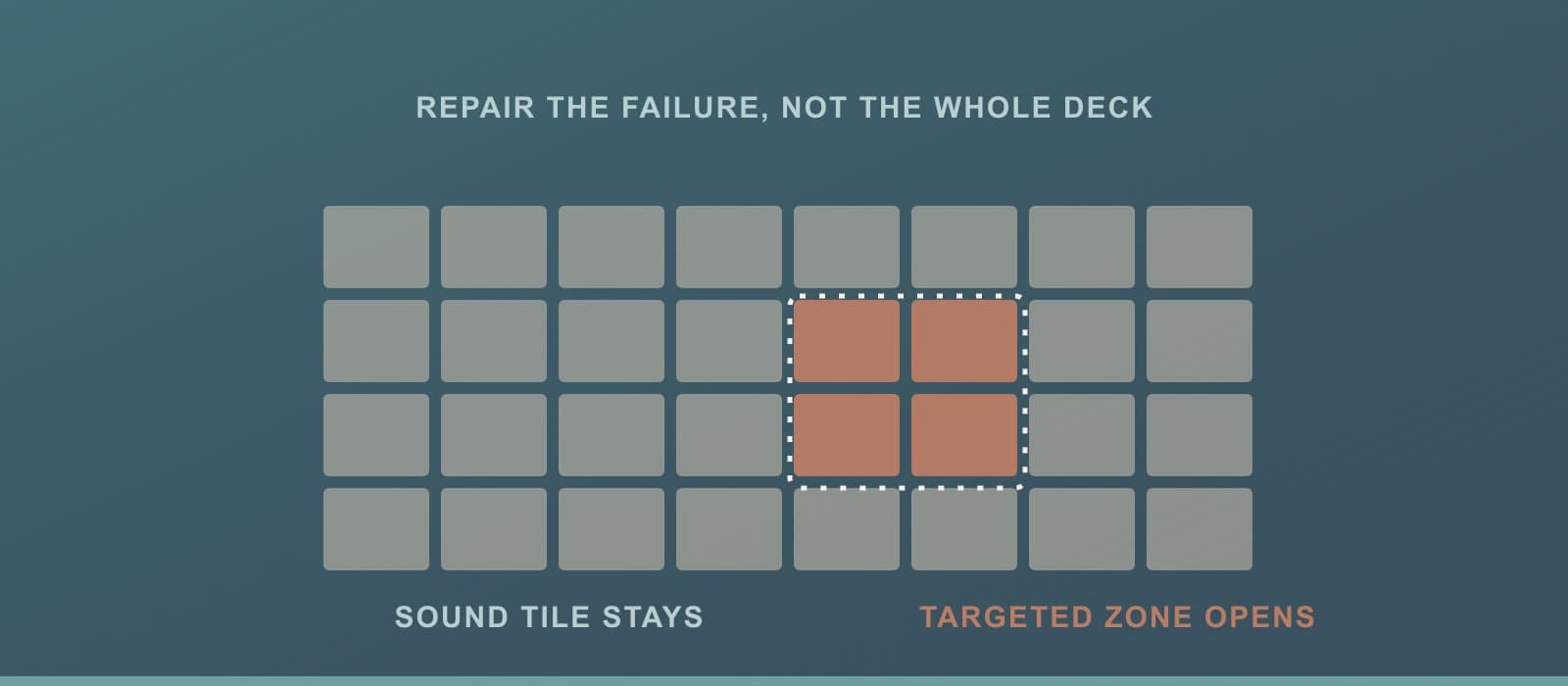
Sometimes the membrane and slab are sound and only the surface has degraded: a few cracked grout joints, missing perimeter sealant, or a handful of drummy tiles in an otherwise solid field, with no active leak into the space below. When a contractor removes a suspect tile and the mortar bed underneath is dry and firm, the repair can be limited to re-bedding loose tiles, raking out and replacing failed grout, cutting in proper expansion/movement joints, and re-sealing the perimeter and penetrations.
This is the cheapest outcome, but it is only valid if the diagnosis confirms the buried membrane is still doing its job. If water is reaching the unit below, the problem is not finish-only, no matter how good the tile looks.
Layer 2: A failed buried membrane on a sound slab (the middle path)
This is the most common real-world scenario: the slab is structurally fine, but the buried membrane has aged out, cracked from substrate movement, or was breached at a poorly detailed edge or penetration, and water is now getting through. Here a board has two defensible options:
- Re-waterproof over the existing tile. A liquid-applied membrane (often a clear or pigmented aliphatic polyurethane, or a tile-bonding waterproof system) can be installed over sound, dry, properly sloped tile to create a new positive-side barrier without removing the finish. Done correctly, this preserves the look, avoids weeks of demolition, and can cost a fraction of a full tear-off. Vendors of over-tile systems commonly cite a cost of under 10% (do-it-yourself) to under about 35% (professionally installed) of replacing the membrane under the tile.
- Tear off to the slab and rebuild. Remove the tile and mortar, install a new code-compliant waterproofing assembly, and re-tile or switch to a pedestrian traffic coating. This costs more and takes longer but resets the entire system and its warranty.
The right choice depends on substrate condition, slope, the value of preserving the existing tile, and how long the board needs the repair to last. We cover the over-tile option's limits in detail below, because it is where most coastal mistakes happen.
Layer 3: A structural problem (the most serious)
If sounding and inspection reveal that the concrete slab itself is deteriorating (spalling concrete, rust staining, exposed or corroded rebar, soft or crumbling substrate when a tile is lifted), then no surface or membrane fix is appropriate. The structure has to be repaired first: remove the finish, remove unsound concrete, treat and replace corroded steel, and rebuild the slab to recognized concrete-repair standards (the International Concrete Repair Institute, ICRI, surface-prep guidelines) before any new membrane goes down. This is the scenario where coating over the tile is not just ineffective but actively harmful, because it hides a structural condition that a milestone inspection is specifically designed to catch.
The Over-Tile Coating: When It's Smart, and When It's a Trap
Re-waterproofing over existing tile is a real, legitimate technique, and it is also the option most likely to be misused on a coastal condo. It works well, but only when several conditions are all true:
- The slab is structurally sound and dry. Over-tile membranes are positive-side systems: they stop rain and hose water coming from above. They do not stop moisture rising or trapped from below, and they cannot reinforce a moving or distressed slab. If the substrate keeps cracking, the leak comes back.
- The balcony has positive fall to drain. Most liquid membranes, and clear coatings especially, can blush, turn milky, or break down where water ponds. They need the minimum 1/4-inch-per-foot slope to drains or scuppers to perform.
- The existing tile and mortar are firmly bonded and the surface is properly prepared. Loose tile must be re-set, missing grout replaced, joints cut in, and the surface cleaned and dried before any coating is applied. A coating is only as good as what it bonds to.
Here is the coastal trap, stated plainly: applying a pretty clear coating over a tiled balcony whose real problem is a deteriorating slab can seal a structural finding out of sight, exactly the kind of condition a milestone inspector is looking for. It buys a season of dryness while corrosion continues underneath, and it can leave a board having spent reserve money on a cosmetic fix that a later inspection forces them to tear out anyway. The over-tile coating is a tool, not a default. It belongs on a balcony that has been diagnosed as a sound-slab, failed-membrane problem, not on one that has never been properly assessed.
Why Coastal Tiled Balconies Fail in the First Place
Coastal Florida is uniquely hard on tiled balconies, and understanding why helps a board read the warning signs early.
Salt-driven concrete corrosion. Salt-laden humidity drives chloride ions into concrete. When chloride reaches the embedded rebar, the steel corrodes and expands, and corroding steel can occupy several times its original volume, which cracks and spalls the concrete from within. A tiled balcony that has leaked for years frequently hides not just a failed membrane but the early stages of this rebar corrosion, because the trapped water accelerates the whole process. This is the same coastal mechanism behind concrete spalling on exposed balconies and facades.
Detailing failures at the edges. Membranes rarely fail in the open field first. The most common entry points are the transitions: where the balcony deck meets the building wall, around door thresholds, and at every railing-post penetration. If the flashing and sealant at these details were skimped at install, or have simply aged out, water gets behind the membrane there and tracks under the tile, even while the field looks perfect.
Movement and ponding. Buildings move with thermal cycling and settlement. A membrane bonded directly to a moving substrate, without proper crack isolation, eventually cracks with it. Add a balcony that never had real slope, so water sits instead of draining, and you have a membrane under constant standing-water stress in a climate with a six-month wet season.
Doing It Right: The Standards That Govern a Real Repair
A board can tell a properly bid balcony repair from a hopeful one by whether the contractor references the assembly standards. For a bonded waterproof membrane under tile, the relevant references are ANSI A118.10 (load-bearing, bonded waterproof membranes for thin-set tile) and ANSI A118.12 (crack-isolation membranes), with detail methods drawn from the Tile Council of North America (TCNA) Handbook for exterior deck and balcony assemblies. Exterior pedestrian traffic membranes, the alternative to re-tiling, are tested to ASTM C957, the standard for liquid-applied elastomeric membranes over concrete that take foot traffic. And when concrete repair is required underneath, surface preparation follows ICRI guidelines. A scope that names these standards, specifies slope to drain, and details the flashing at wall transitions and penetrations is bidding the job correctly; one that only quotes "re-tile the balcony" is not.
Who Pays, and Why That Question Comes First
Before a board approves any balcony scope, it has to answer a question that has nothing to do with coatings: who is responsible? In most Florida condominiums a balcony is a limited common element, and the declaration controls whether the association or the individual unit owner is obligated to maintain and repair it, and who pays for water damage to the unit below. Two buildings on the same street can assign that responsibility differently. The first step in any leaking-balcony situation is therefore to read the governing documents (and, where there's a dispute, involve association counsel), not to pick a product.
This matters financially because balcony waterproofing is also a reserve component. On condominium and cooperative buildings three or more habitable stories tall, the building envelope, including balcony waterproofing, falls under the Structural Integrity Reserve Study (SIRS) requirements of Florida Statute §718.112(2)(g), and balconies receive specific attention in the milestone inspection required by §553.899. A milestone Phase 1 is a visual assessment; Phase 2, when triggered, can include core sampling, ground-penetrating radar, and impact-echo testing to find exactly the hidden slab deterioration that a leaking tiled balcony tends to hide. Diagnosing finish-versus-membrane-versus-structure before spending reserve dollars is what keeps a board from funding a cosmetic repair that the next inspection cycle condemns.
How Beachfront Approaches a Tiled-Balcony Job
Beachfront Commercial Services is a licensed and insured Florida contractor (DBPR CGC #1537131, CCC #1333921, CCC #1333373) with coastal properties as our specialty, and tiled balconies sit at the intersection of two things we self-perform: waterproofing and concrete restoration. That combination is the point. A waterproofing-only contractor can coat a balcony; a tile company can re-set tile; but when the diagnosis turns up a spalling slab, the job suddenly needs structural concrete repair, and a board that has to stop, re-bid, and bring in a second trade loses time and money. Because we hold both the general and roofing/restoration licenses and run W-2 crews, we can sound the balcony, lift test tiles, assess the slab, and then either re-waterproof a sound deck or perform the concrete repair and rebuild the membrane assembly, under one scope, on systems from certified-applicator manufacturers, documented in a way that supports your milestone and SIRS record.
The honest version of our advice is the part that protects boards most: not every leaking tiled balcony needs a full tear-off, and not every one can be safely coated over. The money is saved, or wasted, at the diagnosis, not the coating.
Frequently Asked Questions
Why are my condo balcony tiles hollow or loose if there's no obvious crack?
Because the problem is usually underneath the tile, not on it. Water that gets past a grout line, a failed perimeter sealant, a railing-post penetration, or a breached membrane edge saturates the mortar bed and breaks the bond, so tiles loosen and sound "drummy" even when the surface looks intact. Loose tile is the symptom; the trapped water and its entry point are the cause that has to be found and corrected.
Can you really waterproof over balcony tile without removing it?
Yes, in the right conditions. A liquid-applied membrane (often a clear or pigmented aliphatic polyurethane) can be installed over tile that is sound, dry, firmly bonded, and properly sloped to drain, preserving the look at a fraction of tear-off cost. It will not work if the slab is moving or structurally distressed, if the balcony ponds water, or if the tile is widely debonded. The over-tile option is only valid after a diagnosis confirms the slab is sound and the issue is a failed membrane.
How do I know if it's just the tile or the structural slab underneath?
A contractor sounds the full balcony field and lifts one or more test tiles. If the mortar under a lifted tile is dry and firm and there's no leak below, it may be a finish or membrane issue. If the concrete is spalling, rust-stained, soft, or shows exposed or corroded rebar, it's structural and must be repaired before any membrane goes back down. On buildings three or more stories, a Florida-licensed engineer should evaluate suspected structural deterioration, which also intersects the milestone inspection.
Who pays for a leaking balcony in a Florida condo, the association or the owner?
It depends on your declaration. Balconies are frequently limited common elements, and the governing documents control whether the association or the unit owner maintains and repairs them and who is responsible for resulting damage to the unit below. Read the declaration first; for disputes or water-damage claims, involve association counsel. Because balcony waterproofing is also a SIRS reserve component on buildings three-plus stories, how the repair is funded matters as much as who orders it.
Should we fix the balcony before or as part of our milestone inspection?
Diagnose it before you spend money on a finish. A leaking tiled balcony can hide the exact slab and rebar deterioration a milestone Phase 2 (core sampling, ground-penetrating radar, impact-echo) is designed to find. Coating over the tile without assessing the slab can seal a structural finding out of sight and force a tear-out later. Sequencing a proper balcony assessment alongside the milestone and SIRS work keeps a board from paying twice.
Ready to Protect Your Property?
Tell us about your building and a Beachfront estimator will follow up with a clear scope and fair pricing.