Roofing
Your Tile Roof Has Two Clocks: The Underlayment Problem South Florida Condo Boards Miss
A South Florida tile roof runs on two separate clocks: the tile (40–100 years) and the underlayment beneath it (roughly 15–25 years on the coast). Here's why the underlayment fails first, when a lift-and-relay beats a full tear-off, and how boards should budget for it.
Beachfront Commercial Services ·
Direct answer: A South Florida tile roof is not one system on one timeline. It runs on two separate clocks. The clay or concrete tile can last 50 to 100 years (clay) or 25 to 50 years (concrete), but the underlayment beneath it, the membrane that actually keeps water out, typically fails in roughly 15 to 25 years on the coast. That means a building can have a perfectly good-looking tile roof that is already leaking, because the waterproofing layer under the tile has reached the end of its life. When that happens, the fix is usually a lift-and-relay (remove the tile, replace the underlayment and battens, and re-install the original tile), not a full tear-off.
If your board has been told you own an "80-year roof," this is the post that explains why that number is only half true, and how to budget for the half nobody mentioned.
This is general information for boards, CAMs, and building owners, not engineering advice; roof-covering decisions on a 3+-story building should be confirmed by your roofing contractor and, where applicable, the milestone inspector.
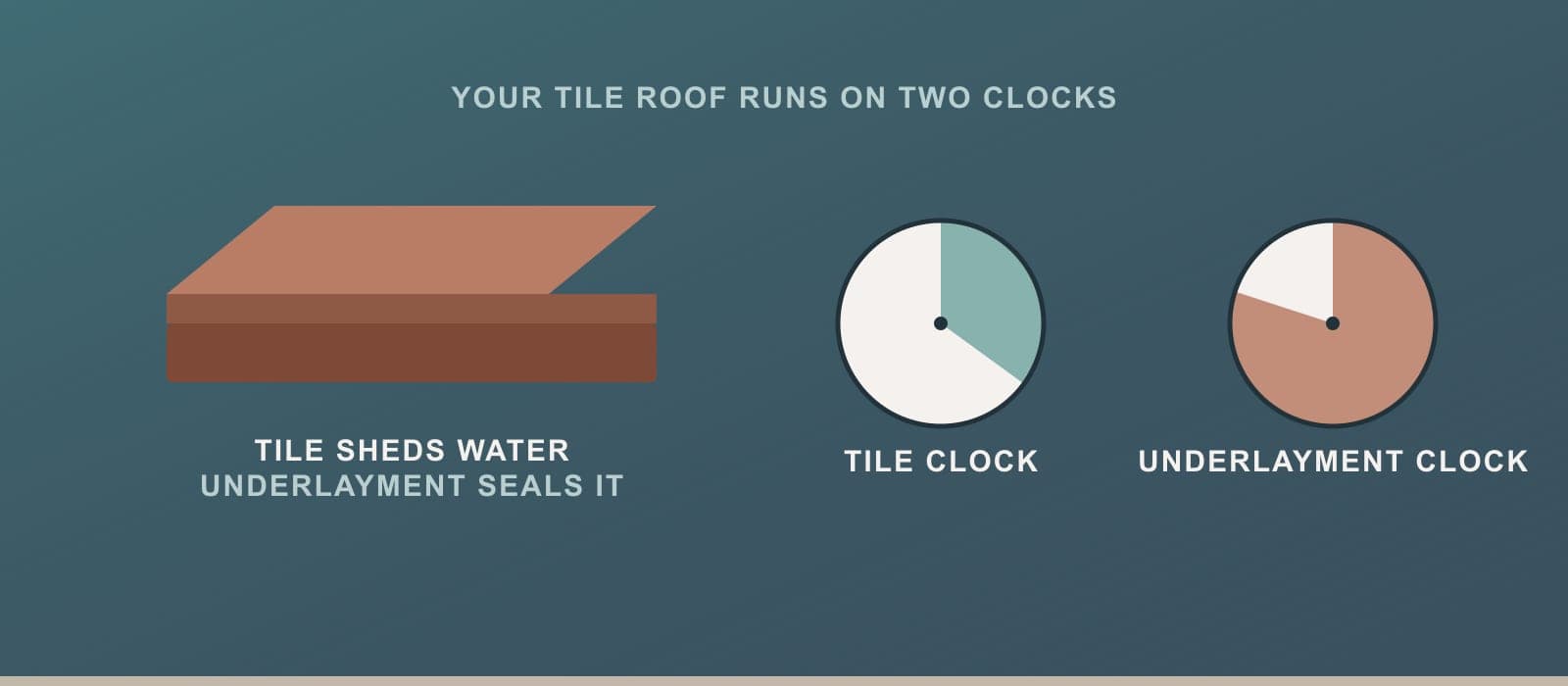
The two-clock model: tile is the armor, underlayment is the raincoat
Picture a tile roof as two products stacked on top of each other.
The tile, clay (terracotta) or concrete, is the armor. It sheds the bulk of the rain, takes the UV, and gives the building its Mediterranean or Spanish look. Tile is remarkably durable: fired clay tile routinely lasts 50–100 years, and concrete tile commonly runs 25–50 years depending on the mix and the exposure. On the street, tile can look flawless for decades.
The underlayment is the raincoat. It is the layer of felt, synthetic, or self-adhering membrane fastened to the wood or concrete deck, underneath the tile. In a tile roof, the underlayment, not the tile, is the actual waterproofing layer. Tile is water-shedding, but wind-driven rain, capillary action, and the gaps around every tile mean water regularly reaches the underlayment. The raincoat is what keeps that water out of the building.
Here is the problem: the raincoat wears out two to four times faster than the armor. Trap the two clocks side by side and the mismatch is stark:
| Layer | What it does | Typical service life (coastal South Florida) |
|---|---|---|
| Clay tile | Sheds water, UV armor, appearance | 50–100 years |
| Concrete tile | Sheds water, UV armor, appearance | 25–50 years |
| Organic felt (#30) underlayment | Waterproofing membrane | ~15–20 years (shorter near the ocean) |
| Synthetic underlayment | Waterproofing membrane | ~20–30 years |
| Self-adhering SBS "peel-and-stick" (ASTM D1970) | Waterproofing membrane, bonds to deck | ~30–40+ years rated; coastal service often shorter |
The single most important sentence a board can take from this table: most South Florida tile-roof failures are underlayment failures, not tile failures. The building doesn't leak because the tiles wore out. It leaks because the membrane under intact tiles quietly aged out.
Why the coast runs the underlayment clock down faster
Underlayment manufacturers publish life expectancies based on average U.S. conditions. South Florida is not average. Several coastal accelerants push the raincoat clock toward the short end of every range:
- Heat and thermal cycling. A tile roof surface can exceed 160°F on a summer afternoon, then drop to the 70s overnight. Air gets trapped in the cavity beneath the tile, so the underlayment cooks and cools in a daily expansion-contraction cycle that embrittles asphaltic membranes and stresses the fasteners.
- UV exposure. With 230+ sunny days a year, ultraviolet radiation reaches the underlayment through gaps and at edges, breaking down the asphalt binder and the reinforcement.
- Salt air. Within about 10 miles of the coast, which is essentially all of Palm Beach, Broward, and Miami-Dade, airborne chloride corrodes the metal parts of the assembly: nails, battens fasteners, flashing, drip edge, and valley metal. Corroded fasteners are often the first breach.
- Hurricane-driven rain and wind uplift. From June 1 to November 30, wind-driven rain is forced up and under tile at pressures the roof never sees in calm weather, and repetitive uplift works fasteners and flashing loose. One storm rarely destroys the underlayment; ten seasons of it does.
- Slow drainage and debris. Flat terrain, intense downpours, and clogged valleys keep water sitting against the membrane longer than in drier climates, finding every aged seam.
The net effect: an underlayment rated "20–30 years" on a national spec sheet frequently behaves like a 15–25-year component on an oceanfront or Intracoastal building, and the low end of that range on a west- or south-facing, sun-loaded, near-water slope.
How to tell the underlayment is failing when the tile looks fine
Because the tile hides the failing layer, the warning signs show up inside the building and at the details, not on the field of the roof:
- Ceiling or wall staining in top-floor units, often appearing after a hard rain rather than continuously.
- Musty odor or visible moisture in attic spaces, chases, or the underside of the deck.
- Slipped, cracked, or "walking" tiles: when fasteners corrode or the underlayment shrinks, tiles lose their grip and shift.
- Corroded or lifting flashing at walls, chimneys, valleys, skylights, and penetrations, usually the first place water gets in.
- Efflorescence or rust streaking on soffits and fascia.
- Leaks that move: water shows up in a different spot than the visible stain, because it travels along the deck before it drips.
A qualified roofing contractor confirms the diagnosis with an inspection that looks under representative tiles, checks fastener and flashing condition, and, on larger or occupied buildings, may use infrared or moisture scanning to find saturated decking before it becomes structural. The goal is to separate a localized repair (a few sections) from a whole-roof underlayment issue (the raincoat is simply old).
Lift-and-relay vs. full replacement: the decision that saves the tile
Here is the good news that many boards never hear: if the underlayment has aged out but the tile is still sound, you usually do not need a whole new roof. You need a lift-and-relay (also called a lift-and-reset or "lift-n-lay").
What a lift-and-relay is. The roofer carefully lifts and stages the existing tile, tears off and disposes of the old underlayment and battens, installs a new code-compliant underlayment bonded to the deck, replaces battens and corroded fasteners/flashing, and then re-installs the original tile using a current NOA-approved (Notice of Acceptance) fastening system. You keep the armor and replace the raincoat.
Why it's attractive. A lift-and-relay is commonly around 20% less than a full tile tear-off and replacement, because you are not buying an entire roof's worth of new tile, one of the most expensive line items. You also preserve the exact color and profile the building was designed with, and you keep matched tile that may no longer be manufactured.
When a full replacement is the better call instead. Choose a full tear-off and new tile when:
- The tile itself is past its service life (widespread cracking, spalling concrete tile, delamination).
- More than roughly 10% of the tiles are already cracked or chipped. Relaying that field means an unacceptable amount of replacement anyway.
- The original tile is discontinued and breakage during the lift would force a mismatched partial-color repair (see the breakage note below).
- The board is changing the tile profile or color entirely, or upgrading the whole assembly for wind or energy reasons.
The breakage reality: budget for it. Even skilled crews break tile during a lift, because prying old, fastener-locked tile stresses the nail holes and creates hairline cracks. A common planning figure is to budget around 15–20% tile breakage/waste. That's exactly why discontinued tile changes the math: if you can't buy matching replacements for the pieces you break, a relay can turn into a de facto replacement. An experienced coastal roofer minimizes breakage and sources matching salvage where possible, worth asking about in any bid.
What the code now requires (and why it matters to your reserve)
If you are re-doing the underlayment on a South Florida tile roof, you are doing it under the current code, and the code changed. The 2023 Florida Building Code, 8th Edition (in effect since December 31, 2023) tightened steep-slope underlayment requirements. In the High-Velocity Hurricane Zone (HVHZ), Miami-Dade and Broward, the roof deck must be covered with an approved self-adhering polymer-modified bitumen underlayment complying with ASTM D1970, installed per both the underlayment and the roof-covering manufacturers' instructions, with the whole assembly carrying HVHZ/NOA approval.
For boards, three practical consequences follow:
- You cannot simply put back "what was there." A 1990s felt-and-hot-mop or 30-lb-felt assembly is replaced with a modern self-adhering system bonded to the deck: better waterproofing and storm resistance, but a different (and often higher) cost basis.
- The new membrane resets the underlayment clock, not the roof-age clock for insurance. A fresh peel-and-stick membrane can restore the raincoat for decades. Whether a carrier treats a lift-and-relay as a "new roof" for underwriting and roof-age rules is a separate question, one worth confirming in writing with your agent before you spend, as we cover in our post on roof coatings, roof age, and Florida insurance.
- Palm Beach County sits outside the strict HVHZ but is a high-wind coastal county; specify a self-adhering, code-approved membrane there too rather than reverting to felt.
The board takeaway: budget the underlayment as its own reserve line
This is where the two-clock model becomes a governance and finance issue, not just a roofing one. Under Florida's structural integrity reserve study (SIRS) law, §718.112(2)(g), condominium associations of three or more habitable stories must reserve for the roof as a mandatory component, and the milestone inspection law, §553.899, brings the whole envelope under scrutiny at 25 or 30 years depending on coastal distance. Boards that budgeted a single "40–80-year roof" line and never funded a mid-life underlayment replacement are the ones hit with a surprise special assessment when top-floor units start leaking at year 18.
The fix is to model the roof as two components on two clocks:
- Tile (armor): long life, low near-term reserve pressure, but confirm the tile's actual condition, don't assume the catalog number.
- Underlayment + flashing + fasteners (raincoat): a 15–25-year coastal component that should have its own reserve funding and its own planned replacement, ideally executed as a lift-and-relay before leaks force an emergency.
Documented inspections and a planned lift-and-relay let a reserve professional assign a realistic remaining useful life (RUL) to the roof, which is what actually drives the annual reserve contribution, the same RUL logic we lay out in our coastal building-component service-life reference and our guide to avoiding special assessments with preventive maintenance.
Where Beachfront fits
Beachfront Commercial Services is a licensed and insured South Florida contractor (CGC #1537131, CCC #1333921, CCC #1333373) serving condo and HOA boards, CAMs, and commercial owners across Palm Beach, Broward, and Miami-Dade. Because we self-perform roofing and waterproofing under one roof, the same team that lifts and relays your tile also details the flashing, penetrations, and wall transitions where coastal roofs actually leak, with no handoff between the "roofer" and the "waterproofer." We install code-compliant, NOA/HVHZ-approved self-adhering underlayment systems, document condition for your milestone inspection and SIRS reserve study, and phase work to keep an occupied building protected. On tile specifically, we assess whether your tile can be salvaged in a lift-and-relay before anyone recommends the more expensive full tear-off.
General information, not engineering advice. Roof-covering condition, structural findings, and milestone determinations on 3+-story buildings should be confirmed by your licensed roofing contractor and, where applicable, a Florida-licensed engineer or architect.
Frequently Asked Questions
Do I have to replace my whole tile roof, or can I just replace the underlayment? If your tile is still sound and only the underlayment has aged out, you can usually keep the tile and do a lift-and-relay: the roofer removes the tile, installs new code-compliant underlayment and battens, and re-installs the original tile. A full tear-off and new tile is warranted when the tile itself is past its service life, more than about 10% is cracked, the profile is discontinued, or you're changing the look.
How long does the underlayment under a tile roof last in South Florida? Roughly 15–25 years on the coast, depending on the material and exposure: organic felt at the short end (~15–20 years), synthetic in the middle (~20–30 years), and self-adhering peel-and-stick (ASTM D1970) longest. Salt air, UV, thermal cycling, and hurricane-driven rain push most coastal underlayments toward the lower end of their rated ranges, even while the tile above still looks new.
How much does a tile lift-and-relay cost versus a full replacement? A lift-and-relay commonly runs about 20% less than a full tear-off-and-replace because you're reusing the tile rather than buying a whole new roof's worth. Actual pricing depends on roof size, slope, height, tile fragility, and the amount of flashing and deck repair needed, so a per-building inspection and scope are the only reliable way to price it. Budget for tile breakage of roughly 15–20% either way.
Why is my tile roof leaking if the tiles look perfect? Because the tile is not the waterproofing layer. The underlayment beneath it is. Tile sheds most water, but wind-driven rain reaches the membrane routinely, and once that membrane ages out, water passes through even though every tile looks intact from the ground. That's why coastal tile roofs "look fine but leak," and why interior stains and attic moisture are the real early warnings.
Does replacing the underlayment count as a new roof for insurance and reserves? For your reserve study, the underlayment/flashing package should be treated as its own component with its own replacement cycle, separate from the long-lived tile. For insurance, whether a carrier counts a lift-and-relay as a "new roof" for roof-age purposes varies. Confirm it in writing with your agent before the work, since a fresh membrane and a fresh code-approved installation can affect how your roof age is evaluated.
Ready to Protect Your Property?
Tell us about your building and a Beachfront estimator will follow up with a clear scope and fair pricing.