Roofing
Does a Roof Coating Help Your Florida Insurance? Roof Age, Wind Mitigation, and the Coating-vs-Replacement Trap for South Florida Condos
A South Florida condo board and property manager's guide to whether a roof coating helps you keep or qualify for property insurance: Florida's 15-year roof rule (Fla. Stat. §627.7011), the 5-year remaining-useful-life inspection, why a maintenance coating is not a 'new roof' to your carrier or Citizens, whether coatings earn wind-mitigation credits, and how to spec a permitted restoration or replacement that an underwriter will actually accept.
Beachfront Commercial Services ·
Short answer: A maintenance roof coating applied over an existing roof does not make an aging roof "new" to your insurer, and by itself it does not earn wind-mitigation credits. Florida's property carriers, including state-backed Citizens, treat acrylic, silicone, urethane, and elastomeric maintenance coatings as protection for a roof, not as proof that the roof covering was replaced. What can help an older roof stay insurable is a documented remaining-useful-life (RUL) inspection showing five or more years of life left, and what actually resets your roof age is a permitted, code-approved re-cover or full replacement installed by a licensed roofing contractor. For a coastal condo board weighing a coating against a reroof, the difference between those two things is the difference between keeping coverage and paying for a coating that your carrier ignores.
This guide is written for South Florida condo and HOA boards, community association managers (CAMs), and commercial building owners in Palm Beach, Broward, and Miami-Dade counties who are hearing "coat it and save the roof" from one vendor and "your carrier won't accept that" from another. Both can be true. Here is how to tell which one applies to your building. It is general information, not insurance, legal, or engineering advice.
Why roof coatings and insurance collide in South Florida right now
Two pressures are hitting coastal condo associations at the same time. First, the Florida insurance market has tightened hard: the state has led the nation in homeowners nonrenewals, and carriers increasingly scrutinize roof age because roofs are the single largest driver of hurricane claims. Second, salt air, ultraviolet load, humidity, and storm-pressure cycling shorten roof life on the coast. A roof membrane that might last 20 to 30 years inland often loses roughly three to seven of those years within about a mile of the ocean.
So a board with a functional but aging roof faces a real question: can we spend a fraction of a reroof on a coating, protect the roof, and keep our insurance happy? The coating vendors say yes. Many carriers say no. The honest answer requires separating two things that get blended together: the building-science value of a coating (waterproofing, reflectivity, extending service life) and the insurance value of a coating (whether an underwriter will treat it as a roof replacement). They are not the same, and confusing them is how a coastal association ends up spending money that does nothing for its policy.
Florida's roof-age rules: the "15-year rule" explained
The core statute is Fla. Stat. §627.7011. Its roof-age provisions were added in 2022 and apply to homeowners' policies issued or renewed on or after July 1, 2022. Two rules matter most:
-
The under-15 protection. An insurer "may not refuse to issue or refuse to renew a homeowner's policy insuring a residential structure with a roof that is less than 15 years old solely because of the age of the roof." In plain terms, a roof under 15 years old cannot be dropped for age alone.
-
The over-15 inspection path. For a roof that is at least 15 years old, the insurer must allow the policyholder to obtain a roof inspection by an authorized inspector at the owner's expense before requiring replacement as a condition of coverage. If that inspection shows the roof has five years or more of useful life remaining, the insurer may not refuse to issue or renew solely because of roof age. Roofers sometimes call this "15 years plus-plus," because a sound older roof can keep buying five-year insurable windows.
Who counts as an "authorized inspector"? Under §627.7011, it includes a licensed home inspector, a certified building-code inspector, a professional engineer, a registered architect, and, importantly for boards, a general, building, or residential contractor or a roofing contractor. Florida's HB 1611, effective July 2024, reinforced that licensed roofing contractors can perform these inspections and increased insurer roof reporting. That means a licensed contractor like Beachfront (DBPR CGC #1537131, CCC #1333921, CCC #1333373) can document remaining useful life for the underwriting file.
One more technical point that trips up buildings with phased roof work: for insurance purposes, roof age is calculated from the last date on which 100 percent of the roof's surface area was built or replaced to the code in effect at that time. Coating 100 percent of the surface does not reset that date. Replacing 100 percent of the covering does.
The condo and commercial caveat almost no one mentions
Here is the nuance that separates a real board resource from a homeowner blog: §627.7011 governs homeowners' policies. It "does not apply to commercial or mobile home policies." A condo association's building is typically insured under a commercial residential master policy, which is underwritten under the carrier's commercial rules (or, if placed with Citizens, under Citizens' commercial-lines underwriting), not under the 15-year homeowner statute. So a board cannot simply wave §627.7011 at its master-policy carrier. The principles (roof age matters; a documented inspection helps; a coating is not a replacement) carry over, but the specific statutory protection is written for the single-family homeowner. Individual unit owners buying HO-6 policies are a different story. Always confirm which policy, master or unit, you are actually trying to satisfy.
Coating vs. replacement in the eyes of an insurer
This is the heart of the matter, and Florida's own state insurer has spelled it out. In its December 15, 2022 "Roof Coatings Clarification" (a Commercial Lines Bulletin), Citizens Property Insurance told agents exactly how it treats coated roofs:
"Maintenance roof coatings, such as acrylic, silicone, urethane, soy, elastomeric or other similar coatings that are typically applied to an existing roof covering for waterproofing or UV protection, do not meet Citizens' requirements for proof of roof covering material replacement."
In other words, painting a protective coating over your existing roof does not count as replacing the roof. Citizens will still review the risk based on the age and condition of the original roof underneath. An underwriter may extend the roof's remaining useful life by only one to three years on a coated building, and only after a licensed roofer or general contractor documents the condition with photos of the entire roof line and surface. A one-to-three-year bump is not the same as resetting a 20-year-old roof to zero.
By contrast, Citizens (like the broader market) recognizes two things as an actual roof replacement:
- A re-roof: complete removal of the old covering and installation of a new one.
- A one-time re-cover: a complete new covering installed over one existing underlying substrate (a single overlay; Florida code does not allow stacking a second one).
Either way, the replacement must use an FBC-approved roof covering product, be installed by a Florida-licensed roofing contractor, and be permitted. Documentation (the permit, the contract or proposal identifying the approved product, and final inspection) is what an underwriter accepts as proof.
The practical takeaway for a board: if your goal is to satisfy a carrier that is uneasy about roof age, a maintenance coating is the wrong tool. A permitted, code-approved re-cover or replacement is the tool that changes your roof age on the record.
Do roof coatings earn wind-mitigation credits? Almost never
Boards often hope a coating will at least earn a wind-mitigation premium credit. It generally will not, and understanding why helps you spend on the things that do earn credits.
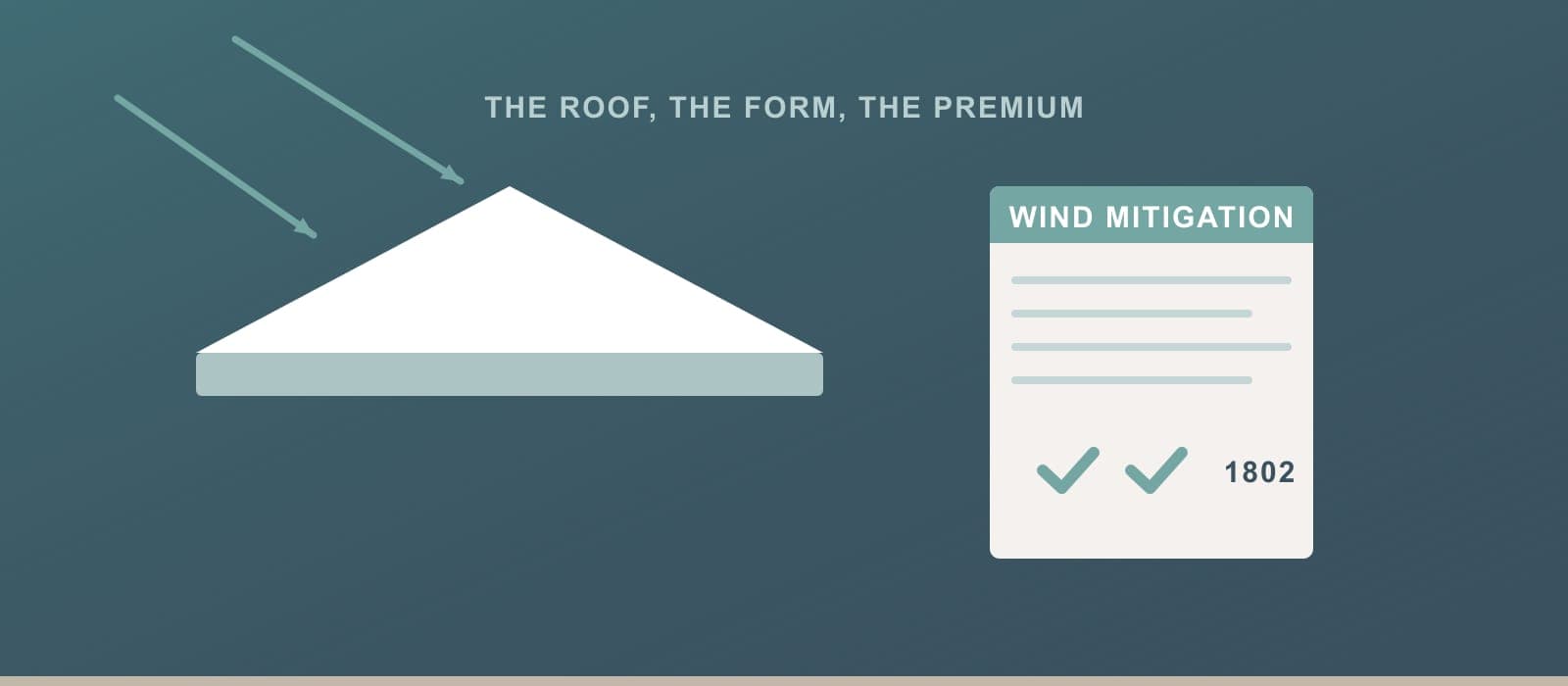
Florida's uniform wind-mitigation inspection rewards a specific, closed list of construction features, none of which a surface coating changes:
- Roof covering: whether the covering meets Florida Building Code or Miami-Dade product-approval standards.
- Roof deck attachment: nail type and spacing fastening the sheathing to the trusses.
- Roof-to-wall connection: toe-nails vs. clips vs. single or double wraps (hurricane straps).
- Roof geometry: a hip roof earns more than a gable.
- Secondary water resistance (SWR): a sealed barrier under the covering that limits water intrusion if the covering is lost.
- Opening protection: impact-rated or shuttered windows and doors.
A coating rolled onto the top of a finished roof does not touch fastening, connections, geometry, or openings. It is also not secondary water resistance. SWR has a precise definition: a self-adhering polymer-modified-bitumen underlayment adhered to the roof sheathing before the roof covering was installed (standard felt and synthetic underlayments do not qualify, and neither does a valley-only strip). Because SWR lives under the covering and must be there at installation, a coating applied over an existing roof cannot earn the SWR credit. As one South Florida insurance broker who specializes in condo and commercial buildings put it, meaningful wind-mitigation credits for coated or liquid roofs are, for now, hard to come by.
If wind-mit savings are the goal, the money belongs in deck re-nailing, roof-to-wall strapping, opening protection, or a code-compliant reroof with proper SWR, not in a surface coating.
A coastal cautionary tale: coated roofs, refused coverage
This is not theoretical. In January 2025, Insurance Journal (drawing on the Palm Beach Post) reported that one West Palm Beach condo association spent millions of dollars coating its buildings' roofs with a polyurethane-and-silicone product, and its insurance company still refused to write the property, entirely because of the age of the roof. Agents quoted in the same reporting said the carriers they work with do not accept that a coating extends the life of the covering underneath.
The lesson is not that coatings are worthless. It is a sequencing failure. The association spent the money before confirming what its carrier would accept. For a board, the order of operations is everything: ask the carrier or agent, in writing, what they will accept before you spend a dollar on a coating meant to solve an insurance problem.
When a roof coating IS the right move
None of the above means coatings are a scam. Applied for the right reason, a roof coating or a liquid-applied restoration system is a legitimate, cost-effective tool. It simply solves a building problem, not an insurance one. Coatings genuinely can:
- Waterproof and protect a sound low-slope roof, sealing seams and small defects and shedding water.
- Reflect heat and cut cooling load, extending the membrane's service life against South Florida's UV and thermal cycling.
- Extend remaining useful life so a board can defer a reserve-funded replacement a few years and plan the capital cost, the same RUL lever that, documented properly, supports a Structural Integrity Reserve Study.
There is also a meaningful difference between a maintenance coating over an old covering and a liquid-applied membrane installed as a replacement system. Professional-grade polyurethane and silicone systems, for example Sika's Sikalastic line, can be installed as a genuine roof system bonded to the deck, carrying long manufacturer warranties (often around 20 years) and strong wind-uplift resistance. Installed to the decking under permit as a re-cover or replacement, that is a new roof; brushed over an aging shingle or old membrane as maintenance, it is a coating. Same chemistry, very different insurance status. The distinction is how and where it is installed, and that is exactly the kind of call a licensed roofing and waterproofing contractor is qualified to make.
The board and CAM playbook: get roof spend to actually help your policy
Before your association spends reserve or operating dollars on a roof coating or replacement with an insurance goal in mind, run this sequence:
- Verify your true roof age: the last date 100 percent of each roof's surface was replaced to code. Pull permits and prior contracts; phased work can make the "age" older than people remember.
- Get a remaining-useful-life inspection from a licensed roofing or general contractor, with full roof-line and surface photos. If the roof has five or more years of life, that documentation is your strongest insurability asset for an aging roof.
- Ask the carrier or agent in writing what they will accept (a coating, a re-cover, or only a full replacement) before you spend. Get the answer specific to your master policy, and have unit owners confirm requirements for their HO-6 policies separately.
- If you must replace or re-cover, spec it correctly: an FBC-approved (and, in the High-Velocity Hurricane Zone across Broward and Miami-Dade, HVHZ-approved) product, installed by a Florida-licensed roofing contractor, under permit, with final inspection.
- Keep the underwriting file: permit, contract identifying the approved product, final inspection, and photos. That package is what changes your roof age on the record and what an underwriter accepts.
- Coordinate with milestone and reserves. For buildings three or more habitable stories, the roof is both a milestone-inspection concern (Fla. Stat. §553.899) and a reserve component in your SIRS (§718.112(2)(g)). Sequencing a roof decision with those deadlines keeps a compliance clock from forcing a rushed, uninsurable choice.
Beachfront Commercial Services is a licensed, insured contractor that self-performs roofing and waterproofing across Palm Beach, Broward, and Miami-Dade, which means the same firm can inspect and document remaining useful life, install a legitimate liquid-applied restoration where it fits, and execute a permitted re-cover or replacement where the carrier requires one. We are the contractor that does the work and documents it for underwriting; we are not your insurance agent, carrier, or the engineer of record, and coverage decisions always rest with your carrier.
Frequently Asked Questions
Does a roof coating count as a new roof for Florida insurance? No. Florida carriers, including Citizens, treat maintenance roof coatings (acrylic, silicone, urethane, soy, elastomeric) as protection applied over an existing roof, not as proof the roof covering was replaced. An underwriter may add only about one to three years of remaining useful life for a coated roof, and only after a licensed contractor documents its condition. To reset roof age, you need a permitted, code-approved re-cover or full replacement.
What is Florida's 15-year roof rule? Under Fla. Stat. §627.7011, an insurer cannot refuse to issue or renew a homeowners policy solely because the roof is less than 15 years old. For a roof 15 years or older, the insurer must allow an inspection by an authorized inspector before requiring replacement, and cannot refuse for age alone if the roof shows five or more years of remaining useful life. Note this statute governs homeowners' policies. A condo association's commercial master policy is underwritten under separate commercial rules.
Will a roof coating qualify my building for a wind-mitigation credit? Generally no. Wind-mitigation credits reward roof covering compliance, deck attachment, roof-to-wall connections, roof geometry, secondary water resistance, and opening protection. A surface coating changes none of those. Secondary water resistance specifically requires a self-adhering membrane installed under the roof covering at the time of roofing, so a coating applied on top of a finished roof does not earn it.
Can a condo association use the 15-year rule to keep its master policy? Not directly. Section 627.7011 applies to homeowners' policies, and a condo association's building is usually insured under a commercial residential master policy underwritten under commercial rules. The same principles (roof age matters, a documented inspection helps, a coating is not a replacement) apply in practice, but the specific statutory protection is written for single-family homeowners. Individual unit owners' HO-6 policies are separate.
We have an aging but sound roof. What should we do first? Verify the true roof age from permits, get a remaining-useful-life inspection from a licensed roofing or general contractor with full-roof photos, and ask your carrier or agent in writing what they will accept before spending. If the roof has five or more years of documented life, that may preserve coverage without any roof work. If replacement is required, spec an FBC/HVHZ-approved system installed under permit by a licensed roofer, and keep the paperwork for underwriting.
This article provides general information for South Florida condo boards, property managers, and building owners. It is not insurance, legal, or engineering advice, and it does not guarantee any coverage outcome. Insurance eligibility and underwriting decisions rest with your carrier; confirm requirements with your agent and, where structural or code questions arise, a licensed engineer.
Ready to Protect Your Property?
Tell us about your building and a Beachfront estimator will follow up with a clear scope and fair pricing.