Compliance & Ownership
Milestone Inspection and SIRS Together: How South Florida Condo Boards Coordinate Both in One Engagement
Which comes first, the milestone inspection or the SIRS? Can you do them at the same time? A South Florida condo board's guide to sequencing both, the HB 913 Dec 31 2026 same-time window, and scheduling the engineer and repair contractor together to cut cost.
Beachfront Commercial Services ·
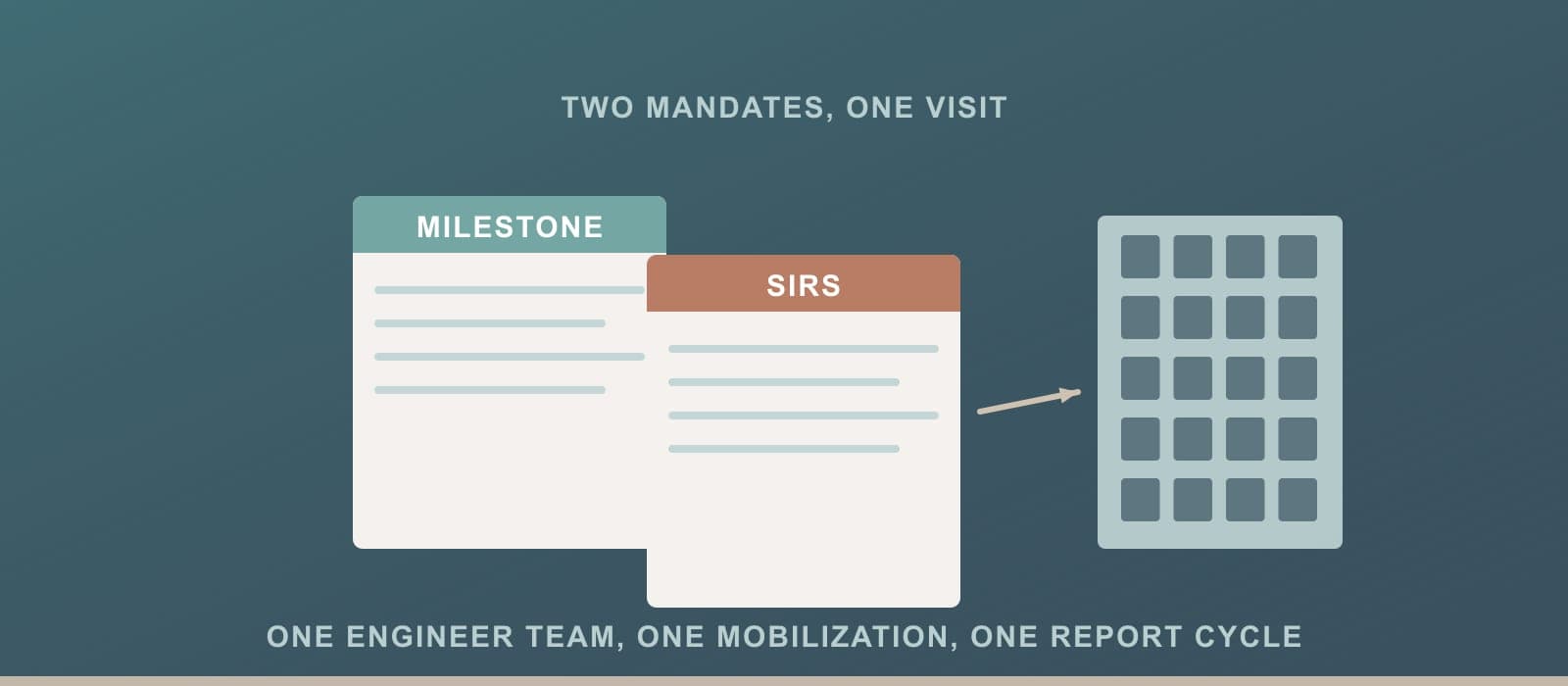
Direct answer: A South Florida condo association can, and in most cases should, run its milestone inspection and its Structural Integrity Reserve Study (SIRS) as one coordinated engagement, with the milestone inspection performed first (or on the same building visit), because the milestone's structural findings are the inputs the SIRS uses to set each component's remaining useful life and replacement cost. Under HB 913, if a building's milestone inspection is due on or before December 31, 2026, the association may complete its SIRS at the same time as that milestone inspection, but in no event may the SIRS be completed later than December 31, 2026. Coordinating the two is where boards save real money: the engineer is already on site, one building-access cycle covers both, and the repair contractor can mobilize once against a single, reconciled scope.
If your board is staring at two compliance letters, two proposals, and two different vocabularies, this guide untangles them. It explains what each requirement actually is, which one comes first and why, how to schedule them together, and, the part most articles skip, how to line up the engineer and the licensed restoration contractor so a coastal building gets inspected, priced, and repaired without paying for three separate mobilizations.
This is general information for planning purposes, not engineering or legal advice. Confirm the deadlines and scope that apply to your specific building with your inspecting engineer or architect and your association's attorney.
Two Requirements, Two Jobs: The Milestone Inspection vs. the SIRS
Both requirements grew out of Florida's post-Surfside reforms (Senate Bill 4-D, 2022), but they answer different questions.
The milestone inspection (Florida Statutes §553.899) answers is the building structurally safe right now, and what has to be repaired? It is a structural inspection of a condominium or cooperative building's primary structural systems, required for buildings three or more habitable stories in height. A licensed Florida engineer or architect performs it, starting with a Phase 1 visual, non-invasive assessment. If the Phase 1 identifies substantial structural deterioration, the process advances to a Phase 2 inspection, which can involve destructive or otherwise invasive testing to determine the extent of the damage and the repairs needed.
The SIRS (Florida Statutes §718.112(2)(g)) answers will we have the money to keep the building safe over the decades ahead? It is a study of the reserves an association must fund for the future major repair and replacement of critical components: the roof, load-bearing walls and other primary structural members, floor, foundation, fireproofing and fire protection, plumbing, waterproofing and exterior painting, windows, and any other item with a deferred maintenance expense or replacement cost above the statutory threshold. A SIRS may be prepared by a licensed engineer or architect, a reserve specialist holding the CAI "RS" credential, or a professional reserve analyst holding the APRA "PRA" credential.
Put simply: the milestone inspection is the building's structural health check; the SIRS is the long-term treatment-and-funding plan. One tells you what is wrong. The other tells you how to pay to keep it from getting wrong again. (For a deeper walk-through of what the SIRS must fund and how envelope work enters the reserve, see our dedicated SIRS and reserve-study guide.)
Who has to do each
For applicable residential condominium and cooperative associations, both requirements generally apply to buildings three or more habitable stories in height. "Habitable stories" means floors used for living, sleeping, eating, or cooking, so a building with two residential levels over a non-habitable parking or storage level typically does not count toward the three-story threshold. A structure below three habitable stories is generally exempt from both the milestone inspection and the SIRS, though that does not make its roof, garage, or balconies any less in need of maintenance.
Which Comes First, Milestone or SIRS?
In almost every case, the milestone inspection should come first, or be performed on the same building visit that feeds the SIRS. The reason is mechanical, not bureaucratic: the SIRS has to assign a remaining useful life and a replacement cost to each structural component, and the most defensible source for those numbers is a licensed engineer's current structural findings. Commissioning a SIRS before anyone has looked hard at the structure means the reserve professional is estimating condition from age tables and a walkthrough, and then you may have to revise the whole funding model the moment the milestone report lands with a Phase 2 finding on the garage or the balconies.
Sequence it the other way and the numbers reconcile the first time:
- The milestone inspection classifies findings by severity and recommends repair time frames.
- The SIRS preparer reviews the full milestone report, including any Phase 2 findings, and adjusts the remaining useful life and replacement cost of the affected components to match what the engineer actually found.
- The reserve funding plan and the annual budget are built around both existing deterioration and the repair program that flows out of the milestone inspection.
That is the "milestone first" rule. But "first" does not mean "separate."
Can We Do the Milestone Inspection and SIRS at the Same Time?
Yes, and this is the coordination that saves money. Because the same categories of licensed professional (an engineer or architect) can perform the milestone inspection and prepare the SIRS, many South Florida associations engage one firm to do both against a single building mobilization. The engineer is already on the roof, in the garage, and on the balconies for the milestone; capturing the SIRS component data on the same visit avoids paying twice for access, scaffolding, and site time.
HB 913 (effective July 1, 2025) built a specific timing allowance around exactly this. Here is the timeline boards most often get wrong:
- For existing, unit-owner-controlled associations with buildings three or more habitable stories, the SIRS generally must be completed by December 31, 2025.
- There is one narrow exception: if your association is required to complete a milestone inspection under §553.899 on or before December 31, 2026, you may complete the SIRS at the same time as that milestone inspection.
- In no event may the SIRS be completed after December 31, 2026.
So unless a 2026 milestone inspection clearly applies to your building, treat December 31, 2025 as your operating deadline rather than assuming you have until 2026. Qualified engineering firms across Palm Beach, Broward, and Miami-Dade are working through a heavy backlog of milestone and SIRS work, and scheduling bottlenecks are common. An association that has not started should engage a firm now rather than counting on the milestone-aligned date to buy time.
The Third Clock South Florida Boards Forget: County Recertification
Outside South Florida, boards juggle two clocks. In Miami-Dade and Broward, there is often a third: the county's long-standing building recertification program (commonly the 40-year, and now frequently 25- or 30-year, recertification), a local requirement that predates the statewide milestone program and covers both structural and electrical systems. The statewide milestone inspection does not automatically discharge a county recertification, and vice versa, though a qualified engineering firm can often scope one visit to gather what both need.
There is also a coastal wrinkle in the milestone trigger itself. The statewide default is an initial milestone inspection in the year the building turns 30, then every 10 years. But a local enforcement agency may require the initial inspection earlier, commonly at 25 years, for buildings within three miles of the coastline. For an oceanfront condo in Sunny Isles, Fort Lauderdale, or Palm Beach, that five-year difference decides whether your milestone is already overdue. Confirm the exact trigger with your local building department before you schedule anything.
A Sequencing Playbook for Coordinating Both
Every building is different, but the following order keeps a coastal association compliant, avoids re-work, and minimizes what you spend on inspections and access.
Step 1: Confirm which buildings and which deadlines apply
Build a simple table of every building the association owns. For each one, record whether it is a condominium or cooperative under Chapter 718/719 (single-family HOAs under Chapter 720 have different rules), the number of habitable stories, the certificate-of-occupancy date that drives the milestone age, and whether your local jurisdiction imposes an earlier (25-year coastal) trigger or a separate county recertification. DBPR's inspection resource pages plus your city or county building department are the right starting points.
Step 2: Schedule the milestone inspection first (or the shared visit)
Engage a licensed Florida engineer or architect who does milestone work in your county. Give them the building plans, prior reports, and any existing reserve study. Ask whether they can capture SIRS component data on the same mobilization. For many firms this is a single proposal with a milestone deliverable and a SIRS deliverable. Plan owner notices and unit-access logistics once, for both.
Step 3: Feed the milestone findings into the SIRS
Once the Milestone Inspection Report is in hand, the SIRS is built on real condition data rather than assumptions. The components the SIRS must fund (roof, structural systems, waterproofing, exterior painting, and load-bearing elements) get their remaining useful life and replacement cost set to reflect the engineer's findings. This is also where an accurate, coastal-adjusted remaining-useful-life view matters; a maintained roof or balcony coating carries more life (and a smaller reserve line) than a neglected one, which is why documented maintenance is worth capturing before the study is finalized.
Step 4: Convert the SIRS into a funding plan, budget, and owner communication
Under §718.112, the SIRS is meant to drive the annual budget and reserve schedule, and associations may not waive or underfund reserves for the SIRS-listed structural components after the statutory cutoff. Work with your reserve professional to choose a compliant funding path, reflect it in the noticed and adopted budget, and give owners a clear explanation of how the milestone findings and the SIRS changed their assessments.
HB 913 added flexibility for boards facing a wall of milestone-driven repairs. If your association has completed a milestone inspection that identified necessary repairs, the board may pause reserve funding for up to two consecutive budget years to redirect those funds toward the required repairs, but this pause is not a unilateral board decision; it requires a vote of the unit owners, and a new SIRS must be completed before normal funding resumes. HB 913 also lets associations pool structural reserve accounts (structural items only; you cannot combine roof-replacement reserves with amenity funds) without an owner vote, and raised the mandatory-reserve threshold from $10,000 to $25,000 (indexed to inflation beginning February 1, 2026). Structural reports, including milestone and SIRS reports, must now be retained for 15 years. A single inspection is a snapshot; fifteen years of data is the trend line that tells your board whether the building is improving or deteriorating.
Step 5: Execute the repairs, then update the SIRS
The milestone report's repair recommendations get carried out, often in phases across an occupied building, and the SIRS is updated as actual project costs come in and remaining-life assumptions reset. This is the step the reserve-study firms and the inspecting engineers hand off, and it is the step that determines whether your building actually gets safer.
A South Florida Coastal Sample Timeline
For a 30-year oceanfront condominium reaching its milestone, an integrated sequence typically looks like this:
- Year 1: Milestone inspection completed; Phase 1 and, if triggered, Phase 2 identify significant balcony, garage, or waterproofing repairs (on the coast, chloride-driven concrete spalling and post-tension anchor distress dominate Phase 2 findings). Emergency stabilization and shoring where ordered; board engages legal and engineering counsel on scope.
- Year 2: SIRS commissioned (or completed on the same engagement) explicitly incorporating the milestone findings; the reserve model shows required funding for structural components over the next 10–20 years; the board adopts a budget funding both immediate milestone repairs and reserves for the rest of the envelope.
- Years 3–5: Major repairs executed in phases; the SIRS is updated as real costs land and remaining-life assumptions reset.
- Years 6–10: Attention shifts to structural items not in the initial milestone scope but covered by the SIRS (roof, waterproofing, foundation); the association prepares for the next milestone cycle and the next SIRS update.
Keep the Inspector and the Repair Contractor Separate, and Coordinated
Here is a distinction that protects your association and, done right, saves it money. HB 913 requires that any architect, engineer, or licensed contractor hired to perform a SIRS or milestone inspection must disclose in writing if they also intend to bid on the resulting repair work, and a violation of that disclosure requirement makes the contract voidable. The rule exists because some firms used inspection findings as a sales tool, inflating deficiencies to win larger repair contracts. Boards protect themselves by keeping the party who inspects and certifies separate from the party who bids and performs the repair.
That separation is exactly how Beachfront Commercial Services works. Beachfront does not sign your milestone certificate or prepare your SIRS. That is the inspecting engineer's or architect's job, and it should stay independent. What Beachfront does is self-perform the repairs the milestone and SIRS identify: concrete restoration, balcony and deck waterproofing, roofing, sealants, and exterior coatings, under a licensed and insured general and roofing contractor (DBPR CGC #1537131, CCC #1333921, CCC #1333373).
Coordination without conflict is where a board captures the savings the reserve-study firms and stand-alone inspectors cannot deliver. On a coastal building, the biggest cost line often is not the inspection. It is access: swing stages, mast climbers, lifts, and the resident-notice cycle that comes with an occupied building. When the same restoration crew self-performs concrete repair, then the waterproofing, then the recoat against a single mobilization, you pay for that access once instead of three times. Because Beachfront self-performs both the structural concrete repair and the waterproofing detailing, the spall and the leaking detail that caused it get fixed by one crew in one pass, which is the difference between a repair that clears the next inspection and one that reappears in it.
As a South Florida contractor working Palm Beach, Broward, and Miami-Dade, Beachfront also brings the coastal context the national reserve-software and out-of-region engineering pages miss: salt-air chloride intrusion, hurricane-season access constraints, HVHZ requirements, and the reality that most coastal Phase 2 findings trace back to water and chlorides reaching the reinforcing steel.
Frequently Asked Questions
Which should we do first, the milestone inspection or the SIRS?
The milestone inspection, in almost every case. The SIRS has to assign a remaining useful life and replacement cost to each structural component, and the most defensible basis for those numbers is a licensed engineer's current milestone findings. Run the SIRS first and you often have to revise the entire funding model once the milestone report identifies a Phase 2 repair. Scheduling both on the same building visit, milestone data and SIRS data captured together, is the money-saving version of "milestone first."
Can we complete the milestone inspection and the SIRS at the same time?
Yes. The same categories of licensed professional can perform both, and doing them on one mobilization avoids paying twice for building access. Under HB 913, if your building's milestone inspection is due on or before December 31, 2026, you may complete the SIRS at the same time as that milestone inspection, but the SIRS can never be completed later than December 31, 2026.
Is our SIRS deadline December 31, 2025 or December 31, 2026?
Generally December 31, 2025 for existing, unit-owner-controlled associations with buildings three or more habitable stories. The December 31, 2026 date is a narrow exception that applies only when a milestone inspection is due on or before that date and you complete the SIRS alongside it. Unless a 2026 milestone clearly applies to your building, plan around the 2025 deadline. Confirm your building's specific deadline with your engineer and association counsel.
Can the same firm inspect the building and also do the repairs?
Florida law (HB 913) requires any engineer, architect, or contractor performing a SIRS or milestone inspection to disclose in writing if they also intend to bid on the repair work, and undisclosed conflicts make the contract voidable. Best practice is to keep the inspecting engineer or architect independent from the repair contractor. Beachfront does not issue milestone certificates or prepare SIRS reports; it self-performs the concrete restoration, waterproofing, roofing, and coating repairs those reports call for, coordinated with but separate from the inspecting professional.
Do we still owe the county 40/50-year recertification if we've done the milestone inspection?
Often, yes. In Miami-Dade and Broward, the county building-recertification program is a separate local requirement that predates the statewide milestone program and covers electrical as well as structural systems. Completing the statewide milestone inspection does not automatically satisfy a county recertification. A qualified engineering firm can frequently scope one site visit to gather what both require. Confirm the specifics with your local building department.
How does coordinating both actually save money on a coastal building?
On an occupied coastal condo, the largest cost driver is usually building access (scaffolding, swing stages, lifts, and the resident-notice cycle), not the inspection fee itself. Running the milestone and SIRS on one engagement uses a single access cycle for both, and self-performing the resulting concrete, waterproofing, and roofing repairs with one crew in one mobilization means you pay for that access once instead of repeatedly. Fixing the structural spall and the waterproofing detail that caused it in the same pass also reduces the odds the problem reappears at the next inspection.
This article is general information for South Florida condo and cooperative boards and property managers. It is not engineering or legal advice. Milestone inspection scope and certification are the responsibility of a licensed Florida engineer or architect, and SIRS preparation must be performed by a qualified professional as defined by statute. Confirm the requirements and deadlines that apply to your specific building with your inspecting professional and your association's attorney.
Ready to Protect Your Property?
Tell us about your building and a Beachfront estimator will follow up with a clear scope and fair pricing.