Roofing
Florida's 25% Roof Rule and the 'One Re-Cover' Limit, Explained for South Florida Condo Boards
Why a roofer sometimes quotes a full reroof for what looks like a partial repair. A plain-English guide to Florida's 25% roof rule (FBC §706 / §1511), the SB 4-D 2007-code exemption, and the one re-cover limit, for South Florida condo and HOA boards.
Beachfront Commercial Services ·
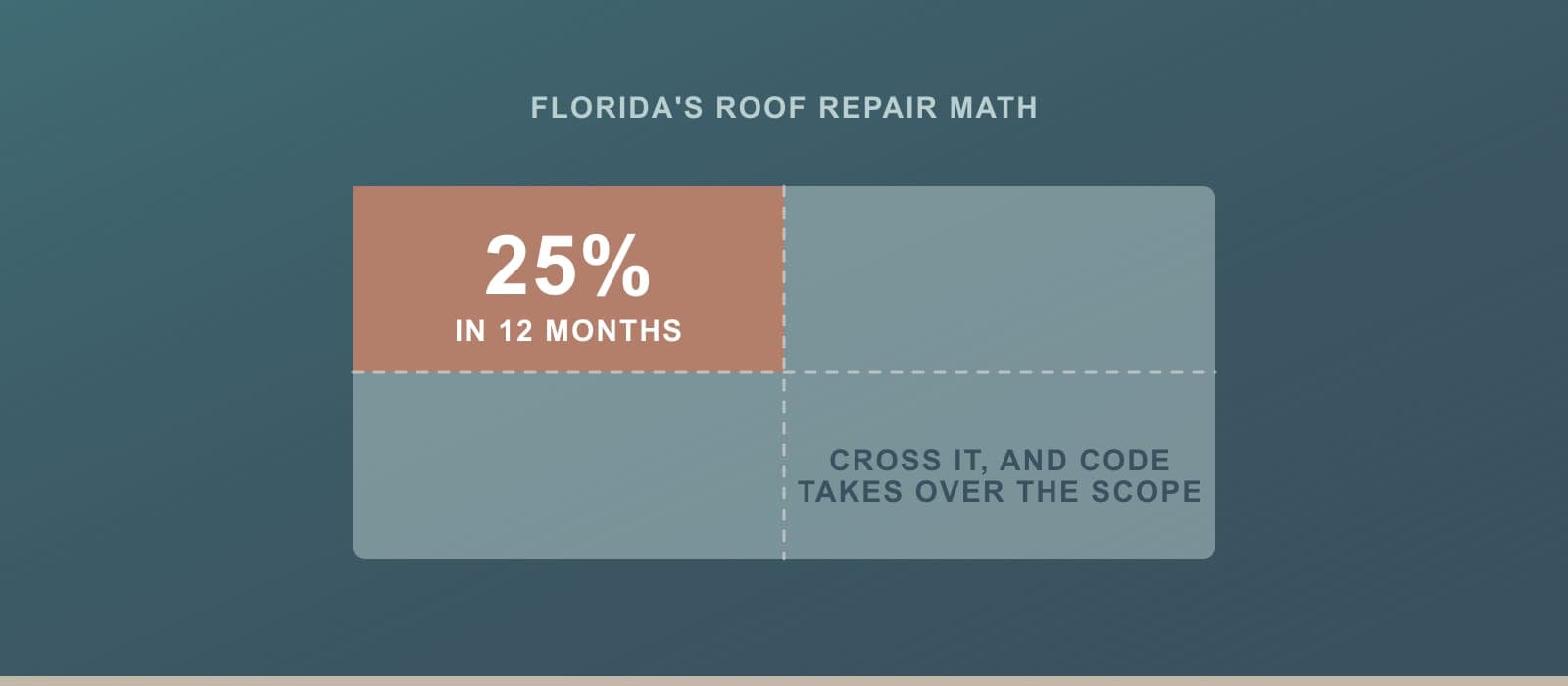
Direct answer: Florida's "25% rule" says that if you repair, replace, or recover more than 25% of a roof (or of a distinct roof section) within any 12-month period, the entire roof or section normally has to be rebuilt to the current Florida Building Code, not just patched. There is one big exception: if that roof was built or last fully replaced to the 2007 Florida Building Code or a later edition (in practice, permitted on or after March 1, 2009), Senate Bill 4-D now lets you repair only the damaged portion. Separately (and this trips up just as many boards), the "one re-cover" limit means you generally cannot add a second layer of roofing over an old one; most South Florida condo roofs must be torn off to the deck when they are re-roofed. If a roofer quotes a full reroof for what looked like a localized leak, one of these two rules is usually why.
This guide is written for condo and HOA boards, property managers (CAMs), and commercial owners across Palm Beach County, Broward, and Miami-Dade. It explains what the rules actually say, which of your buildings they catch, and how to plan and permit the work, without the sales pressure.
A note on scope. This is general educational information for board decision-making, not code, engineering, or legal advice. The Florida Building Code is interpreted and enforced by your local building official (the "authority having jurisdiction," or AHJ), and a licensed design professional or contractor confirms how it applies to a specific roof. Always verify with your AHJ and your licensed roofing contractor before scoping work.
The two rules that turn a repair into a reroof
Boards tend to hear "the whole roof has to go" and assume the roofer is upselling. Sometimes the real driver is the code. Two separate provisions of the Florida Building Code (FBC) do most of the surprising:
- The 25% rule: a quantity trigger. Work on more than a quarter of the roof and current code applies to the whole section.
- The one re-cover limit: a layering trigger. You cannot keep stacking new roofs over old ones; past a point, everything comes off to the deck.
They live in the FBC, Existing Building, Section 706 ("Existing Roofing") and the mirror provisions in FBC, Building, Section 1511 / Chapter 15. A statute, Florida Statutes §553.844, layers a critical 2022 exemption on top of the 25% rule. Understanding all three is what keeps a board from being blindsided at budget time.
What the 25% rule actually says
The core language of FBC Existing Building §706.1 (and §1511.1 in the Building volume) reads:
"Not more than 25 percent of the total roof area or roof section of any existing building or structure shall be repaired, replaced or recovered in any 12-month period unless the entire existing roofing system or roof section is replaced to conform to requirements of this code."
Translated for a board: once your roofing work crosses the 25% threshold on a given roof or roof section in a rolling 12-month window, the code stops treating it as a repair. The section you are working on has to be brought up to the current FBC edition: current underlayment, current fastening and uplift, current flashing, current secondary water barrier where required. That is a fundamentally different (and more expensive) job than a patch.
"Roof section," not just "the whole building"
The rule applies to a roof section, not only to the entire building footprint. A large condo or a garden-style HOA with multiple buildings, or a commercial building with several independent low-slope areas separated by parapets or expansion joints, may have several distinct roof sections. Damage confined to one section is measured against that section's area, which can make it easier to trip 25% on a small section than people expect. A 1,000-square-foot section with 300 square feet of storm damage is already at 30%.
The 12-month aggregation trap
The threshold is cumulative over any 12-month period. If your building takes hurricane damage in September and unrelated leak repairs in February, the code can add those areas together against the 25% limit. Boards that approve a series of "small" repairs across a year can walk into a full-code trigger without a single job crossing the line by itself. Keep a simple running log of roof work by section and date so you know where you stand before you authorize the next repair.
The exemption that changes everything: SB 4-D and the 2007 code
Here is the provision that determines whether the 25% rule actually bites your building. In May 2022, the Legislature passed Senate Bill 4-D, which added subsection (5) to F.S. §553.844, effective May 26, 2022. In plain English:
If an existing roofing system or roof section was built, repaired, or replaced in compliance with the 2007 Florida Building Code or any later edition, and 25% or more of it is being repaired, replaced, or recovered, only the repaired, replaced, or recovered portion must be built to the code currently in effect.
The 2007 FBC took effect on March 1, 2009. So the practical dividing line is:
- Roof permitted on or after March 1, 2009 → the 25% rule is effectively lifted. You can repair just the damaged portion to current code; you are not forced into a full-section reroof by the percentage alone.
- Roof permitted before March 1, 2009 → the original 25% rule still governs. Cross 25% and the whole section must come up to current code.
For South Florida condos, roof vintage is everything. A 1980s oceanfront tower that has never had a documented full reroof to the 2007 code is squarely in "old rule" territory; a building that re-roofed after a 2010s storm is likely protected by the exemption. This is exactly why the age question below is the first thing a board should answer.
How a board proves its roof's code vintage
The exemption only helps if you can document that the roof met the 2007 (or later) code. Pull:
- The building permit and final inspection records for the last roof replacement from your city or county building department.
- The Notice of Acceptance (NOA) or Florida Product Approval numbers for the roof system installed.
- The roofing contract, warranty, and closeout package in the association's files.
If your files are thin (common for older associations), your licensed roofer or the building department can often reconstruct the history from permit archives. Getting this straight before you bid the work can be the difference between a partial repair and a six-figure reroof.
The "one re-cover" limit: why you usually can't add a second layer
The second rule is about layers, and it is the one most owners have never heard of. FBC §706.3 ("Recovering versus replacement") states that a new roof covering shall not be installed over the existing one (everything must be removed down to the roof deck) where any of these conditions exist:
- The existing roof or covering is water-soaked or deteriorated to the point it is no longer an adequate base for new roofing.
- The existing covering is wood shake, slate, clay, cement, or asbestos-cement tile.
- The roof already has two or more applications of any type of covering.
- Blisters exist in the roofing (unless they are cut or scraped open and the remaining material secured first).
- The existing roof can't meet the §1504.1 securement requirements for attaching a new system.
Read condition (3) again: two or more layers already present → tear off. That is the practical "one re-cover" limit. A roof can carry at most one recover before the next re-roof has to strip everything to the deck. And because condition (2) names tile and condition (1) names water-soaked decks, most South Florida roofs (tile-covered towers and aging low-slope condo roofs that have taken on moisture in our climate) cannot legally be re-covered at all. They must be replaced.
The exceptions that do allow work over an existing roof
Section 706.3 lists specific carve-outs, and they matter for planning:
- Separate standing-seam metal systems that transmit roof loads directly to the building's structure and do not rely on the old roof for support may go over an existing roof without tear-off.
- A new protective coating over an existing spray polyurethane foam (SPF) roof is permitted without tear-off.
- Elastomeric or maintenance coatings over asphalt shingles are allowed when applied per the shingle manufacturer's approved instructions.
Note the theme: these are maintenance or purpose-built overlay systems, not a way to dodge a needed replacement. And as we've covered in our companion piece on roof coatings and insurance, a maintenance coating is not a roof replacement in the eyes of a carrier and does not reset roof age for underwriting, so an overlay that's legal under §706.3 may still leave you exposed on the insurance side.
The HVHZ overlay: Miami-Dade and Broward play by stricter rules
If your building sits in the High-Velocity Hurricane Zone (HVHZ), essentially all of Miami-Dade and Broward counties, reroofing follows an additional, stricter set of provisions, FBC §1512 through §1525. These govern the secondary water barrier, uplift resistance, fastening, and the product approvals (NOA) that a reroof must carry. Palm Beach County is not HVHZ, but it enforces very demanding wind provisions of its own. The takeaway for a board: a reroof spec that is compliant in Jupiter is not automatically compliant in Fort Lauderdale, and the HVHZ requirements can add cost that must be in the reserve number. Always confirm the applicable zone with your AHJ.
There is one helpful HVHZ-related nuance: reroofing is generally not required to meet the minimum quarter-inch-per-foot design slope for roofs that already provide positive drainage. HVHZ buildings follow the specific slope provisions of §1515.2.2.1 and §1516.2.4 instead. In other words, an existing low-slope roof that drains isn't forced into a full re-pitch just to be re-roofed, though ponding still needs to be corrected on its own merits.
Why boards get surprised, and how the pieces interact
Three real-world patterns account for most of the "wait, we have to do the whole roof?" conversations:
- A localized leak crosses 25% of a small section. The board pictures a patch; the section math and (for a pre-2009 roof) the 25% rule turn it into a full-section replacement to current code.
- The roof already has a recover on it. A board hopes to "coat" or "go over" an aging roof one more time, but §706.3 condition (3), two or more layers, forces a tear-off to the deck.
- Insurance and code collide. A carrier cites roof age and won't renew; the board looks at a partial repair to buy time, but the 25% rule (old roof) or the layering rule pushes toward full replacement anyway. Because a 25%-triggered full replacement resets the roof's age and remaining useful life (RUL) for underwriting, the code-driven job can actually solve the insurance problem, but only if it's a true replacement, not a coating. (See our posts on roof coatings, insurance, and wind mitigation, and on component service life and RUL.)
None of these are the roofer inventing scope. They are the code, which is exactly why a board wants a contractor who will document the trigger (photos, area measurements by section, permit-history findings) rather than simply assert "it all has to go."
A board and CAM playbook for the 25% and re-cover rules
When a roof problem lands on the agenda, work the questions in this order:
- Establish the roof's code vintage first. Pull permit and NOA records for the last full replacement. Post-March-1-2009 to the 2007 (or later) code likely means the SB 4-D exemption protects a partial repair; pre-2009 means the 25% rule is live.
- Measure the damage against the right denominator. Is this one roof section or the whole roof? Get the affected area and the section area in square feet, and check it against the 25% line, including anything else done in the trailing 12 months.
- Ask whether a recover is even legal. How many layers are on the roof now? Is it tile or a water-soaked low-slope deck? If §706.3 applies, budget for a tear-off, not an overlay.
- Confirm the zone. HVHZ (Miami-Dade/Broward) triggers §1512–1525 and specific NOA products; Palm Beach County has its own wind demands. This changes the spec and the cost.
- Permit it correctly and keep the paper. A DBPR-licensed contractor pulls the permit, the AHJ inspects, and the closeout package becomes the documentation that protects your next board from re-litigating the roof's age.
- Feed it into the reserve and milestone planning. Roof covering and underlayment are reserve components under SIRS §718.112(2)(g), and roof condition intersects with the milestone inspection (§553.899) on older buildings. A board that knows a 25%-triggered full replacement is possible can fund for it instead of being forced into a special assessment. (See our SIRS and preventive-maintenance posts.)
- Keep inspector and contractor roles clear. The party assessing the roof and the party bidding the replacement should be distinguishable, and any dual role disclosed, consistent with the conflict-of-interest expectations boards now operate under.
Where Beachfront fits
Beachfront Commercial Services is a licensed, insured South Florida contractor holding CGC #1537131, CCC #1333921, and CCC #1333373, serving condo and HOA boards, CAMs, and commercial owners across Palm Beach, Broward, and Miami-Dade. On a roof that may be sitting near the 25% line or facing a re-cover decision, our role is to document the trigger honestly (measure the affected area by section, research the permit history that establishes code vintage, and give the board a clear repair-versus-replace picture with the code basis spelled out), then permit and self-perform the work to the applicable FBC and HVHZ requirements. Because we also self-perform waterproofing and concrete restoration, we can coordinate a reroof with the balcony, façade, and drainage work that milestone and SIRS timelines often bundle together, so a building isn't scaffolded twice.
Frequently Asked Questions
Does the 25% rule mean my whole roof must be replaced if 25% is damaged? Not always. If your roof (or the specific roof section) was built or last replaced to the 2007 Florida Building Code or later (roughly, permitted on or after March 1, 2009), Florida's SB 4-D exemption lets you repair only the damaged portion, even past 25%. If the roof predates that code, then crossing 25% in a 12-month period generally requires bringing the whole section up to current code. The roof's documented age is the deciding factor, so pull your permit records first.
Can I put a second layer of roofing over my existing roof in Florida? Usually no for a South Florida condo. FBC §706.3 requires tearing off to the deck when the roof already has two or more layers, is tile/slate/wood-shake, is water-soaked or deteriorated, or can't meet current securement requirements. A roof can carry at most one recover before the next re-roof must strip everything. Limited exceptions exist (a separate standing-seam metal system, a coating over existing spray-foam roofing, or a manufacturer-approved maintenance coating over shingles), but none of those let you stack a conventional new roof over an old failing one.
Does the 25% rule apply per building or per roof section? It applies to a roof section as well as the whole roof. A multi-building HOA or a commercial building with several independent low-slope areas can have several sections, and damage is measured against the area of the section you're working on. That means a small section can hit 25% quickly: 300 damaged square feet on a 1,000-square-foot section is already 30%.
Do roof repairs added up over the year count toward the 25%? Yes. The threshold is measured over any 12-month period, so separate repairs on the same section can be aggregated. A series of "minor" repairs can collectively cross 25% and trigger full-code compliance, so track roof work by section and date before authorizing the next job.
Is a roof coating a legal way to avoid the 25% rule or a tear-off? A coating can be a legitimate maintenance step in specific cases (over spray-foam roofing, or a manufacturer-approved coating over shingles), but it is not a substitute for a required replacement, it doesn't override the §706.3 tear-off triggers, and it is not treated as a roof replacement by insurance carriers, so it won't reset roof age or remaining useful life for underwriting. Coat for building-science reasons, not to sidestep the code or your insurer.
This article provides general educational information for South Florida condo and HOA boards and is not code, engineering, or legal advice. The Florida Building Code is interpreted and enforced by your local building official; confirm how any provision applies to your building with your authority having jurisdiction and a licensed contractor or design professional.
Ready to Protect Your Property?
Tell us about your building and a Beachfront estimator will follow up with a clear scope and fair pricing.