Roofing
Flat-Roof Coating vs. Replacement for South Florida Condos: Silicone, Acrylic, and the Code & Insurance Traps
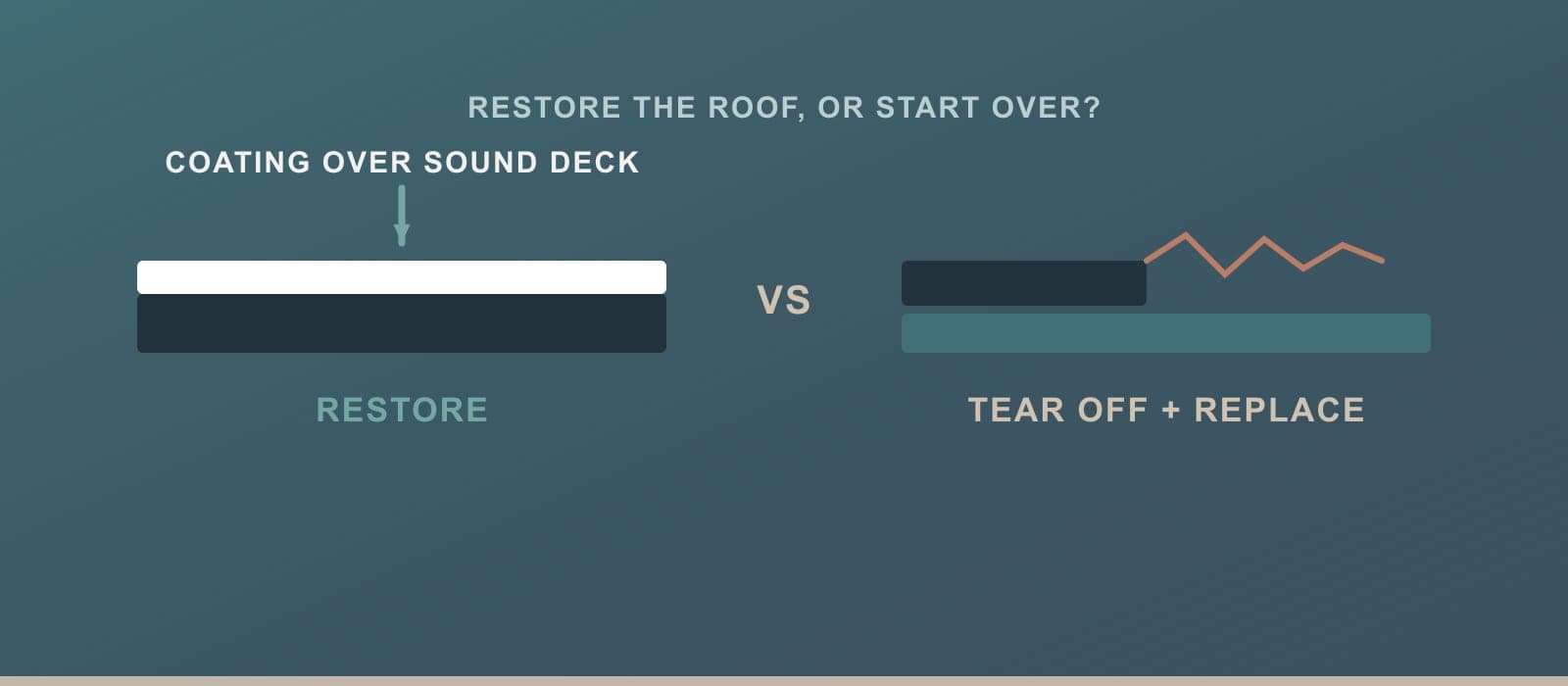
A South Florida board and property manager's guide to restoring a flat or low-slope roof with a silicone or acrylic coating instead of a full replacement: when a coating buys 10–15 years, when a tear-off is the only honest answer, what it costs, the Florida Building Code one-recover and 25% rules, and why your insurer does not treat a coating as a new roof.
Beachfront Commercial Services ·
Short answer: On a structurally sound, low-slope South Florida roof, a fluid-applied silicone (and sometimes acrylic) restoration coating can add roughly 10–15 years of service life for about half the cost of a tear-off, but only when moisture is contained (typically under about 25% of the roof area), ponding is corrected, and the board understands one hard fact: in Florida, a roof coating is not a roof replacement to your insurer, and it does not restore your wind-mitigation rating. A coating renews the roof's wear layer; it does not reset the age of the roof or its structure. Get those distinctions wrong and a "money-saving" coating can quietly cost a condo association a six-figure replacement two years later.
This guide is written for condo and HOA boards, community association managers (CAMs), and commercial building owners across Palm Beach, Broward, and Miami-Dade. It explains how restoration coatings actually work, how to decide between coating and replacement, how silicone and acrylic differ on the coast, what the Florida Building Code requires, and how the decision should fit into your reserve plan. (This is general information for planning, not engineering, code-interpretation, or insurance advice. See the note at the end.)
What a "roof restoration coating" actually is
A roof coating, also called a fluid-applied or liquid-applied roofing system, is a multi-coat, monolithic membrane sprayed or rolled over an existing, structurally sound low-slope roof. It is not a bucket of paint. A legitimate restoration system on a flat roof is a sequence:
- Survey and moisture scan: an infrared or capacitance moisture survey finds wet insulation hiding under an intact-looking membrane.
- Repair and dry-out: saturated substrate is cut out and replaced; seams, laps, penetrations, and pitch pans are reinforced, usually with a polyester fabric embedded in mastic.
- Clean and prime: the surface is power-washed and, where needed, primed so the coating bonds. An adhesion (pull) test confirms compatibility before the crew commits to the whole roof.
- Base and top coats: the elastomeric coating is applied in multiple passes to a manufacturer-specified dry film thickness, building a seamless membrane that reflects sunlight and waterproofs the field.
Coatings are commonly used to restore aging TPO, EPDM, modified bitumen, built-up (BUR), metal, and spray-polyurethane-foam roofs. The Florida Building Code recognizes fluid-applied silicone and acrylic systems as restoration when the existing membrane is sound and the coating meets ASTM D6083 (the standard specification for liquid-applied acrylic coatings used in roofing), installed in multiple coats at the rated thickness.
When a coating is the right call, and when it isn't
The single biggest mistake we see in South Florida is coating a roof that should have been replaced. A coating protects a roof that has good bones; it cannot resurrect one that's already failed. GAF's liquid-applied guidance puts a clean number on it: if a moisture survey finds wet substrate in roughly 25% or more of the roof area, you should be planning a tear-off, not a coating.
A coating is usually the smart, lower-cost move when:
- The roof is structurally sound: no deck deterioration, no sagging, no widespread fastener backout.
- Moisture is limited: the survey shows isolated wet areas that can be cut out and replaced, not system-wide saturation.
- Drainage works: water clears within ~48 hours. Ponding can be corrected with tapered insulation or crickets before coating.
- Leaks are few and findable: they can be located, repaired, and dried before coating. A coating will not "find" or fix widespread active leaks.
- The roof is within its service life, not past it.
Replacement (or a full re-cover) is the honest answer when:
- Moisture is widespread (≈25%+ of area), or insulation is saturated across the system.
- There's structural or deck damage, or major substrate failure.
- Leaks are persistent and multi-point and repairs haven't held.
- The roof is at the end of its service life. Coating it is, as one manufacturer bluntly puts it, money down the gutter.
- Ponding can't be resolved, or adhesion/detailing problems can't be brought back to baseline.
A coating buys time and defers capital cost. It does not buy a new roof. Be honest with your reserve study about which one you actually need.
Silicone vs. acrylic on the South Florida coast
Once a roof qualifies for restoration, the next question is chemistry. Acrylic and silicone are the two workhorses; polyurethane shows up where foot traffic or impact resistance matters. For most South Florida flat and low-slope roofs, silicone is the default, and the reason is our weather.
Silicone is solvent-based, typically 90%+ solids, and is the best-known coating for resistance to ponding water (water that sits more than 48 hours). It holds up to relentless UV without chalking or getting brittle, and it cures across a broad temperature and humidity window, useful in a climate where the dew never really leaves. Its trade-offs: it attracts dirt within 6–12 months (a cosmetic, not performance, issue), it's slippery when wet (a walk-path system is recommended wherever rooftop equipment gets serviced), and it requires mineral-spirits cleanup. Silicone restoration systems are commonly cited and warranted in the 10–20-year range depending on mil thickness.
Acrylic is water-based, lower-cost, easy to apply and clean up, holds color better, and is highly reflective, genuinely good on sloped metal roofs where water sheds quickly. But acrylic is the wrong tool for a true flat roof here: as a water-based film it breaks down under standing water, it loses mil thickness as it ages, and it needs surface temperatures of 50°F or higher to cure properly. On a ponding-prone Miami-Dade or Broward flat roof, an acrylic coating is a short-lived choice.
The practical rule for the coast: flat or ponding-prone roof → silicone. Sloped metal that sheds water → acrylic is viable. Either way, the coating must match your existing substrate, and an adhesion test should confirm it before the project scales up. As a licensed roofing contractor, Beachfront installs manufacturer-certified silicone and acrylic restoration systems (Gaco, Uniflex, Karnak, Henry, Tropical, Progressive Materials) so the assembly carries a real manufacturer warranty, not just a labor warranty.
The Florida code traps national blogs ignore
National coating guides skip the two Florida Building Code rules that change the math on the coast.
The single-recover limit (FBC §1511, Existing Roofing). Florida permits only one roof recover. If your low-slope roof already carries a recover layer over the original, the code generally requires that existing system to be removed before a new one goes on, which can turn a hoped-for re-cover into a full tear-off. A restoration coating over a sound membrane is treated differently from a recover, but the condition of what's already up there governs your options. Know your roof's layer history before you budget.
The 25% rule. Under the FBC, when more than 25% of a roof area or roof section is repaired, replaced, or recovered within any 12-month period, that area generally must be brought up to current code, including current wind-uplift and attachment requirements in our High-Velocity Hurricane Zone (Miami-Dade and Broward) and the coastal wind zones of Palm Beach County. That's a budget cliff: a series of "small" repairs can trip the threshold and trigger a far larger code-compliance scope.
Permits. All commercial and condo roofing work in Florida requires a permit, and any alteration to the roof system must be reviewed by the local building department. Restoration coatings are not a way around the permitting and inspection process.
The insurance reality that can erase your savings
Here is the fact that should drive the board's decision more than any cost spreadsheet: Florida insurers do not treat a roof coating as a roof replacement.
Acrylic, silicone, urethane, and elastomeric coatings do not meet carriers' definition of a replaced roof, and, critically, a coating does not restore the roof's wind-uplift rating, so it earns no wind-mitigation credit. To your insurer (including Citizens), a 25-year-old roof with a fresh silicone coating is still a 25-year-old roof.
The Florida Community Association Professionals (FCAP) documented exactly how this bites: a community (Water's Edge) applied a silicone restoration system in 2020, and in 2024 Citizens declined to renew coverage based on the original roof's age, forcing a replacement reported at roughly $600,000. The coating was sound. It didn't matter. The policy clock runs on the original roof.
The takeaway is not "never coat." Coating is an excellent maintenance and life-extension strategy when the roof qualifies. The takeaway is: before you coat, confirm with your agent how your carrier will treat the roof's age at renewal. If your roof is close to the age where renewal becomes a problem, the smarter capital move may be to replace now (resetting the age and the wind-mit rating) rather than coat and face non-renewal in two or three years.
What it costs in South Florida
Numbers vary widely with roof size, system, access, and how much wet substrate must be replaced, so treat these as planning ranges, not quotes:
- Full tear-off and replacement of a low-slope commercial/condo roof in South Florida commonly runs $4.50 to $12+ per square foot, depending on system, insulation, and code-driven upgrades.
- A restoration coating system typically costs 50–70% less than replacement for a qualifying roof, with far less disruption to residents and no tear-off debris.
A coating also has soft savings boards undervalue: tenants and unit owners aren't living under an open roof for weeks, there's no dumpster-and-crane logistics, and a reflective coating can trim cooling load on the top-floor units. But model it honestly against the insurance question above: a coating that saves $200,000 today is a poor trade if it precedes a $600,000 forced replacement in 2028.
How this fits your reserve plan
For condo and co-op buildings of three or more habitable stories, Florida's Structural Integrity Reserve Study (SIRS) requirements under §718.112(2), Fla. Stat., require the roof to be evaluated and funded as a reserve component on a study completed at least every 10 years. Roof restoration is a legitimate way to extend the funded life of that component and smooth the capital curve, but the reserve study should reflect reality:
- A coating extends the roof's service life; it does not reset it for insurance purposes.
- Budget the next decision (full replacement) on the original roof's true timeline, not the coating's warranty.
- Pair the roof line with milestone-inspection (SB 4-D, §553.899) and waterproofing planning so the envelope is funded as one system, not a series of surprises.
Coordinating roofing with waterproofing, sealants, and concrete restoration is where a contractor who self-performs across those trades (as Beachfront does) saves boards money: one mobilization, one accountable party, and details (parapet walls, scuppers, deck-to-wall transitions) handled by the same crew rather than pointed at each other when a leak appears.
The Beachfront approach
Beachfront Commercial Services is a licensed and insured South Florida contractor (DBPR CGC #1537131, CCC #1333921, CCC #1333373) serving Palm Beach, Broward, and Miami-Dade. On a coating-vs-replacement decision we start with an honest moisture survey and adhesion testing, not a sales pitch, then specify a manufacturer-certified silicone or acrylic restoration system only when the roof genuinely qualifies. When it doesn't, we say so. Because we self-perform roofing, waterproofing, and concrete restoration, we can sequence the whole envelope around your milestone inspection and SIRS schedule, and we document everything your board and insurer will ask for.
Frequently Asked Questions
How long does a roof coating last on a South Florida flat roof?
A properly installed silicone restoration system on a qualifying low-slope roof commonly lasts 10–15 years, and some are warranted up to 20, depending on mil thickness and condition. Acrylic coatings last less and are not recommended over ponding water. Plan an annual inspection and a recoat of the wear layer before it fails. And remember the coating extends the roof's life, it doesn't reset its age.
Does a roof coating count as a roof replacement for Florida insurance?
No. Florida insurers, including Citizens, do not treat acrylic, silicone, urethane, or elastomeric coatings as a roof replacement, and a coating does not restore the roof's wind-uplift rating or earn a wind-mitigation credit. To your carrier, a coated 25-year-old roof is still 25 years old. Confirm with your agent how your roof's age will be handled at renewal before deciding to coat.
When should we replace a flat roof instead of coating it?
Replace when a moisture survey shows wet substrate across roughly 25% or more of the area, when there's structural or deck damage, when leaks are persistent and multi-point, when ponding can't be corrected, or when the roof is past its service life. A coating only makes sense on a roof that is structurally sound and substantially dry.
Is silicone or acrylic better for a condo flat roof in South Florida?
For a true flat or ponding-prone roof, silicone is almost always the better choice because it resists standing water and intense UV. Acrylic is better suited to sloped metal roofs that shed water quickly and where color retention matters. The right answer also depends on your existing roof substrate, which an adhesion test will confirm.
Will coating part of our roof trigger Florida Building Code upgrades?
It can. Under the FBC "25% rule," repairing, replacing, or recovering more than 25% of a roof area or section within a 12-month period generally requires that area to meet current code, including current wind-uplift requirements in the High-Velocity Hurricane Zone. Florida also permits only one roof recover. Knowing your roof's layer history and planning work as one scope avoids tripping these thresholds by accident.
This article is general information to help South Florida boards, managers, and owners plan roofing capital work. It is not engineering, code-interpretation, or insurance advice. Roof condition, code compliance, and coverage outcomes depend on your specific building and carrier. Confirm with a licensed roofing professional, the local building department, and your insurance agent before making a decision.
Ready to Protect Your Property?
Tell us about your building and a Beachfront estimator will follow up with a clear scope and fair pricing.