Compliance / Ownership
DBPR HR-7020 Balcony Inspection: Does Your South Florida Condo Need It, and What to Do When It Finds Problems
If your South Florida building is three or more stories and rents units to the public, Florida Statute 509.2112 requires a DBPR HR-7020 Certificate of Balcony Inspection every three years. Here's who it applies to, how it differs from the milestone inspection and SIRS, what it flags on the salt coast, and how boards prep for it and fix the deficiencies.
Beachfront Commercial Services ·
If your South Florida building is three or more stories and any of its units are rented to the public (a resort condo, a condo-hotel, or an association with a rental program), you are almost certainly required to file a DBPR HR-7020 "Certificate of Balcony Inspection" every three years under Florida Statute §509.2112. This is a recurring life-safety inspection of your balconies, railings, stairways, and walkways, and it is a separate legal obligation from the milestone inspection and the Structural Integrity Reserve Study (SIRS). This guide, written for Palm Beach, Broward, and Miami-Dade boards and property managers, explains exactly who owes the HR-7020, how it differs from the inspections you may already know about, what it tends to flag on a salt-exposed coastal building, and, the part most articles skip, what your board actually does once the report lists deficiencies.
This is general information for building owners and managers, not engineering or legal advice. Confirm your specific obligations with your inspecting professional and association counsel.
The short version: three different inspection clocks
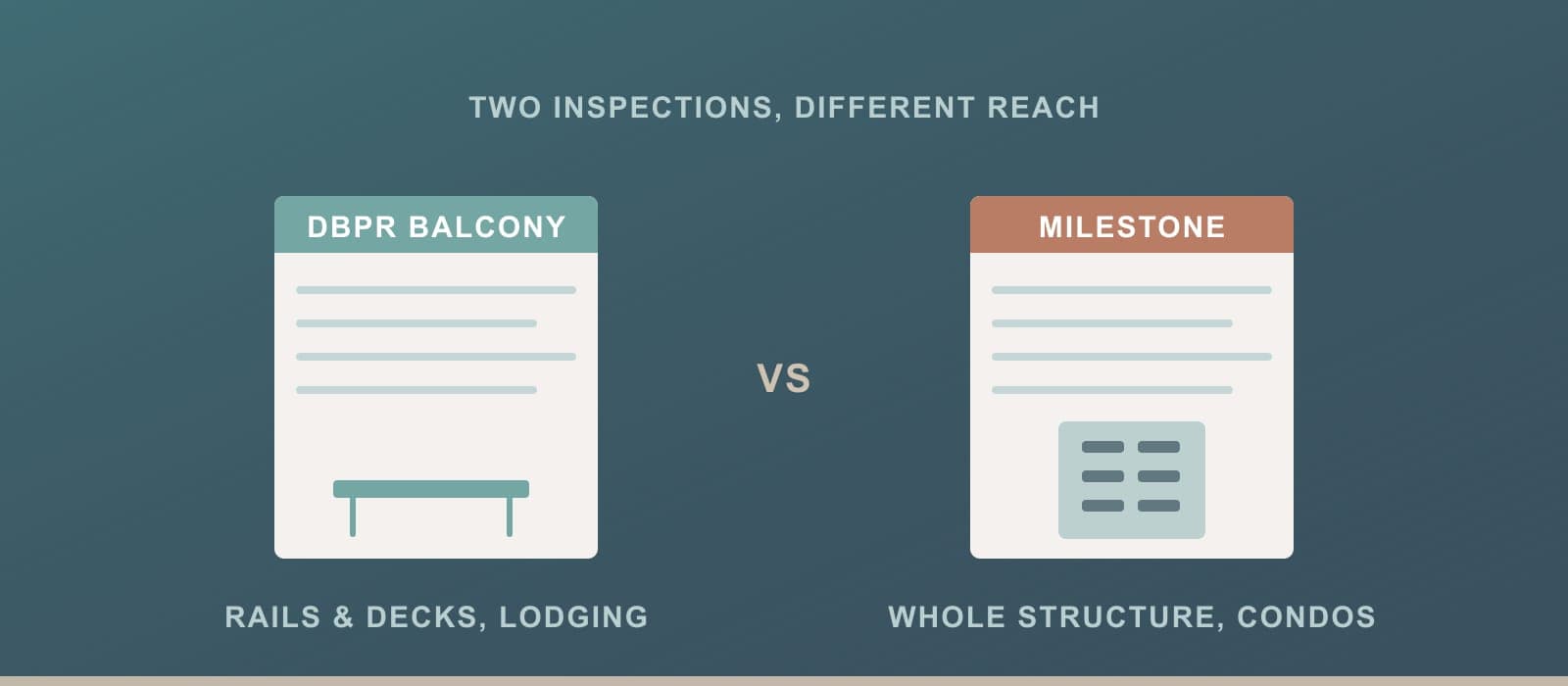
Most South Florida condo boards now know about two post-Surfside requirements. The HR-7020 is a third, older, and frequently overlooked one. Because they get confused constantly, here is the clean distinction up front:
- DBPR HR-7020 balcony inspection (§509.2112): a life-safety inspection of balconies, platforms, stairways, and railings, required of public lodging establishments (buildings renting units to the public) that are 3+ stories. Filed every 3 years with the DBPR Division of Hotels and Restaurants and your local building authority.
- Milestone inspection (§553.899): a structural inspection of the building's primary structural systems, required of residential condominium and cooperative buildings 3+ stories at 30 years of age (or 25 years within 3 miles of the coast), then every 10 years.
- Structural Integrity Reserve Study, SIRS (§718.112(2)(g)): a reserve-funding study for the building's major structural components (roof, load-bearing walls, waterproofing, etc.), required of associations 3+ stories and updated at least every 10 years.
A single beachfront building can owe all three. They are triggered by different things (rental use, building age, and association status), on different clocks (3 years, 30/25 years, 10 years), and they check different things (railings, structure, and reserves). Do not assume that passing your milestone inspection satisfies the balcony law, or vice versa.
What is DBPR HR-7020, exactly?
DBPR Form HR-7020 is the "Certificate of Balcony Inspection" issued by the Florida Department of Business and Professional Regulation (DBPR), Division of Hotels and Restaurants. It is the physical document you file to prove compliance with §509.2112, Florida Statutes, and its implementing rule in the Florida Administrative Code (FAC 61C-1.004).
The statute is not new. It has required filings since January 1, 1991, on a rolling three-year cycle. It states that every public lodging establishment three or more stories in height must file a certificate confirming that "all balconies, platforms, stairways, and railways have been inspected by a person competent to conduct such inspections and are safe, secure, and free of defects."
Two words in that sentence do a lot of work. "Public lodging establishment" is what limits who owes the inspection. "Free of defects" is what turns a routine filing into a repair project when a coastal building's balconies have been quietly corroding for a decade.
Do you actually need one? The public-lodging test
This is the single most-searched question about the HR-7020, and the answer turns on how your building is used, not just how tall it is.
The requirement applies to public lodging establishments: properties that rent living or sleeping units to the public. Under Florida's lodging definitions that includes both:
- Transient rentals: units rented for periods of less than 30 days (the classic hotel, motel, or short-term vacation rental), and
- Non-transient rentals: units rented for periods of 30 days or more.
So the buildings clearly on the hook are hotels, motels, resort condos, condo-hotels, and any condominium or apartment building three or more stories tall that operates a rental program where units are rented to the public. In practice, a large share of South Florida's oceanfront inventory (Sunny Isles, Singer Island, Fort Lauderdale beach, the Palm Beaches) falls into this category, because so many towers run on-site or owner-managed rental programs.
A purely private, owner-occupied residential condominium with no public rental generally does not file the HR-7020. That building still owes its milestone inspection and SIRS, but not the lodging balcony certificate. If your association is a mix (some owners live in their units, some rent them out as short-term or annual rentals through a program), this is exactly the gray area to confirm with your inspecting professional and counsel, because "units rented to the public" can pull the building into public-lodging licensing.
The height and elevation thresholds narrow it further. The law reaches buildings three stories or more, and in practice the inspection focuses on elevated structures, commonly those more than 17 feet above grade. Ground-level decks under about three feet are typically exempt because a fall or collapse there is not a life-safety event in the same way.
What the HR-7020 inspection covers
A proper balcony inspection is a hands-on, element-by-element look at everything a person stands on or leans against outside the building envelope. Expect the inspector to evaluate:
- Balcony and walkway slabs / decking: cracking, spalling, delamination, deflection, and the condition of the wearing surface.
- Railings, guardrails, and balustrades: the single most important life-safety item: are the posts and pickets solid, and are the anchors and embeds still sound?
- Fasteners, ledger boards, and wall attachments: how the balcony and railings connect back to the structure.
- Stairways, landings, and stairwell railings: often shared egress, and often the most heavily corroded elements.
- Parapet walls and screen enclosures.
- Waterproofing and drainage: because a balcony that ponds and leaks is a balcony that is corroding from the inside.
The inspector documents each deficiency and issues a report, then the HR-7020 certificate attests that the structures are (or, after repairs, will be) safe and free of defects.
Who can perform and sign it
The statute requires "a person competent to conduct such inspections." In practice that means a Florida-licensed professional engineer, a registered architect, or a licensed general contractor / qualified building inspector with balcony-inspection experience. The person who signs the certificate is certifying safety, so this is not a job for an unlicensed handyman.
Important role note: the party that inspects and signs the HR-7020 is not the same party that performs the repairs. A licensed restoration contractor like Beachfront Commercial Services does not issue the certificate. That is the inspecting engineer, architect, or GC of record. Beachfront's role is the other half: performing the concrete restoration, waterproofing, railing re-anchoring, and recoating that clear the listed deficiencies, then coordinating the re-inspection so the certificate can be issued. Keeping the inspector and the repair contractor as separate parties is also good governance and helps avoid conflict-of-interest questions.
How and when to file, and the penalties for not
The certificate must be filed every three years from the date of your last inspection, with both:
- The DBPR Division of Hotels and Restaurants (increasingly through the DBPR online portal), and
- The applicable county or municipal authority responsible for building and zoning.
Miss it, and the Division of Hotels and Restaurants can impose administrative sanctions: fines, license action, and in serious cases suspension of the establishment's operating license until compliance is restored. For a rental-driven building, a lodging-license problem is not just a paperwork headache; it can interrupt the revenue that funds the association.
HR-7020 vs. milestone vs. SIRS, at a glance
| Inspection | Legal basis | Who must comply | Trigger | Frequency | What it checks | Who signs |
|---|---|---|---|---|---|---|
| HR-7020 balcony | §509.2112 / FAC 61C-1.004 | Public lodging establishments (rental buildings) 3+ stories | Rental use + 3 stories | Every 3 years | Balconies, railings, stairs, walkways, waterproofing | PE, RA, or licensed GC/inspector |
| Milestone | §553.899 | Residential condo & co-op buildings 3+ stories | Building age 30 yrs (25 within 3 mi of coast), then per cycle | At 30/25 yrs, then every 10 | Primary structural systems | Florida PE or RA |
| SIRS | §718.112(2)(g) | Condo associations 3+ stories | Building operation | At least every 10 years | Reserve funding for structural components | Licensed reserve professional / PE-RA |
The inspections also feed each other. A cracked railing anchor or a spalling balcony nose flagged on your HR-7020 is exactly the kind of finding that, left alone, becomes a milestone Phase-II issue and a bigger reserve line. Treating the 3-year balcony inspection as an early-warning system for your 10-year structural clock is one of the smartest things a coastal board can do.
Why coastal balconies fail: what actually gets flagged in South Florida
On an inland building, a balcony inspection might be a formality. On the South Florida coast, it rarely is, because the same salt air, wind-driven rain, and humidity that make oceanfront living desirable are relentlessly attacking the steel inside your balconies.
The failure chain is consistent:
- Airborne chlorides (salt) settle on and penetrate balcony slabs, stair nosings, and, critically, the concrete around railing-post anchors and embeds.
- Chlorides reach the reinforcing steel, break down the protective layer concrete normally provides, and the steel begins to corrode.
- Corroding steel expands (rust occupies several times the volume of the original metal), which cracks and then spalls the concrete off: the classic rust-stained, crumbling balcony nose or stair edge.
- Once the concrete is cracked and the waterproofing or coating has failed, water gets in faster, and the cycle accelerates. Loose railings, ponding decks, and telegraphing cracks are the visible symptoms.
That is why a South Florida HR-7020 report so often lists corroded or loose railing anchors, spalling balcony and stair nosings, failed balcony waterproofing or traffic coatings, and cracked landings. These are not cosmetic write-ups. A guardrail whose posts are anchored into spalling concrete is a genuine life-safety defect, which is the entire reason the law exists.
What to do when the balcony inspection finds problems
This is the question boards should be planning for before the inspector arrives, because a coastal building over about 15 years old will almost always have something to address. The remediation follows a disciplined sequence:
1. Read the report as a repair scope, not a verdict. Group the deficiencies by type (concrete, railings, waterproofing, drainage) and severity. Not everything is an emergency, but life-safety items, anything compromising a guardrail or a walking surface, come first.
2. Repair the concrete to standard, not with a smear of patch. Sound coastal concrete restoration means removing concrete back to solid material, cleaning and treating or replacing the corroded steel, and rebuilding with a polymer-modified repair mortar, following ICRI (International Concrete Repair Institute) guidelines, including preparing the surface to a proper concrete surface profile (CSP 3–5) so the repair actually bonds. A patch troweled over rusting rebar will pop off within a season and fail the next inspection.
3. Re-anchor the railings properly. Corroded embeds get cut out and replaced with new anchors set into sound, repaired concrete, not shimmed, caulked, or re-tightened into crumbling material.
4. Re-waterproof and recoat. Because the water intrusion is what started the corrosion, a real fix restores the barrier: new liquid-applied waterproofing / traffic-coating systems (for tiled balconies, systems meeting standards such as ANSI A118.10) and fresh, coastal-grade coatings that keep chlorides out going forward.
5. Fix the drainage. A balcony that ponds will corrode again. Restoring positive drainage and clearing scuppers is cheap insurance on an expensive repair.
6. Re-inspect and file. Once deficiencies are corrected, the inspecting professional returns, verifies the work, and issues the clean HR-7020 certificate for filing. Documenting the repair (photos, product data sheets, warranties) also strengthens your record for the milestone inspection and gives your reserve professional evidence to credit extended service life.
Beachfront Commercial Services self-performs this restoration and waterproofing work rather than subcontracting it out, is licensed and insured (CGC #1537131, CCC #1333921, CCC #1333373), and specializes in exactly this coastal balcony/stair failure pattern, which means the crew fixing your building understands why it corroded and how to keep it from happening again before the next three-year cycle.
A board's HR-7020 playbook
To keep the balcony inspection from becoming an expensive surprise:
- Confirm whether you owe it. Verify your building's story count and, more importantly, your rental/lodging status. If units are rented to the public, treat the HR-7020 as required and confirm your cycle date.
- Pre-walk before the official inspection. Have your maintenance team or a contractor do a candid walk-through, note obvious corroded railings, spalling edges, and ponding, and address what you can, so the certified inspection has fewer surprises.
- Keep balcony edges sealed and drains clear. Routine sealing of railing-post penetrations and clearing of balcony drains is the cheapest possible defense against the chloride-corrosion chain.
- Budget for repair, not just inspection. On a coastal building, assume the inspection will produce a punch list. Fund remediation from the correct bucket (operating vs. reserves) per your governing documents.
- Coordinate the clocks. Line up your 3-year balcony inspections and your milestone/SIRS work so findings feed each other and you are not paying to mobilize the same scaffolding twice.
- Keep inspector and contractor separate. Use a licensed engineer/architect/GC for the certificate and a licensed restoration contractor for the repairs.
Frequently Asked Questions
Is the DBPR HR-7020 balcony inspection the same as the milestone inspection? No. The HR-7020 is a life-safety balcony, railing, and stairway inspection required of public lodging establishments (rental buildings) three or more stories every three years under §509.2112. The milestone inspection is a structural inspection required of residential condo and co-op buildings at 30 years of age (25 within three miles of the coast), then every 10 years, under §553.899. A building can owe both, plus a SIRS.
Does my private residential condo need an HR-7020 balcony inspection? Generally no, if it is purely owner-occupied with no units rented to the public. That building owes the milestone inspection and SIRS instead. But a condo that rents units to the public (a resort condo, condo-hotel, or association with a rental program) that is 3+ stories typically does need the HR-7020. Mixed-use rental situations are a gray area worth confirming with your inspector and counsel.
How often is the balcony inspection required in Florida, and who files it? Every three years. The Certificate of Balcony Inspection (Form HR-7020) is filed with the DBPR Division of Hotels and Restaurants and with your local county or municipal building authority. Failure to file can bring administrative sanctions, including fines and license action.
Who can perform and sign the HR-7020 certificate? A person "competent to conduct such inspections", in practice a Florida-licensed professional engineer, registered architect, or licensed general contractor / qualified inspector. The inspecting party issues the certificate; a separate restoration contractor performs any repairs and coordinates the re-inspection.
My balcony inspection found deficiencies. What happens now? The report becomes a repair scope. On the South Florida coast the common findings are corroded railing anchors, spalling balcony and stair edges, and failed waterproofing. A licensed contractor repairs the concrete to ICRI standards, re-anchors railings, restores waterproofing and drainage, and recoats; then the inspector re-inspects and issues the clean certificate for filing. Address life-safety items, anything affecting a guardrail or walking surface, first.
The information above is provided for general educational purposes and does not constitute engineering or legal advice. Balcony safety and code compliance are life-safety matters; consult a licensed Florida engineer, architect, or attorney regarding your specific building and obligations.
Ready to Protect Your Property?
Tell us about your building and a Beachfront estimator will follow up with a clear scope and fair pricing.