Guidance
A Concrete Restoration Bid Is a Forecast, Not a Price: How to Budget the FY27 Line So It Survives the Chipping Hammer
Concrete restoration on South Florida commercial buildings is bought at fixed unit prices against estimated quantities that nobody can verify until the concrete is opened. That makes the bid total a forecast. This guide shows owners, property managers, and facility managers what sits inside the number, which costs stay fixed while quantities move, how the survey behind the quantity should set the contingency, which change orders only record quantity at the contract unit price and which carry a new price, and which line item gets dropped from the budget most often.
Beachfront Commercial Services ·
The total at the bottom of a concrete restoration proposal is a forecast, not a price. The trade buys this work at a fixed price per unit of repair, by the square foot, linear foot, or cubic foot depending on the nature of the repair, multiplied by a quantity somebody estimated from the outside of the concrete. The only instrument that measures the real quantity is a chipping hammer, and it is not used until the contract is signed and the crew is on the wall. That is not a flaw in the bid. It is why the budget line has to be built differently from a paint or roof line, and budgeting season is the moment to build it. Here is what sits inside the number, which parts move, and how much room to leave.
Why concrete restoration cannot be sold at a fixed price
Salt air pushes chloride through the concrete cover to the reinforcing steel. Corroding steel expands, six to ten times the bar's original volume per the contractors and engineers who publish on this, and splits the concrete from the inside: first as a hidden delamination (a layer that has let go of the steel but not yet fallen), eventually as the spall you can see from the parking lot.
The spall is the late symptom. The delamination around it is the quantity. Florida's community-association press states the consequence plainly: no inspection method can see the full extent of deterioration until the concrete is chipped open, so actual quantities often exceed the estimate, and that is why concrete repair is bid at a fixed unit price against estimated quantities. A stipulated-sum contract, the ordinary fixed-price form, does not work for this scope.
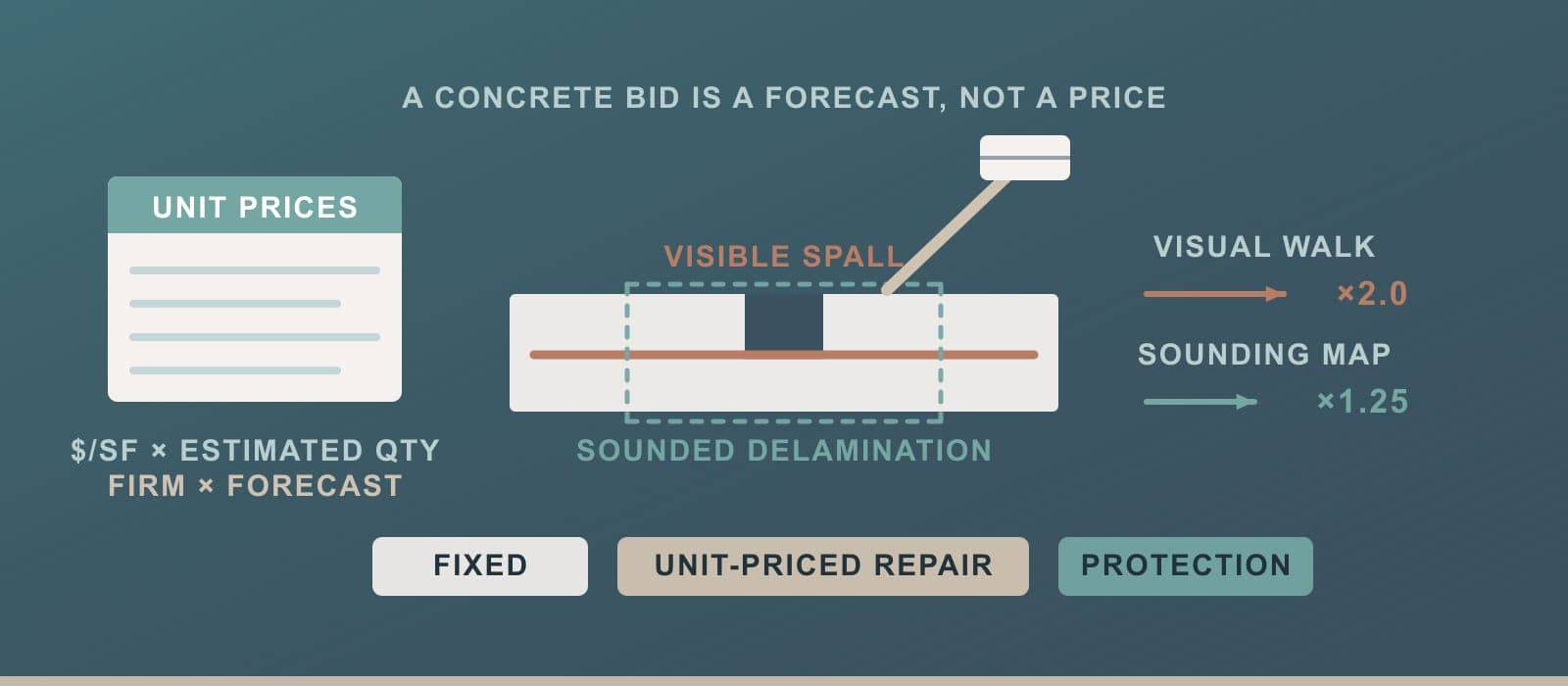
A repaint bid at three different scopes is a comparison problem. A concrete bid is a forecasting problem: the unit prices are firm, the quantity is the estimate, and the estimate is only as good as the survey behind it.
What is actually inside the number
A well-built concrete restoration proposal has three kinds of lines, and they behave differently when the chipping hammer starts finding more.
| Line type | Typical items | Unit | What happens when quantities grow |
|---|---|---|---|
| Fixed | Engineering and permit, mobilization, access (swing stage, lift, or hand work), general conditions, shoring design where required | Lump sum | Stays put. Billed once, often in full at mobilization. |
| Unit-priced repair | Partial-depth horizontal repair, overhead repair, slab-edge spall, beam or column repair, crack injection, rust spots, railing post pockets | SF, LF, CF, each | Scales at the contract unit price. This is the forecast. |
| Protection | Joint sealant replacement, traffic-bearing deck coating, penetrating sealer, drainage correction, stucco and paint at repairs | LF, SF | Does not grow with the repair quantity, but is the line most often cut to make a number fit. |
Two behaviors in that table decide most budgets.
First, the fixed lines stay put in both directions. A swing stage costs the same to hang whether the crew repairs 200 square feet from it or 400. That is why small scopes carry high unit prices, what the community-association press calls economies of scale, and it cuts both ways: estimate the quantity low to make the total look approvable and you sign a high unit price, then pay it on every square foot the hammer finds.
The cautionary case is on record: a Miami Beach high-rise, as told by the restoration consultant brought in to fix it, pushed its engineer to shrink the quantities until the bids fit. The contractor had finished fewer than one tenth of the balconies when it hit 100 percent of the budget for most repair types.
Second, the protection lines decide the next cycle. A repair replaces the concrete that failed; it does not change the exposure that failed it. More on those lines below.
The contingency question, answered by the survey behind the quantity
Ask three South Florida restoration engineers how much room to leave and you will get three numbers, anywhere from 15 percent to a full doubling:
- The community-association press reports that many engineers recommend about 25 percent.
- A South Florida structural engineer writing in late 2025 puts the hidden-conditions contingency at 15 to 25 percent, and separates it from underestimated quantities: a survey that calls 10 percent of a garage deck compromised can turn into 25 percent once the chipping starts.
- Another South Florida engineering firm writes that a $1 million estimate deserves a $1.3 million budget and that doubling is often the safe number. A property-management column this summer told the same story: a $1.1 million garage estimate that finished near $1.7 million once the concrete came up.
- The federal Bureau of Reclamation's repair guide, written for dams rather than buildings, lands in the same place: add 15 to 25 percent to computed quantities, because removing damaged concrete reveals more of it.
Those numbers are not in conflict. They describe different amounts of information behind the quantity. The rule that reconciles them: the contingency belongs to the survey, not to the building.
| How the quantity was established | What it can and cannot see | Growth factor to carry on the repair lines |
|---|---|---|
| Visual walk only (somebody looked, photographed the spalls, and measured them) | Sees failed concrete. Cannot see the delamination around it or the corrosion that has not cracked anything yet. | Treat the total as a floor. Plan for up to 2.0x, per the engineers who advise doubling. |
| Sounding map (every accessible slab edge, soffit, deck, and column sounded with a hammer or chain drag; hollow areas outlined and measured by element type) | Sees delamination that has already happened, not yet fallen. Misses steel that is corroding under concrete that still rings solid. | About 1.25x, the number the community-association press reports most engineers recommend. |
| Sounding plus corrosion testing (half-cell potential survey, chloride sampling at bar depth, cover survey, a few exploratory openings) | Sees where steel is actively corroding before it delaminates, and how far the chloride has reached. Closest thing to knowing. | 1.15x to 1.20x, the lower end of the published ranges. |
Sounding is the middle row, and the one most commercial buildings skip. It is not exotic: delaminated concrete answers a hammer with a hollow "puck" where sound concrete gives a "ping," in the Army Corps of Engineers' description, and a crew can outline and measure every hollow area on a balcony edge or garage soffit in an afternoon. The output is square feet and linear feet by element type, and it is the difference between a budget carrying 2.0x and one carrying 1.25x. Half-cell and chloride testing are the engineer's tools and earn their fee on a garage or a building with repair history; on a first-pass FY27 budget, the sounding map moves the factor the most for the least money.
Two kinds of change order
Owners who have lived through one of these projects remember "the change orders." Under a unit-price contract, expect them. When the measured quantity of a repair type lands above the estimate, the adjustment is often captured through a change order that adds the quantity to the contract sum, because that is how the engineer tracks the cost of the project. It does not change the scope or nature of the project. What matters for the budget is which kind of change order you are signing.
A quantity change order adds measured quantity of a repair type already on the list, marked by the engineer, priced at the unit price already in the contract, and billed against measured quantities. The price was settled at bid and the scope of the project is unchanged; the change order records the quantity. Standard unit-price contract language says exactly this: the unit price is added to or deducted from the contract sum by change order as quantities rise or fall, and if the hammer finds less than the estimate the same mechanism runs backward and the contract sum comes down. Some contracts let either side revisit the unit price only when quantities land far outside the estimate, often beyond about 15 percent, which is why the third bidder question below asks about it. The growth factor from the survey table is the budget's allowance for quantity change orders.
A scope change order is a new item: a repair type not on the unit-price list, a scope the owner added, or a condition that changes the method. It needs a price, written approval, and, per the community-association press, the engineer's sign-off before the work is done. The most expensive change orders in the published South Florida case histories are owner decisions, not concrete: new windows and railings added while the crew was on the wall.
Three questions, asked of every bidder in writing, keep the two categories straight:
- Is every repair type on your proposal unit-priced, with the unit of measure named, and which lines are lump sums?
- Is mobilization billed once, and does access stay in place for the full scope or does it re-price if quantities grow?
- If measured quantities land 50 percent above or 30 percent below your estimate, does the unit price change?
Add one deliverable: an as-built repair map with every pay application, showing the location, type, and size of each repair. It settles billing, becomes the baseline for the next survey, and is the document a buyer or lender asks for.
The line that gets dropped
When a concrete number has to fit a budget, the protection lines go first, because nothing visibly fails when they are cut. They are also the cheapest lines on the sheet relative to what they prevent.
Commercial sealant replacement runs $5 to $18 per linear foot in published South Florida pricing. Moderate concrete repair involving rebar treatment runs $50 to $150 per square foot, and major structural restoration $150 to $400 or more, per a Miami restoration contractor's current published ranges that two other South Florida sources repeat. A failed joint lets water reach the steel along its whole length, and the repair that follows is priced per square foot of concrete, not per foot of joint. That is the argument for the sealant scope staying in the concrete budget instead of waiting for a future paint job.
The same contractor puts the timing plainly: catching spalling at 10 percent of a slab is dramatically cheaper than at 50 percent, and another South Florida contractor's 2026 guide translates that into a 5 to 8 times multiplier after two or three years of neglect, before engineering and access. Read those as planning facts: the building is not in a hurry this afternoon, but the budget is being set this quarter, and the protection lines decide what the next concrete number looks like.
One more place concrete hides: inside a repaint bid as "concrete repairs as needed," an unpriced quantity in a lump-sum contract, the worst of both structures. Any concrete line in an exterior bid should carry a unit, an estimated quantity, and a unit price. The spalling primer covers what the repairs involve; the point here is how they are priced.
Building the FY27 line: a worksheet
The arithmetic below is illustrative, using unit rates from a South Florida engineer's published cost opinion as reported in a 2026 contractor guide. Your unit prices will differ; the structure will not. Suppose a sounding walk on a mid-rise commercial building maps 300 square feet of partial-depth horizontal repair, 150 linear feet of slab-edge spall, 60 square feet of overhead soffit repair, and 80 linear feet of cracks for injection.
| Repair line (unit-priced) | Quantity | Published unit rate | Extended |
|---|---|---|---|
| Horizontal partial-depth repair | 300 SF | ~$75/SF | $22,500 |
| Slab-edge spall repair | 150 LF | ~$75/LF | $11,250 |
| Overhead partial-depth repair | 60 SF | $200/SF (low end of $200 to $350) | $12,000 |
| Epoxy crack injection | 80 LF | ~$100/LF | $8,000 |
| Repair subtotal | $53,750 |
Now the two behaviors from earlier:
- Apply the growth factor to the repair lines only. On a sounding-map basis, carry 1.25x: $53,750 becomes about $67,200. From a visual walk the honest factor is 2.0x, and the same line becomes $107,500. The sounding walk is worth roughly $40,000 of budget certainty on a scope this size.
- Add fixed and protection lines without a factor. Engineering, permit, mobilization, and access come from the bids as lump sums. Protection is quantity-known: 4,000 square feet of traffic-bearing deck coating near the published $6 per square foot is about $24,000, and 900 linear feet of joint sealant at the middle of the published $5 to $18 range is about $10,800.
The FY27 line is fixed lump sums, plus $67,200 of factored repair, plus $34,800 of protection, presented with the three parts labeled. A number with its assumptions showing survives a quantity change order. A single total does not.
One more thing the worksheet shows: the overhead soffit rate is more than two and a half times the horizontal rate for the same square foot. Access drives that spread, and the same guide notes poor accessibility can double labor. Bidders assuming different access produce incomparable bids, so break access out as its own line and hold the pre-bid walk with every bidder looking at the same soffit.
The calendar
Budget adoption for most commercial portfolios runs September through November. Concrete repair mortars, crack injection, sealants, and coatings all prefer the dry season, which the regional climate compact defines as November through April. Those two facts set the sequence:
- October: sounding walk and mapped quantities by element type, with timestamped photos. This is the quantity basis for the budget line.
- November: the FY27 line goes in as fixed plus factored repair plus protection, with the factor stated.
- December through January: engineer of record scopes and specifies where structural repair is involved; bids come back unit-priced against the same quantities.
- Late dry season: execution, with the as-built map building as the pay applications do.
Wait until the spring to look and the first two steps collapse into a visual estimate carried at 2.0x, or worse, a single total carried at 1.0x.
What a fall envelope assessment gets you
The budget rule above depends on one input most buildings do not have in October: a sounding map with quantities. That is what our fall envelope assessment produces for the concrete portion of the envelope.
- A sounding walk of every accessible slab edge, soffit, deck, and column, with hollow areas outlined, measured, and logged by element type in square feet and linear feet.
- A timestamped photo file keyed to the map, so the budget line has evidence behind it and the next survey has a baseline.
- The protection scope counted, not estimated: sealant linear footage by joint type, deck coating condition and square footage, drainage observations.
- A priced dry-season plan that carries the fixed lines, the unit-priced repair lines with their quantities, and the protection lines separately, so the growth factor can be applied where it belongs.
Concrete restoration, waterproofing, and painting are self-performed lines for us, with W-2 crews, which is why the protection scope shows up priced in the same plan instead of deferred to another contractor's bid. Where the repair is structural, an engineer of record marks the work and approves the quantities; the assessment is the file the engineer and the budget both start from.
Assessments are scheduling now for October walks ahead of budget adoption.
561-557-8534 · beachfrontcs.com · info@beachfrontcs.com
Frequently asked questions
Why is a concrete restoration bid an estimate and not a firm price? Because the quantity of concrete that needs repair cannot be measured until the concrete is opened. Corroded reinforcing steel delaminates the concrete around it before anything visibly falls, so the trade prices each repair type per unit (square foot, linear foot, cubic foot) against an estimated quantity, and you pay for the measured quantity actually repaired. The unit prices are firm; the quantity is the forecast.
How much contingency should a commercial owner carry on a concrete repair budget? It depends on the survey behind the quantity: from a visual walk, the engineers who publish on this advise planning for up to double; from a sounding survey that mapped delaminated areas, about 25 percent; from sounding plus corrosion testing and exploratory openings, 15 to 20 percent. Apply the factor to the unit-priced repair lines, not to fixed costs or protection scope.
Is it a change order when the contractor finds more damaged concrete than the estimate? Usually, yes. Under a unit-price contract, adjustments to the quantity of a repair type already on the price list are often captured through a change order at the unit price already in the contract; that is how the engineer tracks the cost of the project, and it does not change the scope or nature of the project. No new price is negotiated. The change order to read closely is the other kind: a new repair type, an added scope, or a change in method, which needs its own price and written approval before the work proceeds.
Do I need an engineer for concrete repair on a commercial building? For structural repairs to slabs, balconies, beams, columns, and garage decks, yes. An engineer of record specifies the repair, marks the areas to open, and approves quantities and pay applications; the contractor performs and documents it. A contractor's sounding walk is a budgeting input, not a substitute for the engineer's scope.
When should concrete restoration be scheduled in South Florida? Repair mortars, injection resins, sealants, and coatings all perform best in the dry season, which runs November through April. Because budgets are set in the fall, the sounding walk belongs in October so the quantity basis exists before the number is adopted.
This article is general information about budgeting and contracting for concrete repair on commercial buildings. It is not engineering, legal, or accounting advice. Structural repair scope is determined by a licensed engineer.
Ready to Protect Your Property?
Tell us about your building and a Beachfront estimator will follow up with a clear scope and fair pricing.