Compliance & Ownership
How Long Do Building Components Last on the South Florida Coast? A Service-Life & RUL Reference for Condo Boards
A coastal-adjusted useful-life reference for South Florida condo boards: how long roofs, paint, sealants, balcony coatings, waterproofing, stucco, and concrete really last near the ocean, and how those years feed a SIRS remaining-useful-life (RUL) plan.
Beachfront Commercial Services ·
Short answer: on the South Florida coast, salt air, ultraviolet (UV) intensity, tropical humidity, and repeated storm-pressure cycling shorten most building-envelope components by years compared with inland. A flat-roof membrane that lasts 20–30 years elsewhere can lose roughly 3 to 7 of them within about a mile of the ocean, and exterior paint that carries an "eight-year" reputation in a catalog often reads closer to five years on a Fort Lauderdale or Singer Island facade. For a condo or HOA board, that means you should plan reserves on coastal-adjusted useful-life numbers, not national averages, and then use documented maintenance and a contractor's condition assessment to push each component's remaining useful life (RUL) back out. This guide gives you the coastal-adjusted numbers for the whole envelope in one place, explains why the coast subtracts years, and shows how the numbers feed your Structural Integrity Reserve Study (SIRS).
This is general information for planning, not engineering or financial advice. Your reserve professional and a licensed contractor should verify each component's condition on your specific building before you fund or schedule work.
Why "useful life" is a reserve word, not just a warranty word
Boards hear three different numbers thrown around and often blur them together. Keeping them separate is the whole game:
- Total useful life (TUL): how long a component is expected to serve from new to replacement under normal conditions and maintenance. This is the "how long does a TPO roof last" number.
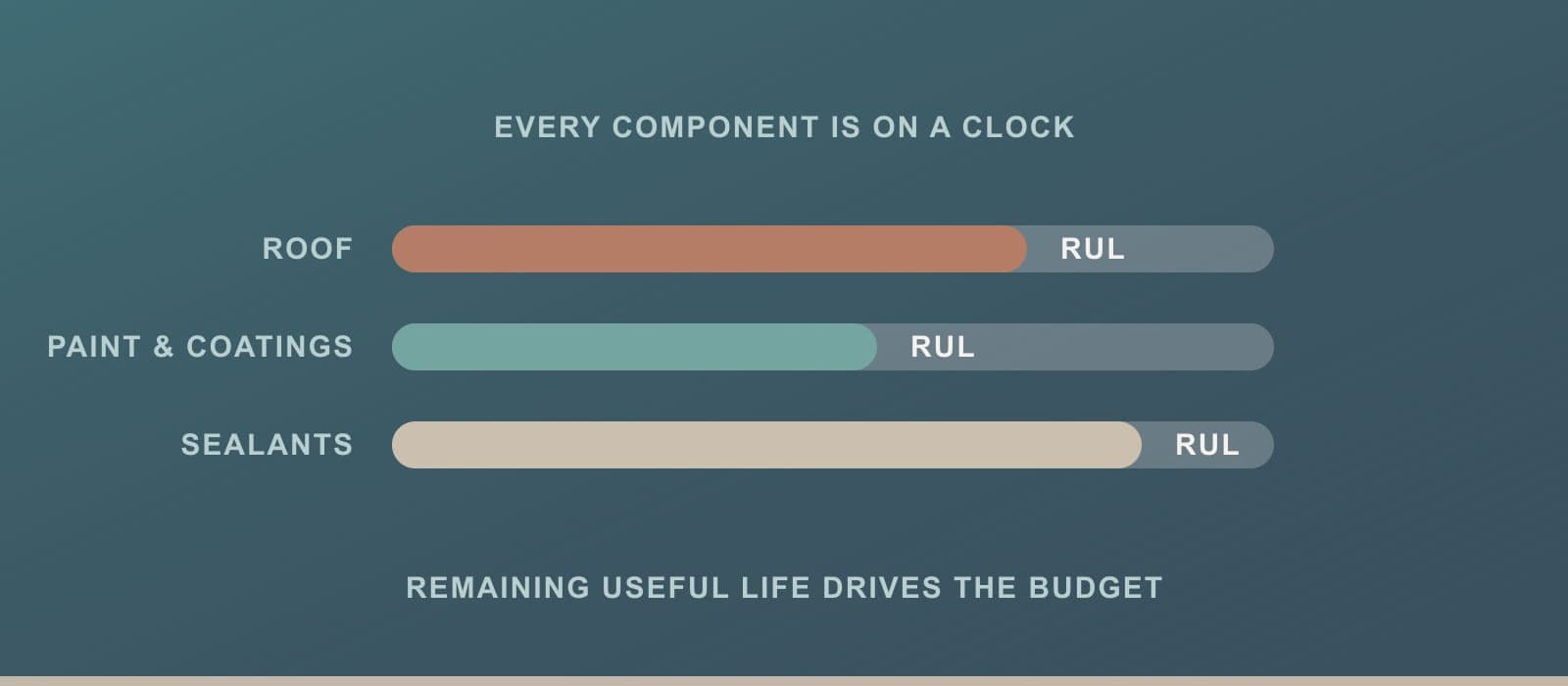
- Remaining useful life (RUL): how many years are left right now on the component you actually have, given its age, its condition, and how well it's been maintained. RUL, not age, is what drives your reserve math.
- Replacement cost: what it costs to replace the component today.
A Structural Integrity Reserve Study is required to estimate exactly these figures (RUL, total/estimated useful life, and current replacement cost) for the statutory components, and to fund at least the next roughly 25 years. Under Florida law (§718.112(2)(g)), a SIRS covers, at minimum, the roof; load-bearing walls; the floor; the foundation; fireproofing and fire-protection systems; plumbing; electrical systems; waterproofing and exterior painting; windows and exterior doors; and any other item with a deferred-maintenance or replacement cost of $10,000 or more. Reserve-study firms are explicit that those life estimates should be adjusted for salt-air corrosion, tropical humidity, and storm exposure on coastal buildings, but most published life-expectancy charts never actually do that adjustment component by component. That's the gap this reference fills.
The practical upshot: a shorter RUL means a higher annual reserve contribution, because you have fewer years to save the replacement cost. That is precisely why the coastal number matters, and why extending RUL through maintenance is one of the only levers a board has left after the 2022–2025 reforms closed the reserve-waiver loophole.
The coastal-adjusted useful-life table (South Florida envelope)
The ranges below combine widely cited service-life references, including InterNACHI's Estimated Life Expectancy Chart for Florida Homes, with coastal adjustments drawn from Florida roofing and reserve-study sources and from Beachfront's own field experience across Palm Beach, Broward, and Miami-Dade. Treat every number as a planning range for a maintained component, not a guarantee. A neglected component fails at the short end or sooner; a well-maintained one reaches the long end or beyond.
| Envelope component | Typical useful life (well-maintained) | Coastal-adjusted range (≈1 mi of ocean) | Primary coastal accelerant | Maintenance lever that extends it |
|---|---|---|---|---|
| Flat/low-slope roof, TPO/PVC | 20–30 yr | ~17–25 yr | UV + ponding + thermal cycling on seams | Keep drains clear; correct ponding; recoat/restore |
| Flat/low-slope roof, modified bitumen | ~20 yr | ~15–18 yr | Thermal cycling, ponding, UV | Reflective coating; ponding correction |
| Flat/low-slope roof, EPDM | 15–25 yr | ~12–18 yr | UV + seam stress | Seam inspection; coating |
| Flat/low-slope roof, BUR (built-up) | 15–25 yr | ~12–20 yr | UV, blistering, ponding | Cap-sheet/coating maintenance |
| Metal roof | 30–45+ yr (system); fasteners far less | ~20–35 yr; fasteners/flashing 10–20 yr | Salt corrodes fasteners, flashing, pipe boots | Stainless/coastal-grade fasteners; re-seal laps |
| Tile roof (clay/concrete) | 40–50+ yr (tile) | Tile 40+ yr; underlayment ~15–25 yr | Underlayment/fastener failure, not the tile | Re-underlayment; ridge/flashing repair |
| Exterior paint (acrylic) | 7–10 yr (catalog) | ~5–7 yr | UV + salt + chalking | Soft wash + timely recoat |
| Exterior elastomeric wall coating | 10+ yr | ~7–12 yr recoat cadence | UV fade; moisture trap if misspecified | Recoat on cadence; correct mil build |
| Sealant / caulk joints (exterior) | 5–10 yr (quality urethane/silicone) | ~1–5 yr for standard caulk; longer for high-movement sealant | Joint movement + UV + salt | Inspect annually; replace failed joints |
| Balcony/deck pedestrian traffic coating | System 15–25 yr | Recoat wear layer every 5–10 yr; system 15–25 yr | Foot traffic + UV + ponding + salt | Recoat top layer on cadence |
| Waterproofing membrane (below finish) | Liquid-applied ~50 yr in ideal use | Effective ~10–25 yr under tile/traffic | Substrate movement, trapped moisture | Protect the finish; fix flashing early |
| Stucco / EIFS cladding | 25+ yr (system) | 25+ yr with crack + coating upkeep | Cracking → water → rebar/spall | Crack repair + breathable recoat |
| Concrete / CMU structure | 75+ yr | 75+ yr if protected from chloride | Chloride → rebar corrosion → spalling | Waterproofing; spall repair; coatings |
| Windows/exterior doors | 15–30 yr | ~10–20 yr (frames/seals/hardware) | Salt corrosion; seal failure | Re-glaze; replace failed seals/hardware |
Two rows deserve a warning label because boards get surprised by them:
Tile roofs are two clocks, not one. The clay or concrete tile can last 40, 50, even 80+ years, but the underlayment and fasteners underneath are the part that actually keeps water out, and on the coast those wear out in roughly 15–25 years. A board that budgets "80-year roof" and never touches the underlayment is planning to fail.
The waterproofing membrane hides behind everything. A liquid-applied membrane can carry a very long lab life, but the effective life of the membrane under your balcony tile, your parking-deck traffic coating, or your planter is governed by the finish above it and the substrate below it. When the finish cracks or the slab moves, the membrane's clock resets to "now." (See our post on repairing a tiled balcony without a full tear-off for how that plays out.)
Why the coast subtracts years: the four shorteners
Every number in the table above is dragged toward its short end by the same four forces, which act together in South Florida in a way they rarely do inland.
1. Salt and chloride
Airborne salt is the coast's signature accelerant, and it works two ways. On metal (roof fasteners, flashing, pipe boots, railing anchors, window hardware) it drives corrosion directly. On concrete and CMU, salt-laden humidity pushes chloride ions into the slab; when chloride reaches the reinforcing steel, the rebar corrodes and expands to several times its original volume, cracking and spalling the concrete from the inside. That's why a "75-year" concrete structure is only 75 years if it's kept dry and protected, and why milestone inspections exist.
2. UV intensity
South Florida's sun degrades the binders and pigments in paints, coatings, and single-ply membranes. The visible symptom on paint is chalking: a powdery surface that means the resin has broken down and the film is thinning. On a roof membrane, UV embrittles the top ply and stresses seams. UV is the main reason exterior paint reads five years here versus seven or eight in a milder climate.
3. Humidity and moisture
High ambient humidity and wind-driven rain keep surfaces wet longer, feed algae and mold that hold moisture against the finish, and make coating cure conditions marginal for much of the year. Trapped moisture behind a low-permeability coating, or standing water ("ponding") on a low-slope roof beyond 48 hours, quietly shortens the life of whatever it sits on.
4. Thermal and storm-pressure cycling
Daily surface temperatures swinging from the 80s into the 110s°F on sun-loaded roofs and walls, plus the pressure cycling of the June 1–November 30 hurricane season, fatigue seams, joints, sealants, and fasteners. Every expansion-and-contraction cycle is a small tug on a joint that was designed for a fixed number of them.
The RUL lever: maintenance buys years
Here's the part reserve-study charts leave out. Those useful-life numbers assume "regular recommended maintenance." Skip the maintenance and you don't get the number. You get the short end or an early failure. Do the maintenance and you can hold the long end and, in reserve terms, push RUL back out. A few concrete examples of the lever at work:
- A soft wash on cadence removes the algae, salt, and chalk that hold moisture against paint and roofing, so the coating reaches its full recoat interval instead of failing early.
- A timely repaint or elastomeric recoat (roughly every 7–12 years on the coast) re-establishes the waterproof skin over stucco and CMU before water finds the reinforcing steel, turning a paint-cycle expense into spall-repair prevention.
- Clearing roof drains and correcting ponding keeps a membrane at its rated life instead of voiding the warranty and cooking the seams under standing water.
- Recoating a balcony/deck traffic coating's wear layer every 5–10 years preserves the buried membrane and the slab, so the full assembly reaches 15–25 years instead of a mid-life tear-off.
Every one of those actions is the cheap end of a failure chain (we walk through the dollar side of that math in our post on avoiding special assessments with preventive maintenance). In reserve terms, documented maintenance plus a contractor's condition assessment can extend RUL, defer the replacement year, and therefore lower the annual reserve contribution. Maintenance is a safety measure and a reserve-math lever.
Note the distinction from our cadence guide: useful life is how long the component lasts before replacement; the recoat/reseal cadence is how often you perform the maintenance that keeps it alive. Different numbers, same goal.
How a board should actually use these numbers
- Feed coastal-adjusted RUL into the SIRS. When your reserve professional pulls a component life from a national chart, ask whether it was adjusted for salt, UV, humidity, and storm exposure. A 25-year inland roof life is not a 25-year Singer Island roof life.
- Commission a condition assessment rather than defaulting to the chart. Age tells you a component's total useful life; only inspection tells you its remaining useful life. A 12-year-old roof that's been maintained and a 12-year-old roof that's ponded for three wet seasons have very different RULs.
- Sequence the reserve work with your milestone inspection. For buildings three or more habitable stories, the milestone inspection (§553.899, generally at 30 years, or 25 years within three miles of the coast) and the SIRS look at overlapping components. Coordinating them keeps you from paying to open the same wall twice.
- Keep a condition log. A repeatable annual photo-and-note record of roof, coatings, sealant joints, and balconies turns "the building looks worn" into trackable RUL data your reserve professional can credit.
An honest note on who does what
Beachfront is a licensed, insured contractor (we hold Florida DBPR licenses CGC #1537131, CCC #1333921, and CCC #1333373) that assesses, maintains, restores, and extends the components in the table above, and self-performs both the waterproofing and the concrete-restoration halves of that work under one roof. We are not the reserve-study or SIRS firm that authors your funding plan; that's the role of a licensed reserve specialist, engineer, or architect. The two roles work best together: the reserve professional sets the numbers, and a self-performing contractor's condition data and documented maintenance are what push those numbers in your favor.
Frequently Asked Questions
How long does a flat roof last on the South Florida coast? Plan on roughly 17–25 years for a well-maintained single-ply membrane (TPO/PVC) and about 15–18 years for modified bitumen near the ocean, generally 3 to 7 years less than the same roof inland, because UV, ponding, and thermal cycling are harder on coastal seams. Clearing drains, correcting ponding, and coating on schedule keep the roof at the long end of that range.
Why does exterior paint only last about five years here when the can says eight? Manufacturer and national-chart figures assume milder UV and lower humidity. South Florida sun breaks down paint binders faster (you see it as chalking), and salt plus wind-driven rain accelerate it further, so exterior acrylic paint typically reads about 5–7 years on the coast. A soft wash and a timely recoat are what stretch it and, more importantly, keep water out of the stucco before it reaches the rebar.
What is remaining useful life (RUL) and why does it matter more than a component's age? RUL is how many years a component you actually have has left, based on its condition and maintenance, not just its age. Your reserve contribution is driven by RUL, because it's the number of years you have left to save the replacement cost. A maintained roof and a neglected roof of the same age can have very different RULs, which is why a condition assessment beats a chart lookup.
Does salt air really shorten how long things last? Yes. Within about a mile of the ocean, airborne salt corrodes metal roof fasteners, flashing, and hardware, and salt-laden humidity drives chloride into concrete, corroding the reinforcing steel and causing spalling. That's why coastal service-life numbers run years shorter than inland ones and why waterproofing and coatings matter so much on the coast.
Can maintenance actually lower our reserve contribution? It can. Documented preventive maintenance and a contractor's condition assessment can extend a component's remaining useful life and defer its replacement year, which lowers the amount you must set aside each year. Your reserve professional decides how that's reflected in the SIRS; the contractor's job is to do, and document, the work that earns the longer life.
Beachfront Commercial Services is a licensed and insured commercial contractor serving Palm Beach, Broward, and Miami-Dade Counties: painting, roofing, waterproofing and sealants, concrete restoration, and pressure cleaning. Licenses: CGC #1537131 · CCC #1333921 · CCC #1333373.
Ready to Protect Your Property?
Tell us about your building and a Beachfront estimator will follow up with a clear scope and fair pricing.