Waterproofing
Balcony & Deck Waterproofing Systems for Florida Condos: Failure Signs, Traffic Coatings, and Inspection Readiness
A Florida board and property manager's guide to balcony and deck waterproofing: how traffic-coating membranes work, how to spot failure early, how often to recoat vs. replace, what it costs, and how it ties to the HR-7020 balcony inspection and SIRS reserves.
Beachfront Commercial Services ·
Direct answer: A balcony or walkway deck on the Florida coast is protected by a traffic-coating membrane (a liquid-applied, UV-stable elastomeric system you can walk on), and on a salt-exposed building that membrane typically lasts about 7–10 years (often only 5–8 years if the UV topcoat is thin or was skipped). Inspect every balcony annually and after every named storm, refresh or recoat the wear layer before it cracks through to the slab, and remember that on buildings with units rented to the public, the structure itself must also pass a DBPR HR-7020 balcony inspection every three years. Catching a worn coating early is the difference between a recoat measured in dollars per square foot and a concrete-restoration project measured in tens of thousands.
This guide is written for condo and HOA boards, community association managers (CAMs), and commercial owners across Florida who are trying to decide whether a balcony needs a touch-up, a full recoat, or a tear-off, and how to budget and document it correctly.
A note on scope: This is general information for planning and maintenance decisions, not engineering or legal advice. Structural cracking, deflection, or a failed inspection should be evaluated by a Florida-licensed engineer. Beachfront Commercial Services (CGC #1537131 · CCC #1333921 · CCC #1333373) self-performs the waterproofing and concrete-restoration work that follows that evaluation.
What a balcony or deck waterproofing system actually is
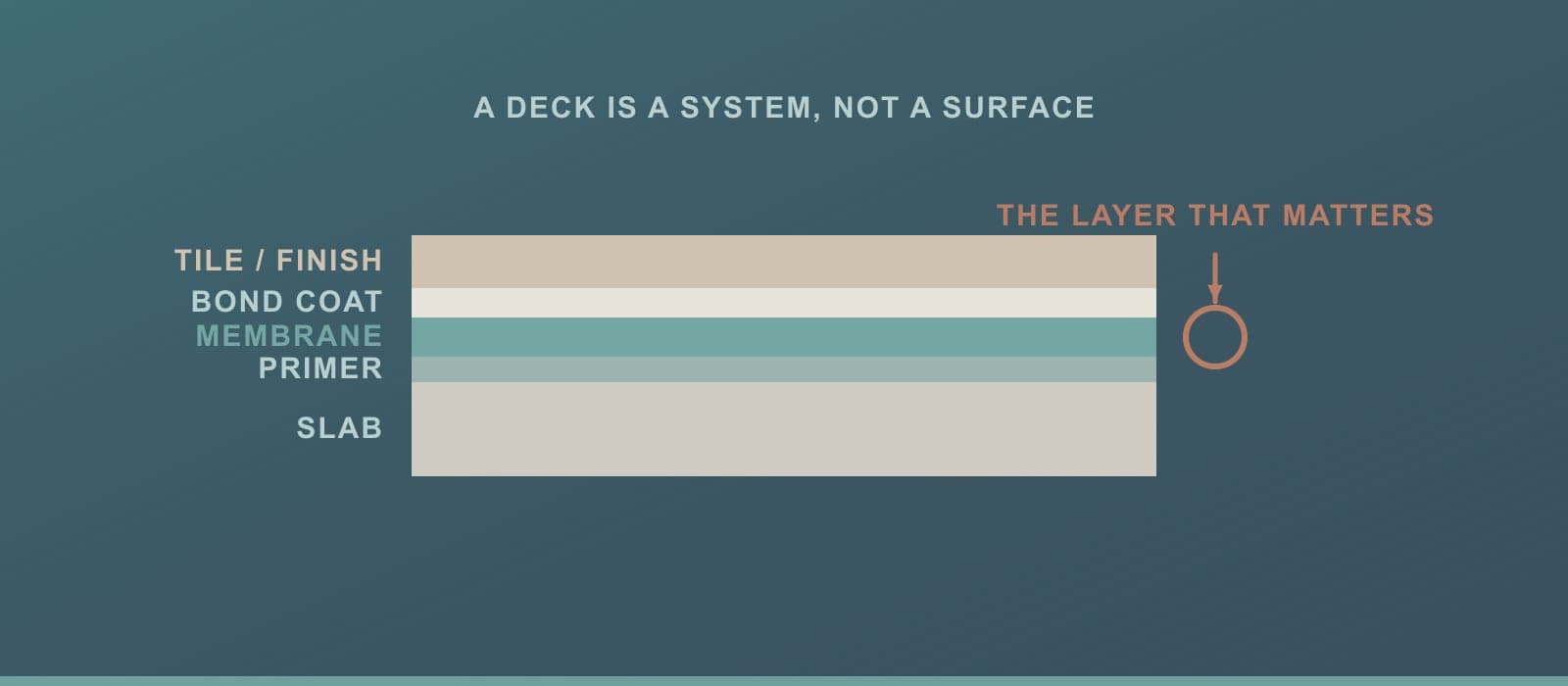
A finished balcony looks like a single surface, but a coastal balcony is really a layered assembly, and water gets in wherever a layer is weak:
- The structural slab: usually reinforced concrete (sometimes post-tensioned), pitched slightly to drain.
- The waterproofing membrane: the layer that actually stops water. On exposed, walked-on balconies this is almost always a liquid-applied traffic coating, not a buried sheet membrane.
- Reinforcing detail at transitions: a fabric or fleece embedded in the coating where the deck meets the wall, at door thresholds, and around railing posts. These transitions are where most leaks start.
- The wear surface and UV topcoat: an aliphatic (UV-stable) topcoat, often with a broadcast aggregate for slip resistance. This is the sacrificial layer that takes foot traffic, sun, and abrasion so the waterproofing underneath survives.
A "traffic coating" is named for the load it carries. Pedestrian traffic coatings protect balconies, walkways, and roof decks. Vehicular traffic coatings are the heavier-build systems used in parking garages, where tires, turning, and point loads demand a thicker, tougher membrane. The two are not interchangeable. Putting a light pedestrian coating in a drive lane is a common, expensive mistake.
These systems are manufactured to a recognized standard: ASTM C957, the specification for high-solids, cold liquid-applied elastomeric waterproofing membranes with an integral wearing surface. When a board sees "ASTM C957" on a proposal, that is the spec a real pedestrian deck coating is written to.
Why coastal balconies fail faster than the brochure says
Manufacturers publish service lives based on a properly prepped substrate and a complete, correctly applied system. The Florida coast shortens that clock in three ways:
- Salt and chloride. Salt-laden air drives chloride into concrete and corrodes embedded steel. As rebar rusts it expands (steel can grow to several times its original volume as it corrodes), and that pressure cracks the slab from the inside, breaking the membrane bond above it. Salt also attacks railing posts and their embedments, opening a direct path for water at every penetration.
- UV and heat. Florida's UV index degrades the topcoat first. A polyurethane system left without an intact UV-stable topcoat will chalk, embrittle, and lose its crack-bridging ability within roughly 5–8 years, well before the membrane's rated life. The topcoat is not cosmetic; it is what keeps the membrane flexible.
- Wind-driven rain. During tropical storms and hurricanes, rain doesn't fall. It's pushed horizontally into door thresholds, under railing bases, and against the deck-to-wall joint. A coating that sheds vertical rain can still leak under a 60-mph horizontal push if the transition details are tired.
The result: an inland balcony coating might run its full rated life, while the same product on an oceanfront building in Singer Island, Sunny Isles, or Fort Lauderdale Beach may need attention years sooner. Cadence on the coast is shorter: by design, not by defect.
How to read a failing balcony: the early-warning checklist
Most balcony leaks announce themselves months before they reach the unit below. Train your staff and your residents to report these signs:
- Ponding water that lingers after rain, especially at the sliding-door track, the lowest and most leak-prone spot on most balconies.
- Loose, drummy, or cracked tile (on tile-over-membrane balconies). A hollow sound underfoot means the bond (and often the membrane) has let go beneath it.
- Blistering, bubbling, or peeling of the coating, or soft, spongy spots underfoot: signs water is already trapped between the topcoat and the slab.
- Rust staining bleeding from railing posts, the slab edge, or the underside drip edge. Rust stains are the visible signature of corroding embedded steel: a structural signal, not just a cosmetic one.
- Cracked or separated flashing/sealant where the deck meets the building wall, and at thresholds. The deck-to-wall transition is the single most common balcony failure point.
- Ceiling or wall stains and bubbling paint in the unit below: the leak's downstream evidence, often the first thing a resident reports.
A useful rule for boards: by the time a stain shows up in the ceiling below, water has usually been migrating through the assembly for months, rusting connectors and saturating the slab edge the whole time. Early coating maintenance is cheap; deferred maintenance turns into concrete restoration.
Recoat, refresh, or replace? A decision framework
Not every worn balcony needs a tear-off. The right intervention depends on how far the failure has progressed:
1. Topcoat refresh (lightest, longest-interval option). If the waterproofing membrane is intact but the UV topcoat and aggregate are worn, the deck can be cleaned, prepped, and re-topcoated. This restores slip resistance and UV protection and resets the wear clock (typically appropriate on a healthy system every several years, well before the membrane is exposed).
2. Full recoat over existing. If the wear layer is gone but the slab and membrane base are sound, the deck can be re-primed and recoated with a full pedestrian traffic-coating system. This is the workhorse mid-life intervention on coastal balconies.
3. Tear-off and rebuild the assembly. If the membrane has delaminated widely, water has reached the slab, or there's spalling, exposed rebar, or structural cracking, coating over the problem only hides it. The correct sequence is: remove the failed system, perform concrete restoration (chip to sound concrete, treat or replace corroded steel, patch with a repair mortar), re-establish proper slope and drainage, then install a fresh membrane with reinforced transitions and a UV-stable topcoat.
The trap boards fall into is paying for option 2 when the building needs option 3: a fresh coating sprayed over rusting rebar looks new for a season and fails fast, because the corrosion underneath never stopped. A proper scope starts with sounding the deck (tapping for the hollow "drummy" areas that signal delamination) before anyone quotes a coating.
Rough cadence and cost ranges for budgeting
Use these as planning ranges only. Actual numbers depend on height/access, the existing system, and how much concrete repair the deck needs once it's opened up.
| Intervention | Typical coastal cadence | Planning cost range* |
|---|---|---|
| Annual visual inspection + sealant touch-ups | Every year + after named storms | Lowest; maintenance line item |
| Topcoat / wear-layer refresh | Periodically within the membrane's life | Lower end of coating cost |
| Full pedestrian traffic-coating recoat | Roughly every 7–10 years on the coast | ~$7–$15 / sq ft for the membrane system |
| Tear-off + concrete restoration + new system | When the membrane and/or slab have failed | ~$25–$40 / sq ft, plus $25–$38 / sq ft where structural/rebar repair is involved |
*Cost ranges synthesized from Florida balcony-waterproofing cost sources; treat as order-of-magnitude planning figures, not a quote.
The economic argument writes itself: a building that funds annual inspections and a recoat on schedule spends in the single-digit dollars per square foot. A building that waits until the slab is leaking spends several times that, and often funds it through an emergency special assessment instead of a planned reserve.
Named systems: what goes on a coastal balcony
Beachfront installs manufacturer-certified pedestrian and vehicular traffic-coating systems and matches the system to the deck's exposure and traffic. Examples of the certified-applicator product families used on coastal Florida balconies and walkways:
- Sika Sikalastic®-726 Balcony One Shot: a two-component, aliphatic, chemically-cured elastomeric polyurethane pedestrian membrane that can be applied in a single coat and cures to foot traffic in about 8 hours, which limits disruption to residents.
- Sika Sikalastic® DeckPro: a one- and two-component balcony/deck line with UV-stable aliphatic topcoats in standard and custom colors.
- Tremco Vulkem® OC810: a single-component, high-solids, UV-stable polyurethane with a rubber-aggregate wear surface, built for exposed light-pedestrian balconies and roof decks.
- Tremco Vulkem® 350/351: a two-coat composite system (tough-curing PU base + UV-stable topcoat) for heavier pedestrian walkways and breezeways.
The right answer depends on traffic, exposure, color, and whether the deck is tiled or exposed, which is why a coating spec should follow a deck condition assessment, not precede it. Because Beachfront self-performs both the concrete restoration and the waterproofing, there's no finger-pointing between a "concrete guy" and a "coating guy" when a deck needs both.
How balcony waterproofing connects to Florida's inspection laws
For boards, the maintenance question is inseparable from the compliance calendar. Three frameworks intersect on a balcony:
HR-7020 balcony inspections (every 3 years). Under Florida Statutes §509.2112 and FAC Rule 61C-1.002, public lodging establishments (including condominium or apartment units rented to the public) must have balconies, decks, stairways, and railings inspected every three years, documented on DBPR Form HR-7020. The requirement generally applies to elevated structures 17 feet or more above grade; ground-level decks under about 3 feet are typically exempt. This inspection is about structural safety of the platform and railings: exactly the things a failed waterproofing membrane quietly undermines from below.
Milestone inspections (SB 4-D, §553.899). Condominium and cooperative buildings three or more stories tall must complete a structural milestone inspection at 30 years and every 10 years thereafter, or starting at 25 years where the local enforcement agency determines that local circumstances, including environmental conditions such as proximity to salt water, require it. A leaking, spalling balcony is one of the visible conditions a Phase I milestone inspection flags, and unresolved water intrusion can escalate it to a Phase II evaluation.
Structural Integrity Reserve Study (SIRS, §718.112(2)(g)). Condo and co-op buildings three or more habitable stories tall must complete a SIRS at least every 10 years, and waterproofing is a mandatory reserve component. That means balcony and deck waterproofing isn't a discretionary repair a board can defer indefinitely. It's a line the reserve study expects to see funded.
The practical takeaway: don't treat the balcony coating as a cosmetic refresh. Treat it as a funded reserve item whose cadence should be documented alongside your HR-7020 cycle, your milestone date, and your SIRS. A board that can show a maintained balcony system and a clean inspection paper trail protects both its residents and its property value.
Why surface prep and detailing decide the outcome
Two balconies coated with the same premium product can perform very differently, and the difference is almost always prep and transition detailing, not the bucket. A coastal balcony coating only lasts its rated life if:
- The deck is cleaned to a sound, contaminant-free substrate (salt, old coating, and laitance removed), often by a controlled soft wash or mechanical prep rather than blasting that damages the slab.
- All cracks and spalls are repaired and the slab is re-sloped to drain. Water that ponds will find the weakest detail eventually.
- The membrane is reinforced with fabric at every transition: deck-to-wall, door thresholds, scuppers, and around each railing post penetration.
- A full-thickness, UV-stable topcoat is applied. Skimping here is the single most common reason a coastal coating dies years early.
This is craft work, and it's why a licensed, insured contractor with W-2 crews and certified-applicator training will outlast a low bid that sprays a thin coat over a dirty deck.
Frequently Asked Questions
How often should a Florida condo re-waterproof its balconies?
Plan on a full pedestrian traffic-coating recoat roughly every 7–10 years on the coast, with a lighter topcoat refresh in between and an annual visual inspection plus a check after every named storm. Salt air, UV, and wind-driven rain shorten the interval compared to inland buildings, so let condition, not just the calendar, drive the decision. A drummy, blistered, or rust-staining deck needs attention regardless of age.
What's the difference between a balcony "traffic coating" and regular waterproofing?
A traffic coating is a waterproofing membrane engineered to be walked on (or driven on). It pairs a flexible, liquid-applied elastomeric base (usually polyurethane, built to ASTM C957) with a UV-stable topcoat and a slip-resistant aggregate. Standard wall or below-grade waterproofing isn't built to take foot traffic, abrasion, and direct sun, so it can't substitute for a deck system.
Is my condo required to have its balconies inspected in Florida?
If your building has units rented to the public and balconies 17 feet or more above grade, the structure must pass a balcony inspection every three years under §509.2112, documented on DBPR Form HR-7020. Separately, condo and co-op buildings three or more stories tall face milestone inspections (at 25 or 30 years depending on coastal proximity) and must fund waterproofing in their SIRS reserve study. These are safety and compliance requirements; a qualified engineer or inspector should confirm what applies to your specific building.
Can a leaking balcony just be recoated, or does it need to be torn off?
It depends on how far the failure has gone. If the membrane base is intact and only the wear layer is gone, a full recoat is appropriate. But if the membrane has delaminated, water has reached the slab, or there's spalling and exposed rebar, recoating over it only hides the problem. The corrosion underneath keeps spreading. In that case the deck needs concrete restoration first, then a new membrane. A proper assessment starts by sounding the deck for hidden delamination before anyone quotes a coating.
Why does Beachfront self-performing the concrete and waterproofing matter?
Because most failed balconies need both concrete repair and a new membrane, and when one contractor does the repair and another does the coating, warranty disputes and finger-pointing follow any future leak. Beachfront Commercial Services is licensed and insured (CGC #1537131 · CCC #1333921 · CCC #1333373), self-performs concrete restoration and waterproofing with its own crews, and installs manufacturer-certified traffic-coating systems, so one accountable team owns the deck from sound substrate to finished, walk-on surface.
Beachfront Commercial Services is a licensed and insured Florida commercial contractor serving condominiums, HOAs, and commercial properties, with coastal properties as our specialty. This article is general information for planning purposes and is not engineering or legal advice; structural conditions and inspection obligations should be evaluated by a Florida-licensed professional.
Ready to Protect Your Property?
Tell us about your building and a Beachfront estimator will follow up with a clear scope and fair pricing.