Compliance
How South Florida Condo Boards Avoid Special Assessments With Preventive Maintenance
Special assessments are usually deferred maintenance with a deadline. Here's how South Florida condo and HOA boards use scheduled envelope maintenance (roofing, waterproofing, paint, and concrete) to avoid six-figure surprises and even lower their reserve contributions.
Beachfront Commercial Services ·
A South Florida condo can no longer legally avoid funding its reserves, but it can still avoid most special assessments by spending small, scheduled dollars on building-envelope preventive maintenance, because deferred coastal repairs typically cost three to five times more once they become emergencies, and a maintained roof, coating, or balcony lasts longer, which actually lowers the reserve contribution the building has to collect. That is the part of the "how do we avoid a special assessment" conversation that reserve-study firms and engineers rarely finish: they tell boards in Palm Beach, Broward, and Miami-Dade to fund the reserve and order a study, both true, but they stop short of the physical work that determines whether the next roof or balcony project lands on schedule and on budget, or arrives early as a six-figure surprise.
This guide is for the board member or community association manager (CAM) who has seen the headlines and wants the maintenance playbook behind them. It is general information for planning, not legal, engineering, or financial advice; confirm specifics with your association's attorney, your reserve professional, and a licensed contractor.
A special assessment is usually deferred maintenance with a deadline
It helps to separate three things boards constantly blur together:
- Regular assessments (dues) fund the annual operating budget: landscaping, management, insurance, routine upkeep.
- Reserves are money set aside on a schedule for predictable major repairs and replacements (roof, paint, waterproofing, concrete) so the cash is there when the component reaches the end of its life.
- A special assessment is any charge levied outside that plan: the bill that arrives when an expense is necessary but the reserve was underfunded, the work was put off, or a sudden failure outran the budget.
Framed that way, the pattern in South Florida becomes obvious. The headline assessments of the past few years were not, for the most part, caused by sudden structural failure. They were the predictable result of years of deferred maintenance, exposed the moment Florida's new inspection laws forced buildings to look honestly at their condition. Residents at The Cricket Club in North Miami faced assessments reported as high as $134,000 per unit in 2024; at Mediterranean Village in Aventura, some owners were reportedly assessed up to $400,000. Across the state, post-Surfside special assessments of $10,000 to $100,000+ per unit have become common, with many buildings landing somewhere in the $500 to $50,000+ per unit range depending on scope and how long the work was postponed.
The lesson coastal boards should take is not "buildings are falling apart." It is that the cheapest moment to address envelope deterioration is years before it becomes a finding, and the most expensive moment is after a milestone inspector writes it up.
Why the old way of avoiding assessments is now illegal
For decades, many Florida condos kept dues artificially low by deferring maintenance and voting to waive or reduce reserve contributions. That escape hatch is closed. Under Senate Bill 4-D (2022), Senate Bill 154 (2023), and House Bill 913 (2025), condominium and cooperative buildings that are three or more habitable stories must complete a Structural Integrity Reserve Study (SIRS) and, for budgets adopted on or after the applicable date, owners can no longer vote to waive or underfund the SIRS reserve components. Those components are spelled out in Fla. Stat. §718.112(2)(g): the roof; load-bearing walls and primary structural systems; fireproofing and fire-protection systems; plumbing; electrical; waterproofing and exterior painting; windows and exterior doors; and any other item over the statutory threshold whose neglect would harm those systems. HB 913 also requires the SIRS to show a baseline funding plan that keeps the reserve cash balance above zero.
Read that list again: roof, waterproofing, exterior painting, and the concrete behind structural members are building-envelope scopes, exactly the work a coastal contractor performs. With waiving off the table, preventive maintenance is now the only remaining lever a board has to keep its numbers down. You can no longer make the problem disappear with a vote. You can only make each component last longer and fail later, and that is a maintenance question.
The number reserve-study firms leave out: deferred work costs 3–5× more
The financial case for preventive maintenance is well established in facilities management, even if it rarely shows up in a condo-board memo. Commonly cited figures include the U.S. Department of Energy's estimate that every $1 spent on preventive maintenance saves roughly $4 in future reactive repair, and the facilities-management rule of thumb that deferred maintenance costs 3 to 5 times more when it is finally addressed as an emergency. The cost of postponed work tends to escalate around 20% per year, and when one neglected component takes others down with it, the multiplier climbs further. (These are industry ranges from facilities-management sources, not a Beachfront measurement; use them for planning, not as a quote.)
On the South Florida coast, those multipliers run hot. Salt-laden air, near-constant humidity, intense UV, and wind-driven rain attack the envelope faster than they do inland, so the gap between "maintain it on schedule" and "replace it after it fails" is wider here than the national averages suggest. A coating that might last a decade in a dry climate is on a shorter clock three blocks from the Intracoastal, and the failure it triggers is usually concrete, which is the most expensive thing on the building to fix.
The maintain-vs-replace table every board should keep
Here is the comparison the reserve-study guides never build: for each major envelope component, the inexpensive scheduled action, the coastal cadence, and the expensive failure it is designed to prevent. The dollar figures are South Florida planning ranges that vary with access, height, and condition.
| Component | Preventive action (the cheap, scheduled spend) | Coastal cadence | What it prevents (the expensive failure) |
|---|---|---|---|
| Facades & roofs: cleaning | Soft wash (low pressure + biocide) to remove algae, salt, and chalk | 1–2× per year by exposure tier | Trapped moisture and biological growth that shorten coating life and stain, and a wrong high-pressure wash that voids paint/roof warranties |
| Exterior paint / elastomeric | Recoat on cadence; spot-repair and re-seal cracks early | ~7–12 years (sooner on ocean/Intracoastal elevations) | Coating breakdown that exposes stucco and CMU to water, leading to spalling and full re-prep |
| Sealant joints | Inspect and replace failed urethane/silicone joints | Inspect yearly; replace ~10–20 yr | Water entry at the joints that rots substrate and corrodes embedded steel |
| Balcony & deck waterproofing | Topcoat refresh / recoat the traffic membrane (~$7–15/SF) | Recoat before the wear layer fails (~7–10 yr) | Full membrane tear-off (~$25–40/SF) plus concrete repair and a balcony-inspection finding |
| Flat / low-slope roof | Restoration coating on a sound membrane (often ~50–70% less than replacement) | Per system; correct ponding early | Premature tear-off, interior water damage, and an insurance non-renewal over roof age |
| Concrete | Seal hairline cracks; address rust staining early | At first sign; map annually | Chloride-driven rebar corrosion and spalling repair at ~$50–150+/SF with structural scope |
Each row is a small operating-budget line item standing in front of a large capital project. Skip the $15-per-square-foot balcony recoat and you are not saving $15. You are scheduling the $40-per-square-foot tear-off, the concrete repair underneath it, and the milestone write-up that makes both non-negotiable.
How the failures actually chain together on the coast
Special assessments rarely come from one component failing in isolation. They come from one skipped task cascading into three expensive ones. A few real-world coastal chains:
- Skip the wash → lose the paint → lose the wall. Algae and salt left on a north-facing, shaded elevation hold moisture against the stucco. The coating fails years early; water reaches the CMU and the embedded steel; what could have been a routine recoat becomes stucco re-prep over active spalling.
- Skip the balcony recoat → fail the balcony inspection. The traffic-coating wear layer thins, water tracks to the slab edge and railing posts, rust expands the concrete, and the next inspection cycle turns a maintenance item into a structural finding the association must remediate on a clock.
- Ignore ponding → lose the roof early. Standing water on a flat roof that never got a drainage correction or restoration coating shortens membrane life, drives interior leaks, and can put the roof's age, not its coating, at the center of an insurance non-renewal.
- Let sealant joints go → corrode from the joints out. Failed perimeter and expansion-joint sealant is a quiet leak path; by the time stains appear inside units, salt water has been working on the reinforcing steel behind the joint for a long time.
In every chain, the cheap intervention sits at the front and the assessment-sized repair sits at the back. Preventive maintenance is simply the discipline of acting at the front.
The part most boards miss: maintenance can lower your reserve number
Here is the loop that turns preventive maintenance from a safety chore into a financial tool. A reserve study funds each component to the end of its remaining useful life (RUL) at its projected replacement cost. Two inputs drive the annual contribution: how many years until replacement, and how much that replacement will cost. Documented preventive maintenance, and a contractor's condition assessment showing a component is sound, can extend the RUL the reserve professional assigns and defer the replacement cost further into the future. Push the replacement year out and the same dollar amount gets collected over more years, which lowers the required annual reserve contribution.
In other words, maintenance is not only how you avoid the special assessment; it is also how you ease the regular one. The building that keeps clean maintenance records and credible condition data hands its reserve analyst the evidence to assign realistic, longer service lives instead of conservative worst-case ones. The building that defers everything hands the analyst nothing but age, and gets funded as if every component is about to fail at once.
A board's preventive-maintenance operating plan
You do not need a complicated program. You need a repeatable one:
- Build an envelope maintenance calendar keyed to the components above (wash, coating, sealant, balcony, roof, concrete), with a cadence for each and a responsible party (usually the CAM coordinating a licensed contractor).
- Document everything for the SIRS and milestone record. Photos, dates, scopes, and contractor condition reports are what let your reserve professional credit the maintenance with extended RUL. Undocumented work helps the building but not the funding math.
- Sequence preventive maintenance around the milestone inspection. South Florida buildings face the milestone inspection at 30 years (25 years within three miles of the coast) under §553.899; a building that has maintained and documented its envelope walks into that inspection with fewer findings and a shorter remediation list.
- Fund it from the right bucket. Routine preventive maintenance generally belongs in the operating budget; component replacement is the reserve-funded event. Keeping the small stuff in operating is what keeps the reserve intact for the big stuff.
- Keep the inspector and the contractor honest and separate. Under HB 913, a firm performing your SIRS must disclose in writing if it also intends to bid the repair work. Transparency protects the board: the professional who diagnoses the building should not be the only one quoting the fix.
Where Beachfront fits, and where it doesn't
Honesty about roles matters here. Beachfront Commercial Services is not your reserve-study or SIRS provider. That work belongs to a Florida-licensed engineer (ch. 471), architect (ch. 481), or a credentialed reserve specialist. Beachfront is the licensed contractor that performs the preventive envelope work the deferred-maintenance problem requires, and whose condition assessments and cost estimates feed the RUL and replacement-cost inputs your reserve professional needs.
That is a useful position for a board, because the company that self-performs the work is the one that can both diagnose a failure chain and stop it. Beachfront is licensed and insured (DBPR CGC #1537131, CCC #1333921, CCC #1333373) and self-performs across the full envelope: commercial and residential painting (including electrostatic), roofing, waterproofing and sealants, concrete restoration, and pressure cleaning, using certified-applicator coating systems. Because the painting crew, the waterproofing crew, and the concrete-restoration crew are the same company, the structural half and the protective half of a job don't get split between subcontractors who each blame the other when a coating fails over an unrepaired crack. For boards across Palm Beach, Broward, and Miami-Dade, that means one accountable partner for the scheduled maintenance that keeps special assessments off the agenda.
Frequently Asked Questions
Can preventive maintenance really keep our condo from ever having a special assessment?
It can't guarantee zero (hurricanes, hidden defects, and aging systems can still force unplanned spending), but consistent envelope maintenance dramatically reduces both the frequency and the size of special assessments. Deferred coastal work typically costs three to five times more as an emergency than as scheduled maintenance, so catching failures early is the single biggest thing a board controls. Combined with properly funded reserves, a documented maintenance program is the most effective protection against six-figure surprises.
Doesn't Florida law require us to fund reserves anyway, so why bother with maintenance?
Yes. Buildings three or more habitable stories can no longer waive SIRS reserve funding, so you must collect for replacements regardless. Maintenance is what keeps that collection affordable. By extending each component's remaining useful life, documented preventive maintenance lets your reserve professional defer replacements and spread the cost over more years, which lowers the annual contribution. Maintenance and reserves aren't alternatives; maintenance makes the reserve math easier.
Is deferring maintenance to keep dues low ever the cheaper option?
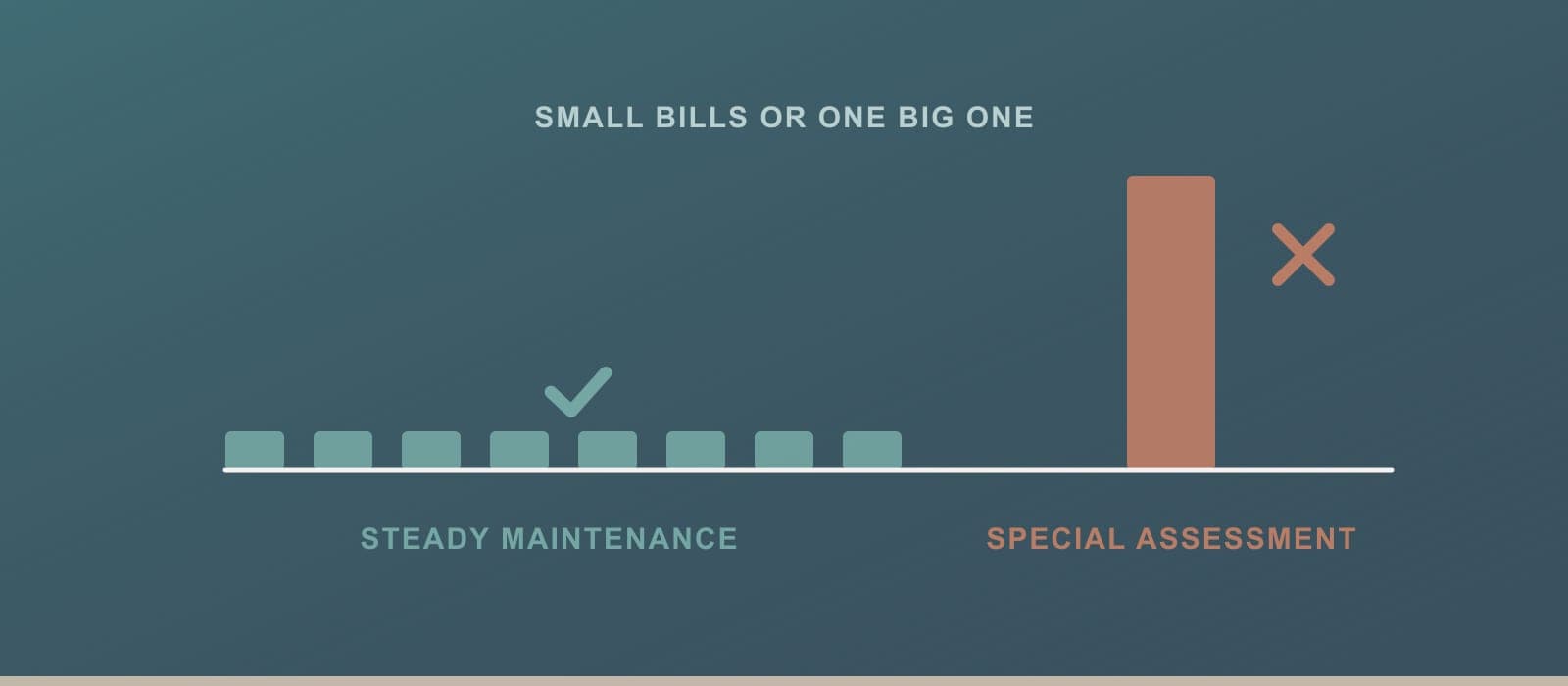
Almost never, and on the coast it's the most expensive choice a board can make. Postponed work escalates roughly 20% a year, and a single neglected component (a failing coating, a worn balcony membrane, an unaddressed roof leak) usually takes more expensive systems down with it, especially the concrete. Low dues funded by deferral simply convert a series of small, predictable bills into one large, urgent one.
What maintenance should a coastal condo board schedule first?
Start with the cheapest tasks that protect the most expensive components: a proper soft wash one to two times a year to keep salt and algae off the envelope, an annual inspection of sealant joints and balcony coatings, and prompt attention to any rust staining or cracking on concrete. Then put exterior recoating and roof restoration on a documented cadence (roughly every 7–12 years for coatings, per-system for roofs) before the existing systems fail rather than after.
How does preventive maintenance connect to our milestone inspection and SIRS?
A maintained, documented building enters its milestone inspection (due at 30 years, or 25 years within three miles of the coast) with fewer findings and a shorter remediation list, and gives its SIRS provider credible condition data to assign realistic service lives. The contractor performing the maintenance isn't the inspector (keep those roles separate), but the maintenance records you generate are exactly what make both the inspection and the reserve study go smoothly and cost less.
This article is general information for South Florida condominium and HOA boards and is not legal, engineering, or financial advice. Reserve funding, milestone inspections, and SIRS requirements should be confirmed with your association's attorney, a Florida-licensed engineer or architect, and your reserve professional; maintenance scopes and costs should be confirmed with a licensed contractor for your specific building.
Ready to Protect Your Property?
Tell us about your building and a Beachfront estimator will follow up with a clear scope and fair pricing.